- Set-up date
- February, 2023
- Aquarium decoration
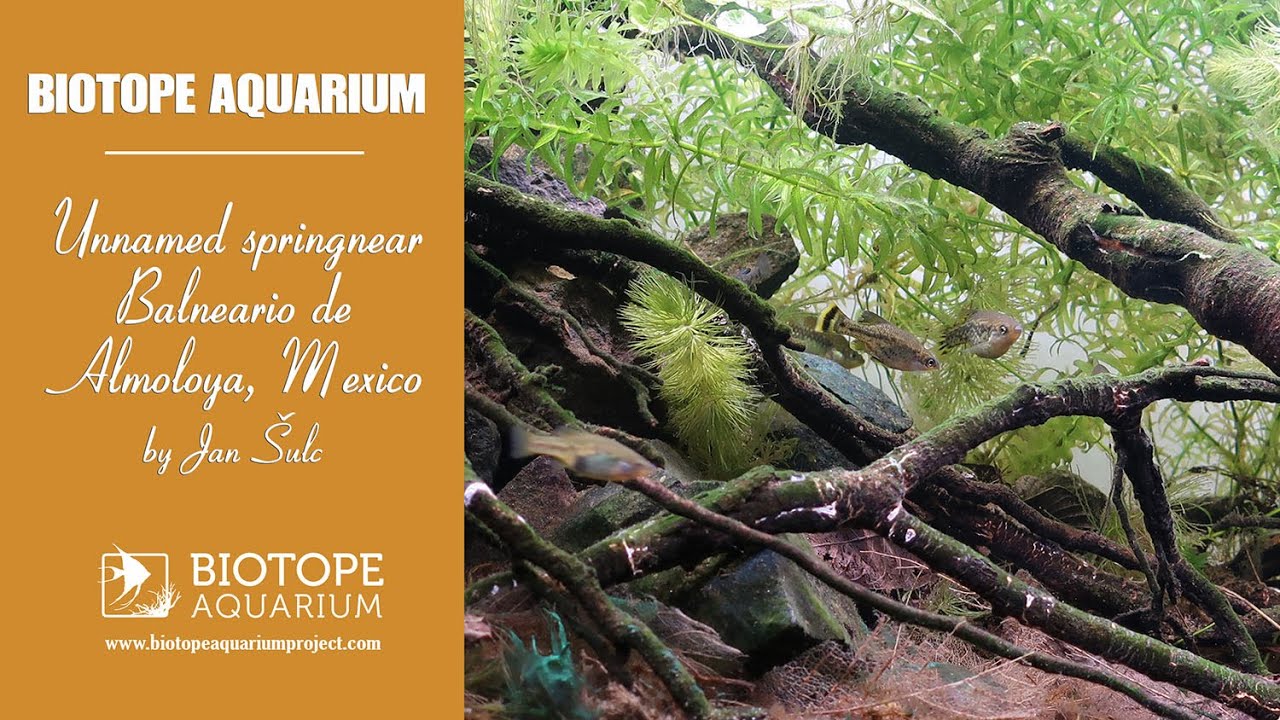
To recreate the habitat of goodeids, I used a mixture of beige fine sand and coarser, multicolored sand, along with small black stones/rocks for the aquarium bottom. The tank is designed to resemble a riverbank that gradually slopes into the water. On the left side of the tank, I created a gentle slope using black and brown stones that I personally collected from nature. I also scattered rock fragments throughout the bottom of the tank.
In the natural habitat, the riverbank is covered with various trees, and their branches and roots extend into the water. To replicate fallen branches and roots, I collected cherry tree branches from the wild and placed them directly in the water. Additionally, I added guava and magnolia leaves on the sand to create a thin layer of leaf litter. It should be noted that it takes a a really long time for them to stop swimming on the surface.
Along the edge of the tank, I planted Eleocharis montevidensis and Hydrocotyle sp. plants to provide shade and shelter, particularly for the Xenotoca doadrioi species. I also introduced several Ceratophyllum demersum plants into the tank, which have naturally attached themselves to branches or stones. In the background of the tank, I planted Egeria densa, which completely covers the rear side of the tank where I applied frosted self-adhesive foil to the backside of the glass. On the right side of the tank, there is Eleocharis montevidensis once again, gradually spreading across the bottom through its runners.
The aquarium’s bottom, along with the branches, rocks and sand, progressively becomes covered with microalgae, which the fish enjoy feeding on. A portion of the aquarium’s water surface is covered with floating plants, specifically Pistia stratiotes, providing further shade and shelter for the fish.
- Aquarium equipment
- External filter Tetra Tec EX 1000 Plus – 1150 l/h.
- Sinkor LED light WRB – 35 Watt, 6000 K, 6487 lm ( running at 80% maximum, the light simulates the sunrise and sunset by gradually brightening and dimming).
- Heater is not needed because during the summer time, the water is warm enough (23-26°C), and during the winter, it is 16-17°C, which the goodeids welcome. This allows them to cease breeding and have a period of rest.
- Fish care
Since the tank is filled with livebearer fish, known for being messy, strong filtration, that provides good mechanical and biological filtration, is necessary.
As the aquarium simulates a shallow spring with the water surface and shore covered by floating plants or terrestrial vegetation – the presence of branches with roots, combined with the floating plants, creates a partially shaded environment in the aquarium, serving as a shelter for the fish.
I feed the fish twice a day. Since goodeids, when mature, prefer food with a predominant plant component, every morning they receive Tetra Phyll flakes with higher plant content and fiber. In the afternoon or evening, the fish receive also dry flakes or pieces of overripe bananas or finely crushed spinach (but not on a daily basis). I have found that they also accept pieces of overripe peaches or apples. Also I have noticed that between feedings, the fish enjoy nibbling on algae from the plants, branches or rocks. To aid in better digestion for fish, I do not use live or frozen food ( such as sludge worms, daphnia, mosquito larvae, blood worms etc.), as recommended by the excellent goodeid breeder and founder of www.goodeidworkinggroup.com Michael Köck.
I change approximately 30% of the water once a week, and also I add a magnesium solution to the new water to prevent spinal deformation by Xenotocas ( as advised by another great goodeid and livebearing fish breeders, Roman Slaboch and Luboš Jedlinský). Unfortunately, one of the adult female Xenotoca has had a spinal deformity since birth, but none of her offspring have shown this deficiency.
Since the goodeids are very prolific, I still have a tank full of fry from all fish species.
Fishlist:
- Xenotoca doadrioi (Goodeidae)
- Ameca splendens (Goodeidae)
- Zoogoneticus purhepechus (Goodeidae)
- Plant care
The aquatic plants in the tank do not require any special care. However, because the floating Pistia consumes a significant amount of nitrate from the water, I add KNO3 to the water once a week and perform a partial water change of about 30% once a week. This is beneficial for both the plants and the fish.
Plants:
- Eleocharis montevidensis (Cyperaceae)
- Elodea densa ( Hydrocharitaceae)
- Hydrocotyle sp. (Araliaceae)
- Ceratophyllum demersum (Ceratophyllaceae)
- Pistia stratiotes (Araceae)
Aufwuchs:
- Water care
Water changes are done once a week at 30% with a tap water. And once a week I add KNO3 to water, because nitrate values are very low, and magnesium solution.