bam Demanding level

Ermenek River, Yerköprü Nature Park, Mersin Province, Turkey

Sponsored by

Turkey, Mersin

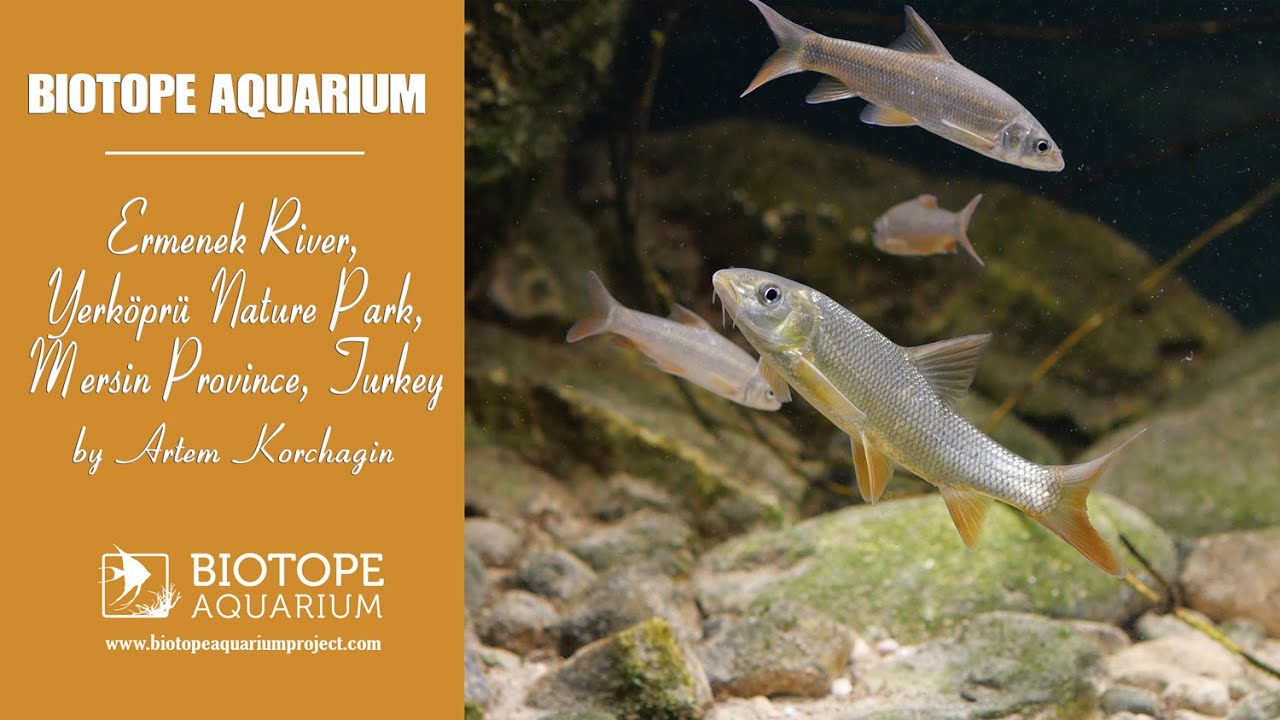
In my 500-liter aquarium, I have recreated a section that simulates the boundary between a deeper, faster-flowing part (the main channel) and a shallower, calmer coastal area (a micro-bay), where the current slows down and, depending on the bottom’s relief, often flows backward along the shore. Many fish are attracted to such zones, spending most of their time here – especially juveniles and young specimens – or visiting briefly.

Additionally, it’s logical and simple to reproduce such a zone in an aquarium with a standard circular water flow. The main feature of the terrain is the irregularly shaped boulders of various sizes – fragments of fallen cliffs (the river here flows through a deep, narrow gorge). The above-water parts of some boulders are covered with a specific plant community. The shallower areas are overgrown in places with reeds and, less frequently, sedges.

I was very impressed by the compact combination of a zone that is convenient for realistic imitation.

Submitted by
Artem Korchagin
Approved by
Friedrich Bitter & Sujoy Banerjee
GPS
36.5346222, 33.2320518
Geographical region
Western Asia
Drainage Basin
Mediterranean sea
River catchment
Goksu river
Water body type
River
Water body name
Ermenek
Water body part
Rapids
Water body course
Upper course
Water body: tributary of
River
Tributary name
Goksu

Videos above and below water


Warning: Undefined variable $fish_parent in /home/biotopea/public_html/wp-content/themes/bap/content-bam.php on line 85

Warning: Undefined array key "additional_species" in /home/biotopea/public_html/wp-content/themes/bap/functions/bap-fields.php on line 349

Water Chemistry

Water information

Water type
fresh-water
Water color
Clear water
Water transparency
Medium
Concentration of sediments
Low
Water temperature
19-23 °C
Water flow/curent
Slow

Chemical parameters

pH
7.6
Conductivity
GH
320 mg/l
dGH
KH
dKH
Dissolved Oxygen

Aquarium information

Aquarium description

Set-up date
May, 2023
Aquarium decoration

I placed large boulders along the edges of the aquarium. The stone in the right corner rises slightly above the water, and on it, in contact with the water, I placed a ready-made clump of plants taken from a similar stone in the river. The base of this clump consists of young willow shoots and their roots, which hold a small amount of soil and several types of herbaceous plants. The space between the stones at the back of the aquarium represents the exit from the shallow micro-bay, a ‘window’ into the deeper, main channel with a stronger current. This current is simulated by the flow along the back wall from the filter outlets, partially hidden behind the right group of stones (for the photo shoot, the outlets had to be removed, and the filters were turned off).

The fish, plants, invertebrates, and most of the stones and substrate were collected from the same river, but in another similar area where collecting is permitted. The stones were collected with their living coverings (Aufwuchs) intact. During the aquarium setup, I used water from the river to preserve as much of the original microflora as possible, gradually adapting it to tap water. Of course, over time, the composition and appearance of the growths on the stones have changed.

The aquarium features three large and very heavy boulders. To protect the glass bottom, I used a substrate under the stones, consisting of a combination of 15mm thick camping foam (on the bottom) and 10mm thick polyethylene cutting boards (on top).

The genus Capoeta is typical for Turkey, with a large diversity of species (around 17 species) found here. In the rivers of central and southern Turkey, Capoeta species often dominate, and in some cases, they are the almost sole fish species in their habitats. Naturally, I wanted to include them in my aquarium. The main challenge is that many species are too large for home aquariums. The Taurus scraper (Capoeta caelestis) found in the Ermenek River, according to available data (which is limited and somewhat inaccurate), does not grow larger than 20 cm; however, I have observed and photographed specimens much larger in the river. I collected very young fish for the aquarium, understanding that they might eventually outgrow the tank, at which point I will return them to their original habitat.

In this section of the Ermenek Creek, aside from the scrapers, I was able to find only one other fish species – Pseudorasbora parva. I also could not find sources reliably confirming the presence of any other fish species in this specific part of the stream. Furthermore, discovering Pseudorasbora parva was unexpected for me – I had not read anywhere that it was present in the Ermenek Creek. As this species is invasive, I decided not to include it in the aquarium.

The river has many Levantine freshwater crabs (Potamon potamios), which are very interesting to me and would have greatly enhanced the aquarium when they were young. However, as they grow, they would become increasingly dangerous to the fish. Additionally, it would be technically challenging to prevent their escape in my aquarium.

I also introduced a group of Luciobarbus pectoralis into the aquarium, despite this species not being present in that specific location. However, Luciobarbus pectoralis are found further downstream in the Ermenek Creek, and although this species is more adapted to calmer waters and soft substrates, they are observed in the same rocky rapids together Capoeta caelestis. I was very interested in observing these somewhat similar species, which are very typical of local rivers, but which also exhibit clear differences in their feeding specialization.

The most characteristic feeding behavior of the scrapers involves sharp strikes with their lower lip, which is adapted into a hard, pointed “scraper” to remove biofilm from rocks. In contrast, the barbs prefer to search for food in soft substrates and among rocks.

In the aquarium, the fish are completely peaceful, both towards their own species and other species.

Aquarium equipment
  • Lighting: OrionLed Plant plus+ 72W, natural sunlight from the window.
  • Filtration: External filter JBL CristalProfi 1900 with standard media (coarse sponge, ceramic rings, plastic bio-balls), internal filter with a flow rate of 3000 l/h (fine sponge + filter wool + activated carbon).
  • Aeration: Achieved by mixing the surface layer of water, combined with the internal filter.
  • The internal filter and the outlets of the external filter are partially hidden behind the stone on the right.
Fish care

The main diet of Scrapers in the wild consists of “aufwuchs” (biofilm) on rocks, which they scrape off — knocking it off — with their lower lip, which has evolved into a cartilaginous scraper. Their diet also includes some invertebrates, mainly Gammarus species and larvae of mayflies and caddisflies. I’ve noticed that they prefer tender unicellular biofilms, while they aren’t very fond of filamentous algae, even young sprouts. Barbels species, on the other hand, are predominantly carnivorous.

I feed the fish dry food for African cichlids based on spirulina, nori seaweed (in the form of sheets for sushi rolls), frozen cyclops and brine shrimp, as well as minced seafood. In my experience, this diet effectively ensures complete and safe feeding for fish with different dietary needs.

Fishlist:

  • Capoeta caelestis (Cyprinidae)
  • Luciobarbus pectoralis (Cyprinidae)

Molluscs:

  • Melanopsis costata (Melanopsidae)
Plant care

The aquarium is positioned by a window, and a significant portion of the light it receives is sunlight. I regulate the duration and intensity of the sunlight using curtains to achieve the desired level of algae growth for the natural feeding of the Capoeta caelestis and the healthy development of the wetland (emergent) plants.

Water care

The values for GH and pH of tap water at my home are similar to those of the Ermenek Creek water, so I simply perform a 30% water change with tap water, filtered through a carbon filter, once a week. I rinse and replace the carbon and filter foam in the internal filter weekly, and rinse the media in the external filter approximately every two months.

Dimensions

Length
160 cm
Depth
65 cm
High
50 cm
Volume
520 L

Substrate in aquarium

Sand
Beige
Pebble/Gravel
Beige
Stone
Beige
Stone form
Irregular
Silt/Mud
Beige
Leaves
None
Driftwood
None
Submerged terrestrial vegetation
Yes

Bibliography

  • J. Anatolian Env. and Anim. Sciences, 6(4), 705-711. - Current Fish Fauna of Göksu River (Turkey) and Evaluation of Its Ecological Status. by Küçük, F., Gülle, İ., Güçlü, S.S. & Turan, D. (2021)
  • Fen Bilimleri Enstitüsü, Mersin Üniversitesi, 2019. - GÖKSU NEHRİ (MERSİN-TÜRKİYE)’NİN BAZI SU KALİTE PARAMETRELERİNDEKİ MEVSİMSEL DEĞİŞİMLER (Yüksek Lisans Tezi) by BOYAR, М.(2019)
  • NEVŞEHIR HACI BEKTAŞ VELI UNIVERSITY GRADUATE SCHOOL OF NATURAL AND APPLIED SCIENCES. - FRESHWATER FISH FAUNA OF MERSIN (MSc Thesis) by G.Temiz (2019)
  • Fresenius Environmental Bulletin 28(4A):2992-3013. - CHECKLIST OF THE FRESHWATER MOLLUSCA OF TURKEY (MOLLUSCA: GASTROPODA, BIVALVIA) by M. Gürlek et al. (2019)
  • Turkish Journal of Fisheries and Aquatic Sciences 7: 53-63. - The Fish Fauna of the Göksu River (Türkiye): Taxonomic and Zoogeographic Features. by F. Küçük et al. (2007)
  • FISHERIES & AQUATIC LIFE (2018) 26: 151 - 158 - A review of the freshwater crabs of Turkey (Brachyura, Potamidae) by M. Harlolu et al. (2018)

Comment by the expert

Friedrich Bitter: The choice of materials and the size of the aquarium create good conditions for observing the natural behaviour of the fish.

Sujoy Banerjee: The aquarium is well presented depicting the actual biotope. As being a river tank adequate water flow is maintained? Large open space allows the fishes to swim while the boulders provide hiding place. Well build biotope aquarium project.