- Set-up date
- June, 2024
- Aquarium decoration
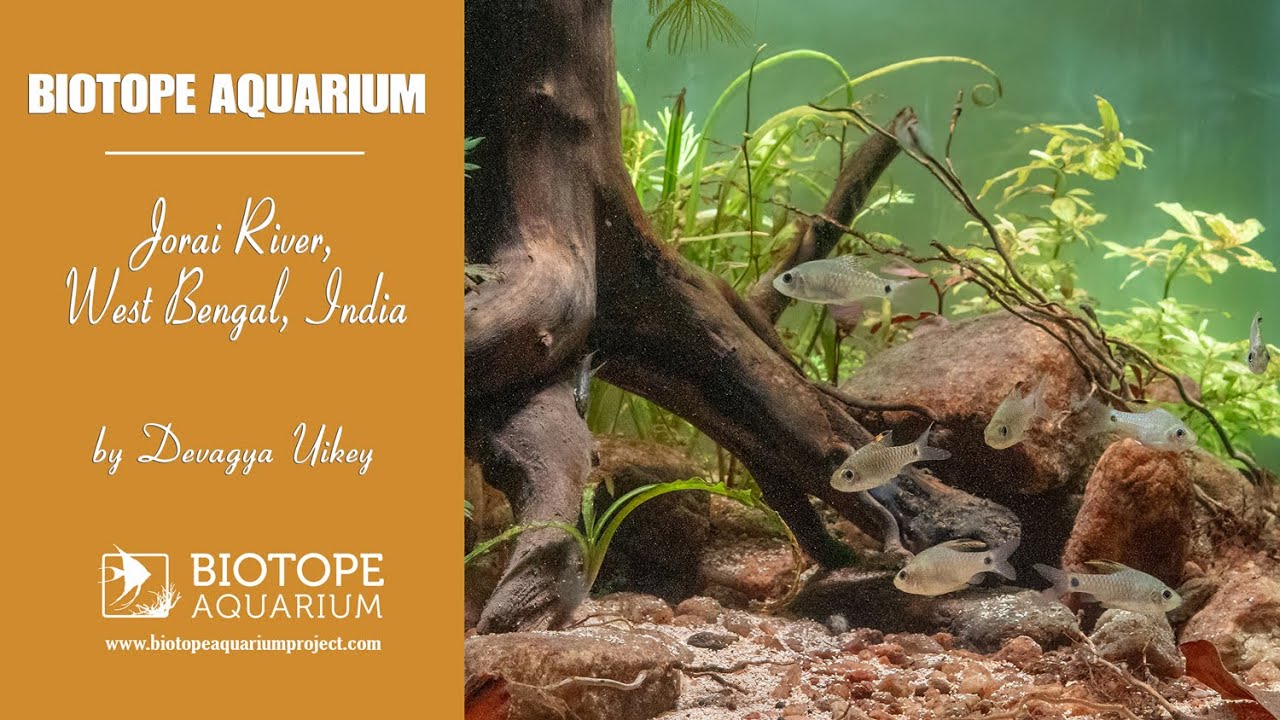
With limited data available online it was very challenging to find the habitat information and create a composition that fits in the 40 cm cube and still provide a visual treat. To get the natural look I decided to go with a tree stump that has thick roots and leaf litter to provide shade and a resting ground, similar to small streams that goes through the forest in CoochBehar district.
The jorai river bed has white sand which is covered with dirt however, there are areas where the sand is visible and Cryptocoryne sp. are scatted across. The similar approach has been taken for this biotope with a mix of sand, pebbles and stones. Plants are mostly added to the back and left side of the biotope allowing majority of the area for free swimming from top to bottom. The plants are selected based on information provided by limited journals and habitat studies available for Oreichthys crenuchoides.
- Stones, Sand & Gravel: Natural river stones, pebbles and gravel were collected from the Mahanadi River (Odisha)
- Driftwood: Indian, derived from the western ghats region (Karnataka)
- Soil: 1L of aquatic soil at the back
- Aquarium equipment
- Filtration system and flow: SunSun HBL 802 – 500 L/H hang-on back filter. The output from the filter has been directed towards the emersed part of the large driftwood so that current is distributed and allows moderate flow across the tank without disturbing the inhabitant’s.
- Light. (Type & Photoperiod): 13W Neo Helios Flat Nano S3 Plus (7 hrs daily)
Fishlist:
- Oreichthys crenuchoides (Cyprinidae)
- Dario dario (Badidae)
- Psilorhynchus sucatio (Psilorhynchidae)
Crustaceans:
- Caridina babaulti (Atyidae)
Aquatic plants:
- Hygrophila difformis (Acanthaceae)
- Hygrophila polysperma (Acanthaceae)
- Cryptocoryne spiralis (Araceae)
- Cryptocoryne retrospiralis (Araceae)
- Cryptocoryne wendtii (Araceae)
- Alternanthera sessilis (Amaranthaceae)
- Ceratophyllum demersum (Ceratophyllaceae)
- Ceratopteris thalictroides (Pteridaceae)
- Fish care
The substrate used provide a similar substrate to the Jorai River bed, and pieces of driftwood and plants offering a safe and natural feel to all inhabitants. The Oreichthys crenuchoides explore the whole tank but mainly remains in the front area, whereas dario remains mostly close to the bed and explore all areas. The water surface area where Ceratophyllum demersum is abundant, shared by dario and caridina babaulti green shrimps. Similar is the case for the backside of the tank with Cryptocoryne sp and Hydrophilia sp. for the breeding ground.
The fish are fed a balanced diet appropriate for their omnivorous feeding habits, ensuring they receive the necessary nutrients to thrive. Including frozen blood worms, tubifex, bug pellets, tropical flakes and algae tablets.
- Plant care
To maintain the healthy habitat and well being of the tropical fishes a variety of aquatic plants like Cryptocoryne, Hygrophila, Ceratopteris and others are included. These plants provide hiding places, breeding grounds, and help maintain water quality, replicating the role of plants in the Jorai River ecosystem.
A moderate lighting schedule (7 hours daily) replicates the natural light cycle of the Jorai River and provide enough time for proper photosynthesis.
A very little amount of fertilizers (6ml) are used every 3 days to provide the essential nutrients required by the plants for healthy, green and lush growth.
- Water care
The tank water chemistry (pH, temperature, hardness) is maintained within a range suitable for the fish species, mimicking the conditions of the Jorai River. Also, dried Indian almond leave are added to keep the water PH near to 7.5.
Furthermore, the 500L/H filter ensures proper water circulation and removes waste products, keeping the water clean and healthy for the fish. It comprises of high quality biological and mechanical media for top class biological filtration. The water flow can be adjusted from moderate to strong water, mimicking the current in the Jorai River streams and encouraging the drape fin barbs natural behavior.
Regular water changes and tank cleaning has been a bi-weekly routine to help prevent the buildup of harmful waste products and maintain good water quality. Also all fishes are wild caught and are very sensitivity to water change so a 50% water is changed to keep the water quality good and well oxygenated.