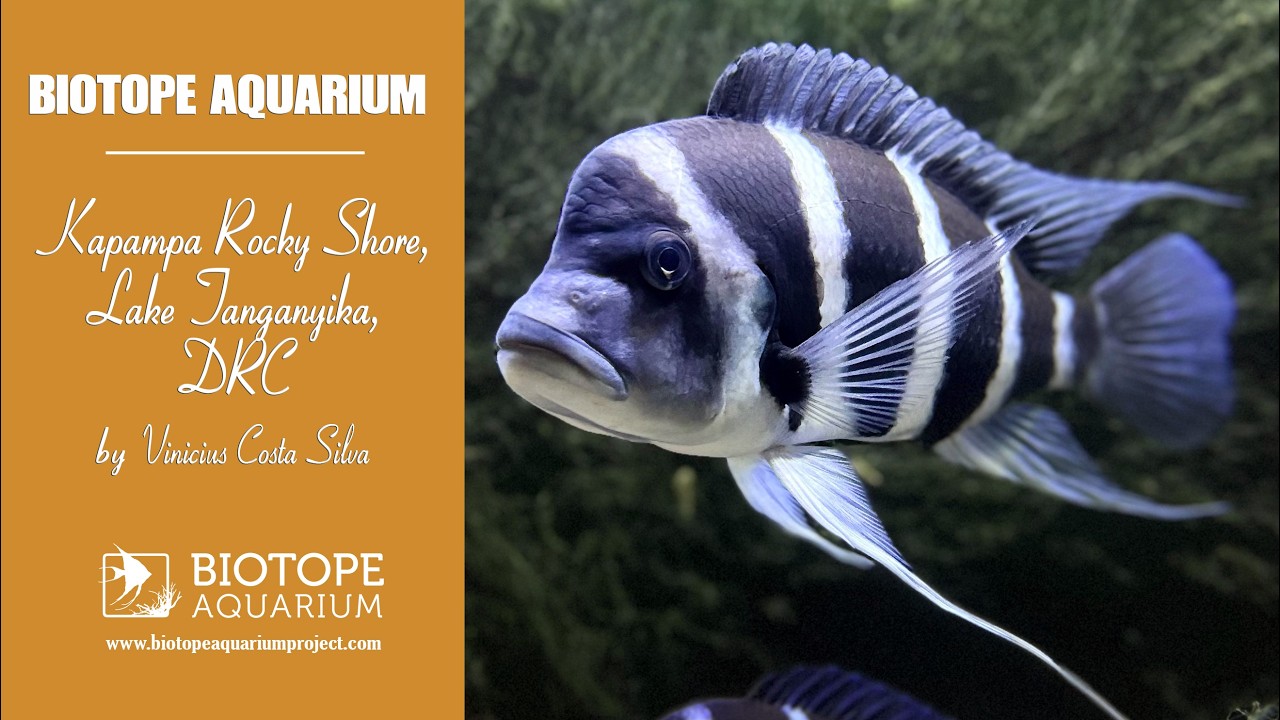
- Set-up date
- September, 2025
- Aquarium decoration
The aquarium was designed to reproduce the intermediate rocky littoral habitat of Kapampa, where scattered rounded boulders gradually transition into open sandy areas. Rounded crystalline rocks of different sizes were arranged over fine, light-coloured sand to recreate the heterogeneous substrate typical of this shoreline, while maintaining extensive open swimming areas and numerous sheltered crevices.
The fish community was intentionally limited to species naturally associated with the Kapampa region. Cyphotilapia gibberosa “Kapampa” was selected as the focal species due to its ecological importance and characteristic use of the rocky-sandy interface. Neolamprologus gracilis and Neolamprologus caudopunctatus complement the community by occupying rocky shelters and transitional habitats, creating a natural distribution of ecological niches.
The aquarium displays behaviours consistent with those observed in nature, including territorial movements around rock formations, shelter utilisation, pair formation, and occupation of different water layers. Restricting the number of species reduces artificial competition and allows natural behaviours to be expressed without excessive territorial conflicts.
Other species recorded from the Kapampa area, including Altolamprologus compressiceps, Julidochromis marlieri, Variabilichromis moorii, and Tropheus spp., were intentionally omitted to maintain ecological balance and keep the focus on the selected fish community. This approach allows the aquarium to represent the habitat structure and ecological relationships of the Kapampa rocky-shore biotope while preserving a stable and natural environment.
- Aquarium equipment
The filtration system consists of a custom-built sump measuring 140×50×60 cm, divided into three compartments to provide efficient mechanical and biological filtration while maintaining a clean appearance within the display aquarium.
The first compartment functions as a sedimentation chamber, allowing suspended particles to settle before the water reaches the filtration media. The second compartment is fully filled with high-porosity ceramic media, providing a large surface area for the colonisation of nitrifying bacteria responsible for biological filtration. A layer of filter floss positioned above the ceramic media provides additional mechanical filtration by capturing fine suspended particles.
The third compartment houses an EHEIM Thermocontrol 250W heater and an 8.000L/h return pump, electronically adjusted to provide an effective flow rate of approximately 3.000 L/h. This configuration ensures stable temperature control, efficient water circulation, high oxygenation, and continuous biological filtration, maintaining the excellent water quality required for a faithful Lake Tanganyika biotope.
- Fish care
Fish welfare is the primary objective of this biotope aquarium. In addition to recreating the visual characteristics of the Kapampa shoreline, the project focuses on reproducing the physicochemical conditions found along the western coast of Lake Tanganyika. Stable water parameters, high oxygenation, and exceptional water clarity are maintained to closely reflect the natural environment, providing optimal conditions for the long-term health, natural behaviour, and well-being of the fish.
The fish are fed once daily with small portions, reflecting the limited and dispersed food resources available in their natural habitat while helping to maintain excellent water quality. Their diet consists of premium JBL pellets supplemented with Dr. Bassleer Biofish Food functional diets enriched with natural extracts such as garlic, açaí, and lapacho. This balanced feeding approach supports immune function, promotes vitality, and contributes to the overall health of the fish.
Fishes:
- Cyphotilapia gibberosa (Cichlidae)
- Neolamprologus caudopunctatus (Cichlidae)
- Neolamprologus gracilis (Cichlidae)
- Plant care
Water chemistry was designed to reproduce the highly alkaline and mineral-rich conditions characteristic of the western littoral region of Lake Tanganyika, including the Kapampa shoreline. Based on limnological data from the lake, target parameters were maintained at pH 9.0, GH 13°dH, and KH 20°dH, providing stable chemical conditions consistent with the natural environment of the resident cichlids.
For each 100 L of replacement water, the following mineral salts were added: 88g sodium bicarbonate (NaHCO₃), 7.6 g sodium carbonate (Na₂CO₃), 70g magnesium chloride hexahydrate (MgCl₂·6H₂O), 9 g calcium chloride dihydrate (CaCl₂·2H₂O), and 7 g potassium sulfate (K₂SO₄). This formulation allows independent control of the main ions (Na⁺, K⁺, Mg²⁺, and Ca²⁺), providing greater precision than commercial Tanganyika salt mixes while closely approximating the ionic composition reported for Lake Tanganyika.
Water changes of 100L are performed every two weeks. Replacement water is prepared 24 hours in advance, dechlorinated, remineralised according to the above formulation, and heated to match the aquarium temperature before use. This procedure ensures stable physicochemical conditions and minimises stress during maintenance.
- Water care