bam Demanding level

#11432 Lion’s Cove, Lake Malawi, East Africa, Malawi

Sponsored by

Malawi, Chadagha

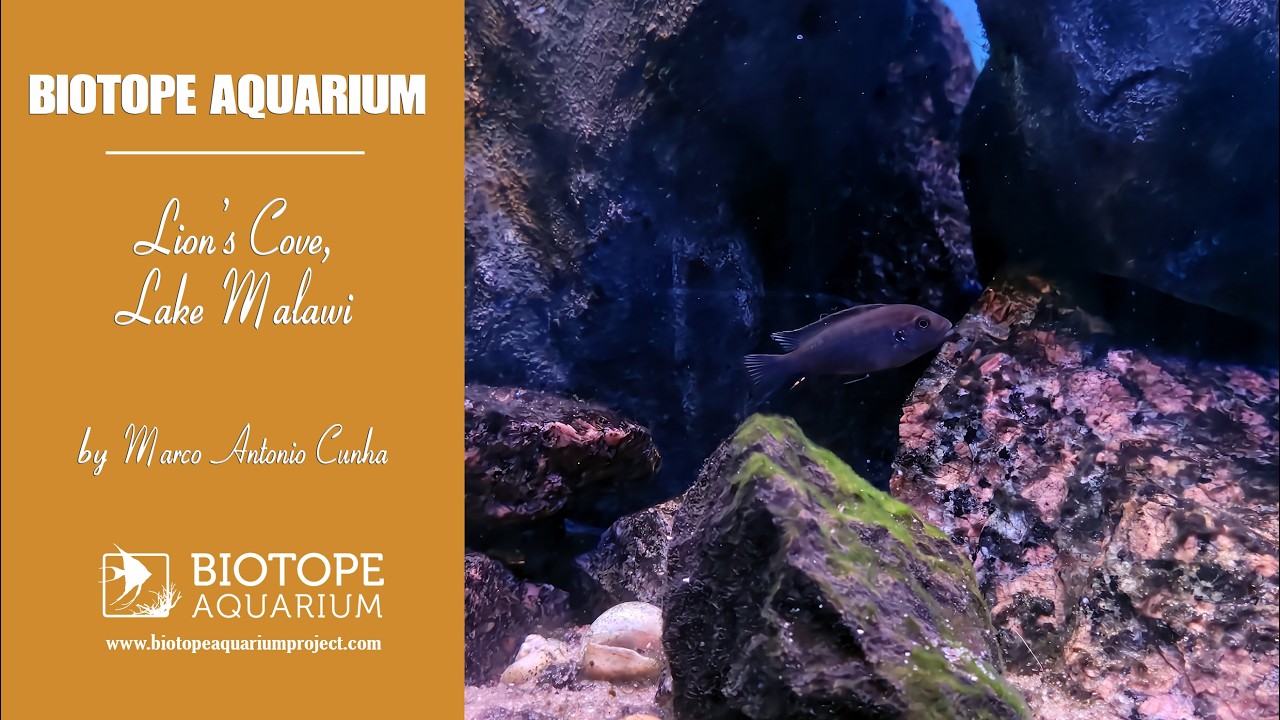
The 200-litre aquarium was inspired by Lion’s Cove, located on the central-western coast of Lake Malawi — a biotope highly representative of the Mbuna (“rock-dwelling fish”) community. It is a single-species setup, inhabited by one male and two females of Pseudotropheus sp. “polit”, a taxon native to this region. The habitat is characterised by steep vertical cliffs descending from the surrounding slopes toward the lake bottom, creating a complex structure of rocky crevices and shelters. Taking advantage of the aquarium’s height (70 cm), rocks and a side background were arranged to recreate the impression of verticality and depth typical of the represented habitat.

Submitted by
Marco Antonio Cunha
GPS
-13.2687206, 33.9301949
Geographical region
Eastern Africa
Drainage Basin
Zambezi River
River catchment
Shire River
Water body type
Lake
Water body name
Malawi
Water body part
Water body course
Water body: tributary of
Tributary name

Videos above and below water

Warning: Undefined variable $fish_parent in /home/biotopea/public_html/wp-content/themes/bap/content-bam.php on line 85

Water Chemistry

Water information

Water type
Freshwater
Water color
Clear water
Water transparency
High
Concentration of sediments
Low
Water temperature
29 °C
Water flow/curent
Slow

Chemical parameters

pH
8.5
Conductivity
GH
dGH
10 °dGH
KH
dKH
10 °dKH
Dissolved Oxygen

Aquarium information

Aquarium description

Set-up date
January, 2026
Aquarium decoration

The decoration is primarily composed of rocks in grey, reddish, and beige tones, aiming to resemble the underwater landscapes documented in the Lion’s Cove region. Two large artificial rocks were combined with smaller stones and a side background, arranged to recreate the structure and appearance of the rocky habitat found along the central-western coast of Lake Malawi.

The environment represents an intermediate rocky habitat characterised by deep crevices at approximately 7-12 metres depth. Below around 5 metres, large rock formations gradually transition into small areas of coarse sand accumulated at the bottom of the crevices, creating a mixed habitat of rocky surfaces and deeper sandy zones. The water in this region is exceptionally clear, allowing strong light penetration that supports the development of a thin aufwuchs layer on the rocks, providing an important food source for herbivorous cichlids.

A blue vinyl panel was applied to the rear glass to enhance the impression of depth and open water. The substrate consists of medium-grained river sand.

Aquarium equipment

I use an Oceantech Noir LED fixture that simulates sunrise and sunset. Despite sunlight penetration, the greater depth of the natural habitat results in a bluish appearance caused by the selective absorption of longer wavelengths, which allows blue light to dominate. For this reason, an additional blue LED bar was installed alongside the main fixture to reproduce this visual effect.

For filtration, I use a 900 L/h Jebo external filter, using only a biological sponge for mechanical filtration and 2 litres of Oceantech ceramic media for biological filtration. Due to the climatic conditions of my region, characterised by low thermal variation and high annual average temperatures, I use a thermostat-controlled ventilation system to maintain the aquarium temperature between 27 and 29°C.

Fish care

Given its dimensions, the aquarium was designed to house only a single species — in this case, one male and two females of Pseudotropheus sp. “polit”, a relatively small but highly territorial Mbuna cichlid.

The lighting is maintained for 10 hours per day at medium-to-high intensity to stimulate the growth of biofilm on the rocks, providing a natural food source for the fish. This reflects the conditions of the represented habitat, where sunlight penetration in shallow and intermediate zones supports the development of aufwuchs, a biological layer composed of algae, microorganisms, and small invertebrates. This biofilm forms the foundation of the local food web and contributes to the strong territorial behaviour characteristic of herbivorous Mbuna cichlids.

Water changes of 25% are performed every two weeks, with the use of buffering products for the correction and maintenance of stable water parameters.

Fish:

  • Pseudotropheus sp. “polit” (Cichlidae)
Plant care
Water care

Water changes of approximately 25% of the total aquarium volume are performed every two weeks. Mineral salts (magnesium chloride, calcium chloride, sodium bicarbonate, and potassium sulfate) are used to adjust water parameters and maintain conditions as close as possible to those found in the natural habitat. The filtration system is cleaned every two months to ensure efficient operation while preserving biological stability.

Dimensions

Length
60 cm
Depth
50 cm
High
70 cm
Volume
200 L

Substrate in aquarium

Sand
Beige
Pebble/Gravel
None
Stone
Grey
Stone form
Irregular
Silt/Mud
Leaves
Driftwood
Submerged terrestrial vegetation

Bibliography

  • Malawi Cichlids in their Natural Habitat by KONINGS, Ad
  • The Cichlid Diversity of Lake Malawi: Results of 30 Years of Field Research by KONINGS, Ad
  • The cichlid diversity of Lake Malawi/Nyasa/Niassa: identification, distribution and taxonomy by SNOEKS, Jos

Sitography

→ MALAWI.SI