bin
Laguna El Arco, Ocoyoacac, Mexico
Mexico, State of Mexico, Ocoyoacac
La Laguna el Arco is located in the Miguel Hidalgo y Costilla National Park, better known as La Marquesa, in the municipality of Ocoyoacac, State of Mexico. In turn, La Marquesa is located in the Central Plateau of Mexico, one of the most extensive mountain systems in the world and is considered by the World Conservation Monitoring Center as one of the most important regions in the world for the conservation of fish. freshwater since here is the main area of freshwater wetlands in the country with a unique diversity of fish, in which the goodeids are one of the most representative groups.
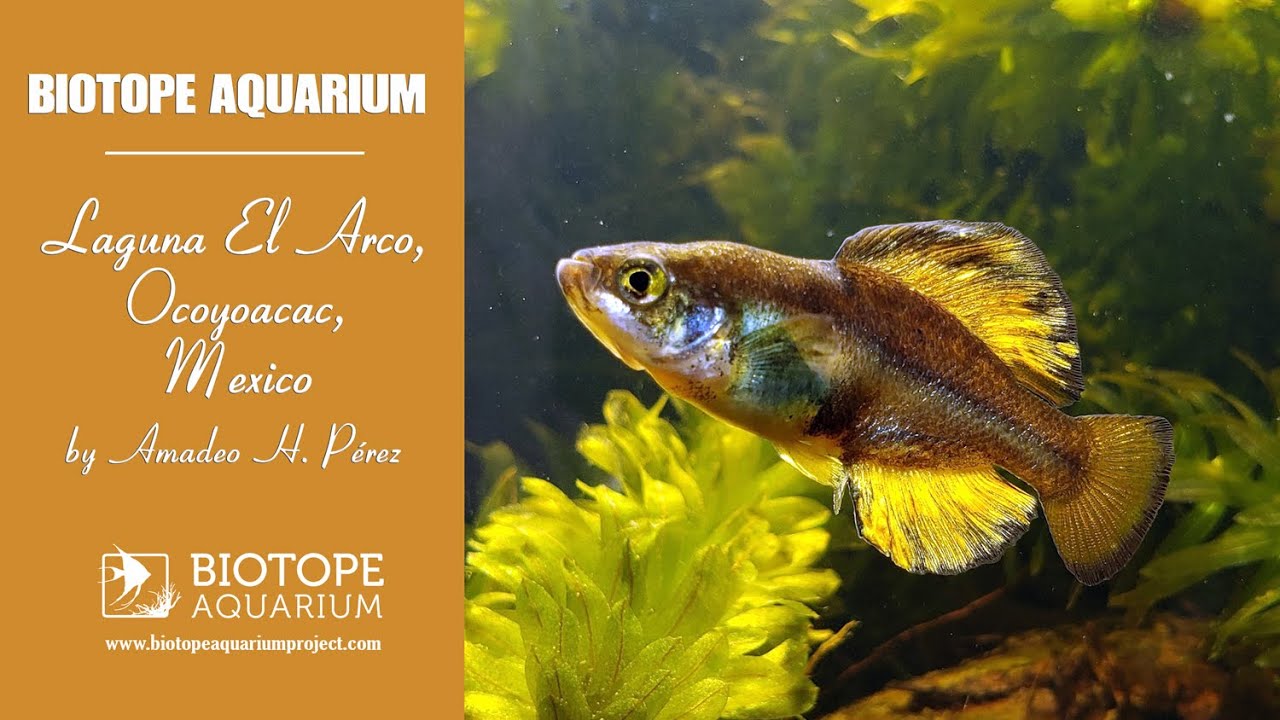
This biotope aquarium represents the marginal area of Laguna el Arco, La Marquesa National Park, where you can find a population of goodeid (Girardinichthys multiradiatus), locally known as Mexclapique, a fish endemic to Mexico with the category of endangered.
- Submitted by
- Amadeo Hernández Pérez
- Approved by
- Michael Köck & Jairo Arroyave
- GPS
- 19.2982750, -99.3763199
- Geographical region
- Central America
- Drainage Basin
- Laguna el Arco
- River catchment
- Parque Nacional la Marquesa
- Water body type
- Laguna
- Water body name
- Laguna el Arco
- Water body part
- Pool
- Water body course
- Water body: tributary of
- Tributary name
Videos above and below water
Warning: Undefined variable $fish_parent in /home/biotopea/public_html/wp-content/themes/bap/content-bin.php on line 55
Water Chemistry
Water information
- Water type
- fresh-water
- Water color
- Clear water
- Water transparency
- Medium
- Concentration of sediments
- Medium
- Water temperature
- 14-18 °C
- Water flow/curent
- Slow
Chemical parameters
- pH
- 7.8
- Conductivity
- GH
- 4 mg/l
- dGH
- KH
- 15 mg/l
- dKH
- Dissolved Oxygen
- 4.1 %
Substrate in nature
- Sand
- Beige
- Pebble/Gravel
- None
- Stone
- Brown
- Stone form
- Roundish
- Silt/Mud
- Beige
- Leaves
- Few
- Driftwood
- Few
- Submerged terrestrial vegetation
- Yes
Aquatic Biotope
- Date of collecting
- 07/05/2024
- Collecting area
- Edge of reservoir
- Water depth
- 0,5m
- Air temperature
- Sunlight
- Full sun
Environment
- Environment
- Human settlements
- Human settlements
- Urban area
- Surrounding area
The lagoon is mainly surrounded by coniferous forest (Pinnus, Abies, Cupressus and Juniperus) and high mountain grasslands, the soil in the area is mainly clay. In this body of water we can find Elodea densa, Hydrocotyle sp., Eleocharis sp., Mimulus sp., Juncus sp., Poa annua, Pennisetum clandestinum and Typha latifolia.
There are waterfowl (Fulica americana and Egretta sp.) and other birds around the lake, such as Turdus migratorius, Junco phaeonotus, domestic Passer, Quiscalus mexicanus. As for reptiles, can be seen lizards (Sceloporus grammicus) and snakes Crotalus triseriatus (range of distribution of the species).
Regarding aquatic fauna, the moderately populated schools of Girardinichthys multiradiatus stand out mainly, which have greater feeding and reproductive courtship activity. Some aquatic snails of the genus Physa and Planorbis are distributed among the colonies of Elodea densa; We can also find the crustacean Cambarellus montezumae locally known as acocil and two species of exotic fish introduced for sport fishing (Oncorhynchus mikiss and Cyprinus carpio). Amphibians make an appearance with frogs of the species Lithobates montezumae.
- Underwater landscape
The lagoon has an approximate length of 150 meters long by 80 meters wide; 85% of its water column is densely populated by large aquatic gardens of Elodea (Egeria dense), its marginal zone ranges between 50-65cm deep and appears crystal clear, making it easy to observe the activity of the Mexcalpique (Girardinichthys multiradiatus) and appreciate the beauty of the biotope as well as its biotic (aquatic flora and fauna) and abiotic (substrate, some roots and very few stones) components. The substrate is clayey and in the event of any aggressive movement the water will become cloudy for a few minutes.
Fishes:
- Girardinichthys multiradiatus (Goodeidae)
- Oncorhynchus mikiss (Salmonidae)
- Cyprinus carpio (Cyprinidae)
Amphibians:
- Lithobates montezumae (Ranidae)
Crustacean:
- Cambarellus montezuma (Cambaridae)
Molluscs:
- Physa sp. (Physidae)
- Planorbis sp. (Planorbidae)
Aquatic plants:
- Elodea densa (Hydrocharitaceae)
- Spirogyra sp. (Zygnemataceae)
Wetland plants:
- Typha latifolia (Typhaceae)
- Juncus sp. (Juncaceae)
- Hydrocotyle sp. (Hydrocotyloideae)
- Threats to ecology
The main threat presented by Laguna el Arco is the illegal logging in the forests around the lagoon. Unfortunately, there is no adequate regularization by local authorities. Another negative point is the poor management that the locals have with the tourism they receive on weekends, the large number of people who come to the site leave garbage and contaminate the area. Another aspect to mention is the introduction of exotic species for sport fishing (Oncorhynchus mickiss and Cyprinus carpio) which have a negative effect since, being exotic species, they
- are predators,
- compete for food resources and
- alter the ecological niche being able to displace local species
Riparian zone
- Trees near the aquatic habitat
-
Many -
Bibliography
-
→ 2007. CONABIO. Biodiversistas 75: 12-15. - Los godeidos, peces endémicos del centro de México.
by Domínguez-Domínguez, O., G, Pérez Ponce de León
-
→ 2007. Ciencia Ergo Sum, vol. 14, núm. 1, marzo-junio, 2007, pp. 63-68 Universidad Autónoma del Estado de México; Toluca, México. - Alimentación de Girardinichthys multiradiatus (Pisces: Goodeidae) en el embalse La Goleta, Estado de México.
by Navarrete-Salgado, Norma A.; Rojas-Bustamante, Margarita L.; Contreras-Rivero, Gilberto; Elías Fernández, Guillermo.
-
→ 2007. Revista Chapingo Serie Ciencias Forestales y del Ambiente 13(a): 15-21, 2007. - Crecimiento, reproducción y supervivencia de Girardinichthys multiradiatus (Pisces, Goodeidae) en el embalse San Miguel Arco, Estado de México.
by Navarrete- Salgado, N. A., Cedillo-Díaz, B. E., Contreras-Rivero, G. y Elias-Fernandez, G.
-
2009. 1ra. Ed. Comisión Nacional para el Conocimiento y Uso de la Biodiversidad, México. Capítulo VI, Familia Goodeidae. - Peces dulceacuícolas de México.
by Rush-Miller, R., Minckley, W. L., Mark-Norris, S.
Comment by the expert
Michael Köck: The biotope has been intensively studied by the participant and described in an adequat way. No complaints.
Jairo Arroyave: Research on this aspect seems sufficient and satisfactory. The description of the habitat is quite detailed and the list of animal and plant appears thorough, and includes fish, amphibians crustaceans, and molluscs, as well as a number of aquatic plants. I think the common name mexclapique applies only to G. viviparus, not G. multiradiatus, though. Video and photo of BIN only from above and not below water. It would’ve been nice to see video of BIN from below the water for comparative purposes with BAM.