bin
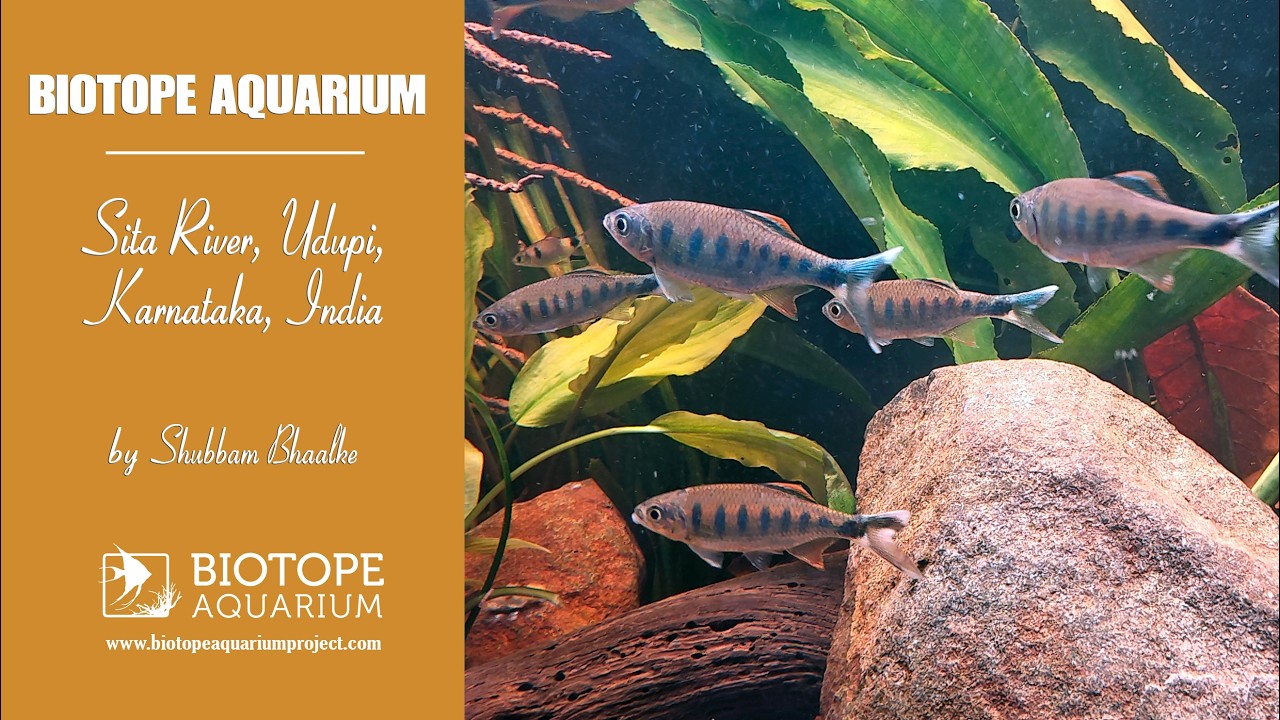
Seetha River, Udupi, Karnataka, India
India, Karnataka, Udupi
The Seetha River is a west-flowing river originating in the Western Ghats of Karnataka and flowing through the Udupi district before entering the Arabian Sea. It supports a remarkably rich tropical river ecosystem with exceptionally high aquatic and terrestrial biodiversity.
Dense low-elevation rainforest characteristic of the Western Ghats forms the riparian canopy, strongly influencing water quality, light availability, and habitat structure. The river also supports diverse communities of microflora, zooplankton, and aquatic invertebrates that form the foundation of the aquatic food web.
The surrounding vegetation includes native tree species such as Dipterocarpus spp., Vateria indica, Calophyllum spp., and Artocarpus spp., together with wild mangoes, coconut palms, and jackfruit. Aquatic vegetation is represented by Lagenandra spp., Vallisneria spp. (tapegrass), Blyxa spp., and Cryptocoryne spp.
The Seetha River is recognised for its exceptional fish diversity, supporting numerous native and endemic species. Characteristic fishes include Barilius ardens, Dawkinsia apsara, and Pethia setnai, while larger species such as the threatened Mahseer (Tor spp.) and the rare Horabagrus nigricollaris also inhabit the river.
- Submitted by
- Shubbam Bhaalke
- Approved by
- Hans-Georg Evers & Friedrich Bitter
- GPS
- 13.4734602, 75.0090714
- Geographical region
- Southern Asia
- Drainage Basin
- Arabian Sea
- River catchment
- Suvarna river
- Water body type
- River
- Water body name
- Sita
- Water body part
- Rapids
- Water body course
- Upper course
- Water body: tributary of
- Hill streams
- Tributary name
- Sita river
Videos above and below water
Warning: Undefined variable $fish_parent in /home/biotopea/public_html/wp-content/themes/bap/content-bin.php on line 55
Water Chemistry
Water information
- Water type
- Freshwater
- Water color
- Clear water
- Water transparency
- Medium
- Concentration of sediments
- High
- Water temperature
- 28 °C
- Water flow/curent
- Strong
Chemical parameters
- pH
- Conductivity
- GH
- dGH
- KH
- dKH
- Dissolved Oxygen
Substrate in nature
- Sand
- Beige
- Pebble/Gravel
- Black
- Stone
- Brown
- Stone form
- Roundish
- Silt/Mud
- Brown
- Leaves
- Many
- Driftwood
- Many
- Submerged terrestrial vegetation
- Yes
Aquatic Biotope
- Date of collecting
- 1 April, 2026
- Collecting area
- River bank
- Water depth
- 1,0m
- Air temperature
- 32 °C
- Sunlight
- Full sun
Environment
- Environment
- Affected by human activity
- Affected by human activity
- Agriculture
- Agriculture
- Advanced
- Surrounding area
This habitat is a lateritic rocky outcrop ecosystem characterised by ephemeral vegetation that develops in response to the strong seasonal contrast between the monsoon and dry seasons. Numerous temporary streams become active during the monsoon, and this observation was made in one such stream on the laterite plateau.
At the time of the survey, we were unaware that this particular species occurred within our study area. As the species appears to be active mainly during the monsoon season, increasingly irregular rainfall patterns may represent a potential threat to its survival.
Additional threats include land-use change and laterite mining, both of which can permanently alter or destroy this specialised habitat. A further concern is the continued classification of lateritic plateaus as “Wastelands” in the Wasteland Atlas of India. This designation may encourage afforestation or industrial and commercial development, resulting in the loss of these unique and ecologically important ecosystems.
Fish:
- Barilius ardens (Danionidae) – 12
- Garra mullya (Cyprinidae) – 7
- Dawkinsia filamentosa (Cyprinidae) – 6
- Dawkinsia apsara (Cyprinidae) – 6
- Devario malabaricus (Danionidae) – 12
- Pristolepis marginata (Pristolepididae) – 6
Aquatic plants:
- Blyxa aubertii (Hydrocharitaceae) – 4
- Lagenandra toxicaria (Araceae) – 8
- Vallisneria sp. (Hydrocharitaceae) – 6
Terrestrial vegetation:
- Mangifera indica (Anacardiaceae)
- Homonoia riparia (Euphorbiaceae)
- Underwater landscape
-
- Threats to ecology
-
Bibliography
-
Gyan publishing house - Freshwater fishes of india
by R. Beaven
ISBN 9789371331524
Comment by the expert
Hans-Georg Evers: Well observed and reported!
Friedrich Bitter: The descriptions of the bodies of water and their surroundings are very detailed and informative; even the vegetation receives considerable attention. Links to relevant online resources are equally helpful. Perhaps the varying conditions at different times of year could have been highlighted a bit more.