bam Demanding level

#11566 Bensbach Creek, Western Province, Papua New Guinea

Sponsored by

Papua New Guinea, Western Province, North Fly District

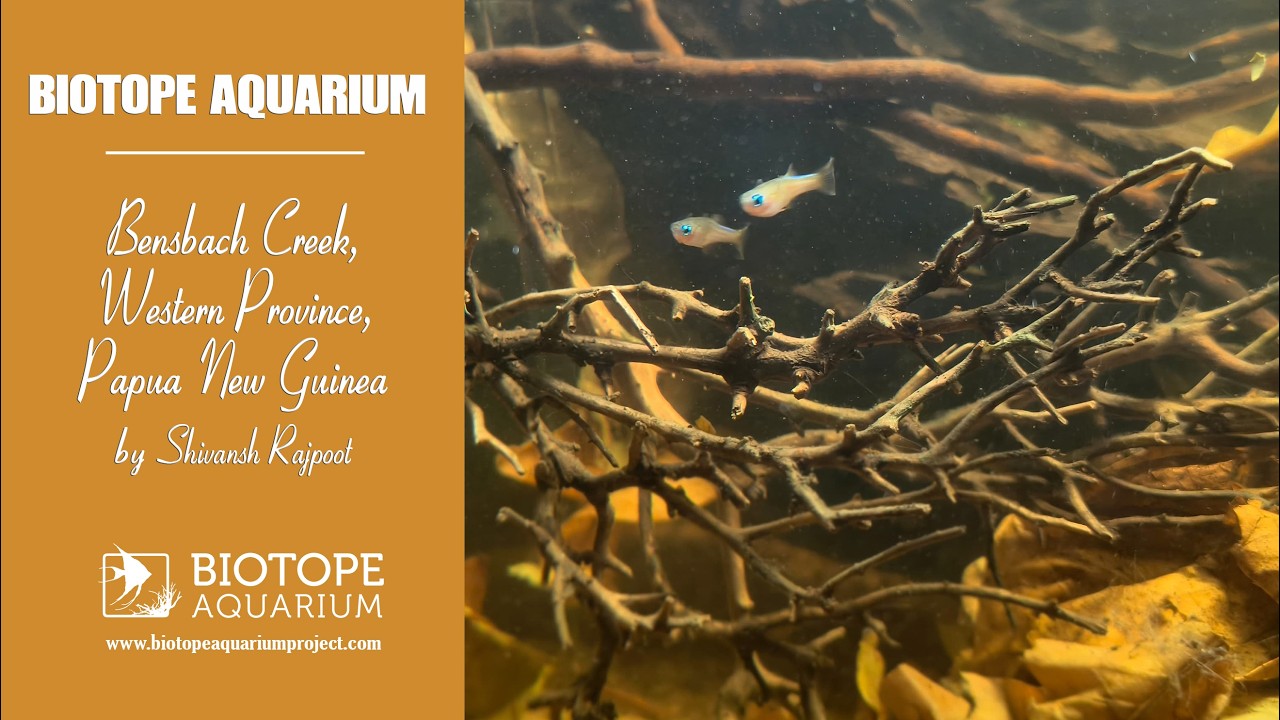
This aquarium recreates a shaded blackwater creek from the Bensbach River Basin in the Western Province of Papua New Guinea, representing the natural habitat of the Paskai Blue-eye (Pseudomugil paskai). The layout features fine sand, leaf litter, tangled driftwood, and submerged roots arranged to resemble the slow-flowing rainforest streams where this species naturally occurs.

The aquarium is intentionally planted sparsely, maintaining open swimming areas while preserving the appearance of a shallow forest creek. Soft, tea-coloured water, subdued lighting, and gentle water movement reproduce the calm conditions of the natural habitat.

The composition emphasises ecological accuracy by using materials and environmental conditions that closely resemble the native blackwater ecosystem, encouraging natural schooling, courtship, and feeding behaviour of Pseudomugil paskai while showcasing one of Papua New Guinea’s unique freshwater environments.

Submitted by
Shivansh Rajpoot
GPS
-6.0475421, 141.1083527
Geographical region
Oceania
Drainage Basin
Gulf of Papua
River catchment
Upper Fly River
Water body type
River
Water body name
Small Blackwater Creek
Water body part
Open water
Water body course
Upper course
Water body: tributary of
Tributary name

Videos above and below water

Warning: Undefined variable $fish_parent in /home/biotopea/public_html/wp-content/themes/bap/content-bam.php on line 85

Water Chemistry

Water information

Water type
Freshwater
Water color
Black water
Water transparency
Medium
Concentration of sediments
Medium
Water temperature
26 °C
Water flow/curent
Slow

Chemical parameters

pH
6.2
Conductivity
45
GH
dGH
20 °dGH
KH
10 mg/l
dKH
Dissolved Oxygen
89 %

Aquarium information

Aquarium description

Set-up date
August, 2025
Aquarium decoration

The aquarium recreates a shallow blackwater rainforest creek from the Bensbach River Basin of Papua New Guinea. Fine river sand forms the substrate and is lightly covered with leaf litter to reproduce the naturally accumulated organic material found in forest streams.

Carefully selected driftwood and intertwined roots create submerged shelters and potential spawning sites typical of the natural habitat. Smooth branches extend across the aquarium to imitate fallen riparian vegetation, while a limited number of native-style aquatic plants are arranged along the margins to preserve open swimming areas.

A dark background and subdued lighting reproduce the shaded conditions beneath the rainforest canopy, highlighting the natural colours and behaviour of Pseudomugil paskai. Every decorative element was thoroughly cleaned and prepared before use to ensure a safe and stable environment.

Aquarium equipment

Filtration: SunSun HW-604 external canister filter providing efficient mechanical and biological filtration through ceramic biomedia and fine filter sponges.

Heating: Temperature is maintained at 26 °C through a thermostatically controlled environment.

Lighting: White LED lighting is operated at reduced intensity to simulate filtered sunlight beneath a dense rainforest canopy.

Water movement is kept gentle to replicate the slow-flowing conditions of natural blackwater creeks while maintaining stable water quality.

Fish care

The aquarium houses a group of Pseudomugil paskai, allowing the fish to display natural shoaling, courtship, and territorial behaviour. Numerous submerged roots and driftwood structures provide shelter and reduce stress.

The fish receive a varied diet consisting of premium micro-pellets, frozen Artemia, Daphnia, mosquito larvae, and other high-quality live or frozen foods. Water parameters, temperature, and fish behaviour are monitored regularly to ensure long-term health and support stable breeding conditions.

Fish:

  • Melanotaenia paskai (Melanotaeniidae) – Paskai Rainbowfish – 4
Plant care

Aquatic plants are maintained under moderate lighting with stable nutrient availability and minimal pruning to preserve a natural appearance. Healthy plant growth contributes to biological stability while maintaining the open structure characteristic of rainforest blackwater streams.

Dead leaves are removed during routine maintenance to prevent excessive organic accumulation.

Aquatic vegetation

  • Vallisneria nana (Hydrocharitaceae) – Dwarf Vallisneria – 2
  • Ceratopteris thalictroides (Salviniaceae) – Water Sprite – 10
  • Nymphaea violacea (Nymphaeaceae) – Blue Water Lily – 1
Water care

Approximately 20% of the aquarium water is replaced every 10–14 days using conditioned soft water matched to the aquarium’s temperature and chemistry. The external filter is cleaned only when water flow is reduced, preserving beneficial bacterial colonies.

Water chemistry, temperature, and conductivity are monitored regularly, while gentle circulation and surface movement maintain adequate oxygenation without disturbing the calm conditions typical of the natural habitat.

Dimensions

Length
60 cm
Depth
45 cm
High
25 cm
Volume
70 L

Substrate in aquarium

Sand
Beige
Pebble/Gravel
None
Stone
Beige
Stone form
Irregular
Silt/Mud
None
Leaves
Adundant
Driftwood
Many
Submerged terrestrial vegetation
Yes

Bibliography

  • Freshwater Fishes of Australia by Allen, G.R.
    ISBN 9780866229426
  • Rainbowfishes: Their Identification, Care & Breeding by Allen, G.R., Unmack, P.J. & Hadiaty, R.K.
    ISBN 9780975150222
  • The Freshwater Fishes of Papua New Guinea by Allen, G.R.
    ISBN 9780958125520