- Set-up date
- April, 2026
- Aquarium decoration
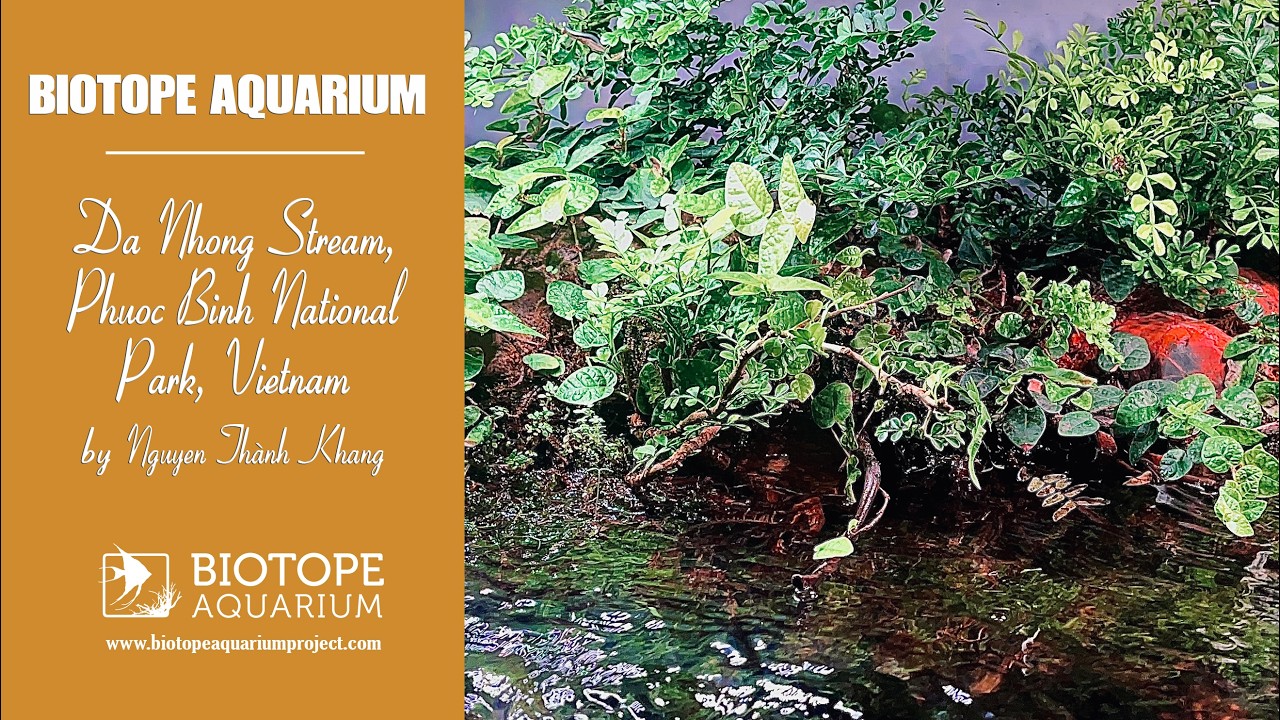
The hardscape is designed to replicate the rugged, high-energy streambed of the Da Nhong headwaters. A combination of large, weathered yellow-brown granite boulders on the left creates deep crevices and vertical structure, simulating the natural rocky banks. These are complemented by rusty, iron-rich river pebbles representing the eroded substrate of the streambed.
The foreground is composed of fine, washed yellowish-grey quartz sand, highlighting the clarity of the water. For the semi-aquatic transition zone, Ficus pumila is planted to creep along damp rock faces, while Vesicularia ferriei (Weeping Moss) is attached to rock crevices exposed to waterfall currents.
No artificial materials or non-native substrates were used, ensuring a purely natural and authentic habitat representation.
- Aquarium equipment
To simulate the high-energy, torrential current of the Da Nhong headwater stream in a 75×50×30 cm aquarium, filtration and water movement are provided by two 800 L/h internal pumps positioned to create a strong directional flow and maintain high oxygen saturation.
Beneath the visible layout, 10kg of porous lava rock is used as a foundational substrate layer, providing additional biological filtration surface area and elevating the hardscape to form the steep riverbank structure.
Temperature is maintained naturally at 24-25°C, supplemented by a 20 W LED spotlight (6500K) operating for 8 hours daily to mimic filtered sunlight beneath a tropical jungle canopy.
- Fish care
To ensure the health and vitality of the fish, water parameters are carefully maintained to reflect the pristine natural conditions of the Da Nhong headwaters, with stable temperatures around 24-25 °C and high oxygen saturation provided by the dual 800L/h pumps.
Regular partial water changes using treated, aged water help replicate seasonal flow dynamics. Feeding is managed carefully with high-quality micro-pellets and live foods tailored to the dietary requirements of both midwater schooling species (Rasbora daniconius, Rasbora paviana) and bottom-dwelling species (Puntius brevis).
Furthermore, the hardscape design, featuring dense granite boulder crevices, provides essential shelter, allowing timid bottom-dwelling fish to reduce stress, while schooling species actively display natural rheotaxis (swimming against the current) in open-water areas.
Fishes
- Rasbora paviana (Cyprinidae) – Pavie’s Rasbora – 2
- Rasbora daniconius (Cyprinidae) – Slender Rasbora – 4
- Puntius brevis (Cyprinidae) – Brevis Barb – 3
- Plant care
To sustain this dual-zone riparian ecosystem, a strict, low-nutrient maintenance protocol is implemented. In the terrestrial zone, Limonia acidissima and Ficus pumila rely entirely on a localised sub-irrigation capillary system.
Continuous moisture moves upward from the lotic water column through porous, interconnected granite fissures, ensuring that roots remain consistently humid without becoming waterlogged.
Submerged and emersed epiphytes, including Vesicularia ferriei and Microsorum pteropus, are maintained without chemical fertilisers or liquid carbon supplementation in order to preserve the pristine, low-TDS water conditions required by the native cyprinid fauna. Instead, they utilise naturally available nitrates generated from fish waste.
A specialised 15 W LED spotlight operates on a strict 8-hour photoperiod, providing a stable light cycle while limiting excessive green spot algae growth.
Aquatic vegetation
- Limonia acidissima (Rutaceae) – Wood Apple – 5
- Cyclosorus parasiticus (Thelypteridaceae) – Parasitic Marsh Fern – 6
- Ficus pumila (Moraceae) – Creeping Fig – 4
- Vesicularia ferriei (Hypnaceae) – Weeping Moss – 10
- Microsorum pteropus (Polypodiaceae) – Java Fern – 2
- Water care
To maintain the pristine hydrochemical integrity of this headwater torrent, a precise water management protocol is followed. A weekly 10% water change is performed using pure reverse osmosis (RO) water, remineralised to a target conductivity of 35 µS/cm to avoid mineral accumulation caused by evaporation.
The internal mechanical filter is rinsed every two weeks using aquarium water to remove accumulated organic detritus without disrupting established nitrifying bacterial colonies. No chemical additives or water clarifiers are introduced.
The strong top-down current generated by the waterfall promotes natural surface agitation, helping to maintain efficient gas exchange and oxygenation. This dynamic hydraulic action supports stable dissolved oxygen levels, maintaining conditions close to 98% saturation.