- Set-up date
- July, 2025
- Aquarium decoration
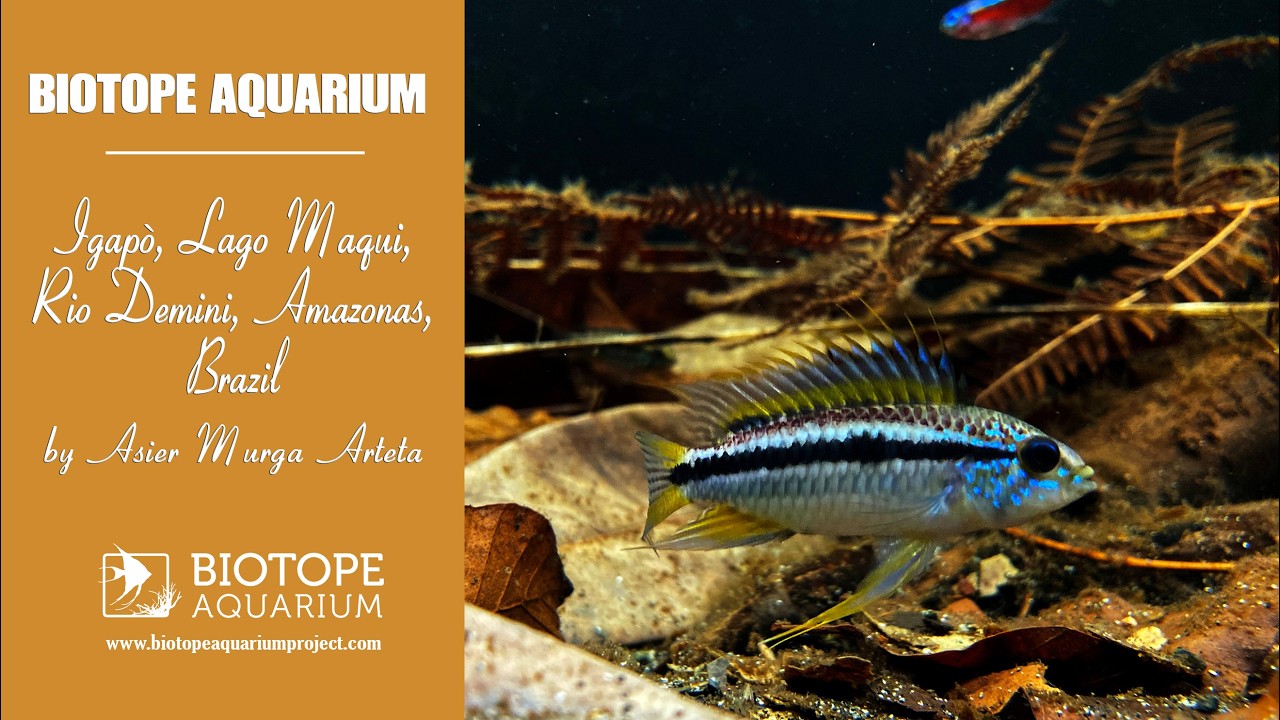
The aquarium is inspired by the clear waters of the Rio Demini, a tributary of the Rio Negro in the Brazilian Amazon. It represents a seasonally flooded stretch of forest, where water covers the ground and transforms the landscape, carrying forest debris such as dry branches, leaves, and fruits.
To create an environment consistent with this type of habitat, I used dark sand with a fine-to-medium granulometry, representing the typical silty-sandy substrate of igapós, with an accumulation of organic matter. The detritus naturally accumulates at the bottom, adding authenticity to the biotope aquarium by imitating the original flooded forest.
The leaf litter layer is composed of leaves that fall from trees into the water, eventually sinking and providing shelter, food, and beneficial tannins for the fish.
You can also see burití (Mauritia flexuosa) fruits and jatobá (Hymenaea courbaril) pods, used to facilitate spawning of Apistogramma species and to increase realism by evoking the surrounding vegetation. Hymenaea courbaril is native to the Amazon and grows near Barcelos; although it is not a typical deep igapó species, it can occur in elevated areas within riparian forests.
This reflects igapó conditions, where light penetration is limited due to humic and fulvic acids from decomposing organic matter and the shade of dense surrounding vegetation. This limits the development of submerged plants, and igapós are flooded seasonally rather than permanently.
I placed a root-like trunk simulating a young flooded tree, as seen in the BIN video. Additionally, a large palm leaf lies on the sloping ground of the igapó, a trace of wind and time.
The water is clear, acidic, and very soft, with no strong amber coloration, reflecting conditions in a clear-water igapó in the middle section of the Rio Demini, where the river expands laterally with a slow current, forming meanders, lakes, igapós, and lagoons such as Lago Maqui, located near the biotope.
The inhabitants here are very comfortable.
One of the greatest satisfactions for an aquarist is achieving successful reproduction of the fish they keep. It is confirmation that the conditions provided are appropriate.
In this case, I first observed reproduction in a wild female Apistogramma bitaeniata (Brazil). I noticed she was intensely yellow, with striking black stripes, and highly territorial toward the other fish. She had been defending an area around the roots of a driftwood structure for several days, so I suspected she was guarding eggs.
Suddenly, I saw her expel something from her mouth. On closer inspection, I realized it was a fry that had strayed from its siblings.
The mother repeatedly collected any fry that moved away from the group and returned it to them. It was a remarkable behaviour to observe; I admire the strong maternal instinct so characteristic of cichlids.
The male also helps guard the territory, although even he seems intimidated by the strong character of his partner. When the female is a first-time breeder, it is common for her to lose all fry, as she becomes very nervous.
Obviously, a community aquarium is not the most suitable environment for successfully raising fry. However, in their natural habitat, a similar process occurs: natural selection ultimately prevails.
In the end, she manages it—life always finds a way.
The male spends his time calmly displaying his colours and fins, clearly behaving as if he is the star of the aquarium (or at least believes so). Sometimes he keeps females away from feeding areas; at other times, he accompanies them while foraging or attempts to mate.
The females prefer to maintain their own space and usually remain separated. They do not fight; their interactions consist of brief chases and ritualised displays, as seen in the video. As mentioned, the female protects her fry and reacts aggressively to any intrusion.
One of the keys to successful coexistence among dwarf cichlids is providing a sense of secure territory. To achieve this, each fish requires its own refuge. This is provided through caves formed by roots and jatobá pods, one per Apistogramma.
These shelters are positioned so that fish emerging from them do not have a direct line of sight to the other cave. The layout distributes visual barriers using roots, leaf litter, and other natural elements, reinforcing territorial separation.
However, one of the strongest ecological associations of Apistogramma is with leaf litter. The substrate layer is especially important, as fish actively explore the microhabitats formed between decomposing leaves, often preferring them over artificial shelters and even breeding directly among them.
From an early age, Apistogramma fry can be seen pecking at leaves and substrate in search of food. They are not consuming the leaves themselves, but feeding on infusoria and microorganisms that develop on them. This behaviour reflects their natural benthic foraging instinct.
In addition, I supplement their diet with newly hatched Artemia nauplii, delivered via pipette directly to the fry area, while distracting the cardinal tetras by feeding them simultaneously in the opposite corner of the aquarium.
The water remains soft, acidic, and lightly tannin-stained, closely replicating natural conditions and reducing stress for the fish.
The fauna also includes a group of Paracheirodon axelrodi, which move among branches and shaded areas.
Kept in groups, they become more confident and active, swimming openly and interacting socially. In the wild, they occupy shallow flooded areas in search of shelter, food, and reproductive opportunities.
- Aquarium equipment
The 240-litre aquarium measures 120 cm in length, 50 cm in height, and 40 cm in width.
It is equipped with two external filters, filled with biological and mechanical filtration media, each fitted with five sponge pre-filters.
The two outlets are positioned on opposite sides to generate a circular water flow within the water column. They are placed just above the surface to enhance gas exchange and prevent the formation of biofilm.
The filter flow is set to a minimum in order to simulate the calm waters of a flooded forest environment.
Both filters include built-in heaters, which makes installation simpler and ensures a very stable temperature, as the water continuously circulates through the heating system.
I am a big fan of using two filters: if one fails or needs maintenance, the other continues to operate as a backup system.
For lighting, I use two LED units with a dimmer, allowing me to simulate sunrise and sunset through gradual transitions, mimicking natural light conditions and reducing stress for the fish.
Behind the aquarium, I placed a custom-cut background: black acrylic on one side and a water-like blue gradient on the other. This enhances the colours of the fish and aquascape, creating an elegant and calming atmosphere while also concealing filter hoses.
Fish:
- Apistogramma bitaeniata (Brazil wild) – 3 (Cichlidae)
- Paracheirodon axelrodi – 15 (Characidae)
- Fish care
The aquarium is equipped with two external filters, filled with biological and mechanical filtration media, each fitted with five sponge pre-filters.
The two outlets are positioned on opposite sides to generate a circular water flow within the water column. They are placed just above the surface to enhance gas exchange and prevent the formation of biofilm.
The filter flow is set to a minimum in order to simulate the calm waters of a flooded forest environment.
Both filters include built-in heaters, which makes installation simpler and ensures a very stable temperature, as the water continuously circulates through the heating system.
For lighting, I use two LED units with a dimmer, allowing me to simulate sunrise and sunset through gradual transitions, mimicking natural light conditions and reducing stress for the fish.
Behind the aquarium, I placed a custom-cut background: black acrylic on one side and a water-like blue gradient on the other. This enhances the colours of the fish and aquascape, creating an elegant and calming atmosphere while also concealing filter hoses.
The water parameters are soft and acidic, with a pH of approximately 5.0-6.0, closely matching natural igapó conditions of the Rio Demini.
- Plant care
I did not use aquatic plants because, in their natural habitat, the vegetation mainly consists of young palm seedlings that do not thrive in aquariums. Instead, I chose to recreate the naturally plant-free areas visible in the BIN video.
- Water care
Water maintenance focuses on providing a healthy, natural environment by replicating the conditions of the Rio Demini igapó, near Lago Maqui.
When setting up this biotope, I added a large quantity of leaves, branches, botanicals, and a large piece of driftwood. During the first weeks, this can temporarily increase phosphate levels. To prevent this, an anti-phosphate resin can be used, phosphate levels should be tested every few days, and a few additional water changes should be carried out.
Doing this during the first two weeks after setting up the aquarium is sufficient. This is the method I followed, and both phosphate and nitrate levels remained close to zero.
I use two external filters, each with four baskets containing biological and mechanical filter media, plus five sponge pre-filters, ensuring efficient and stable filtration. The filter outlets are adjusted to provide a gentle flow, simulating the calm waters of this igapó while creating a circular current that oxygenates the surface and prevents dead spots within the aquarium.
Every Saturday, I change approximately 20% of the water using replacement water at a temperature similar to that of the aquarium to avoid thermal shock.
During water changes, I clean the aquarium glass to remove any algae, although algae growth is minimal because nitrogen compounds remain close to zero.
I also carefully siphon debris around the leaf litter (without disturbing the leaves), on the driftwood, and around both filter intakes, where organic matter tends to accumulate.
When I need to replace leaves because the older ones have decomposed, I boil them beforehand to eliminate possible contaminants. If you are not certain that the leaves come from pesticide-free trees, this step is recommended. Boiling also hydrates the leaves, allowing them to sink almost immediately.
Most of the leaf litter consists of magnolia leaves. Although they are native to the Americas rather than Amazonian igapós, they closely resemble the leaf litter visible in the Maratecoara video and are widely used in blackwater biotope aquariums because their high lignin content and thick structure allow them to decompose slowly.
I also use leaves of the rubber tree (Hevea brasiliensis), which naturally occurs in igapó forests, together with cashew (Anacardium occidentale), Coccoloba spp., Pteridium aquilinum, palm leaves, Ficus spp., and Monetaria spp., all of which are common in Brazil.
To reproduce water conditions as close as possible to those found in the Rio Demini, I prepared a controlled mixture of two water sources to obtain stable mineral content.
This is necessary because my tap water is moderately hard, with a KH of 8 and a pH of 8.
The mixture consists of:
- 90% very low-mineral bottled water
- 10% tap water
A water conditioner is added to remove chlorine.
The resulting water has a KH of approximately 2.5 and a pH of about 6.1.
This mixture provides a stable carbonate hardness while avoiding the instability that can occur when using extremely soft water alone.
Using only very low-mineral water, together with biological activity and surface aeration, can lead to pH fluctuations because of its very low buffering capacity.
For this reason, I include a small proportion of tap water to improve stability without losing the acidic characteristics of the biotope.
The pH is not adjusted chemically. Instead, it is naturally regulated by the aquarium through the action of driftwood, leaf litter, tannins, and humic acids.
The objective is to achieve a balance between chemical stability and natural acidification, producing a stable, slightly acidic pH typical of Amazonian blackwater environments.
I clean one filter approximately every five months, always leaving at least one month between cleaning the two filters. Filter maintenance is carried out using aquarium water to preserve as much beneficial bacteria as possible.
Every two months, I clean the filter hoses to prevent excessive dirt build-up and maintain a constant water flow.
Once a month, I add a bacterial supplement to support the biological filtration, and I repeat the treatment after cleaning a filter.
The pre-filter sponges are replaced whenever I notice a reduction in water flow. Replacing them takes only a few minutes because the pre-filter is separate from the main filter and can be removed without taking the filter out of the cabinet. If time allows, the used sponges are cleaned and stored for future use.
Daily observation of the aquarium is essential for detecting problems at an early stage.
I watch for abnormal behaviour such as lethargy, loss of colour, difficulty swimming, isolation from the group, or loss of appetite, as these are often the first signs of stress or disease.
If the fish begin rubbing against the décor or develop white spots, treatment should be started immediately.
I test nitrite, nitrate, and phosphate levels every week, although they consistently remain close to zero.
I also monitor the water temperature, which remains very stable.
Power failures should not be underestimated, especially if they last longer than one hour. In such cases, the water surface should be agitated to improve oxygenation, partial water changes may be necessary, and products such as Purigen®, together with water tests and beneficial bacteria, can help maintain water quality.
Careful observation and regular monitoring of this small ecosystem are essential for maintaining a healthy, stable, and natural environment.