- Set-up date
- October, 2025
- Aquarium decoration
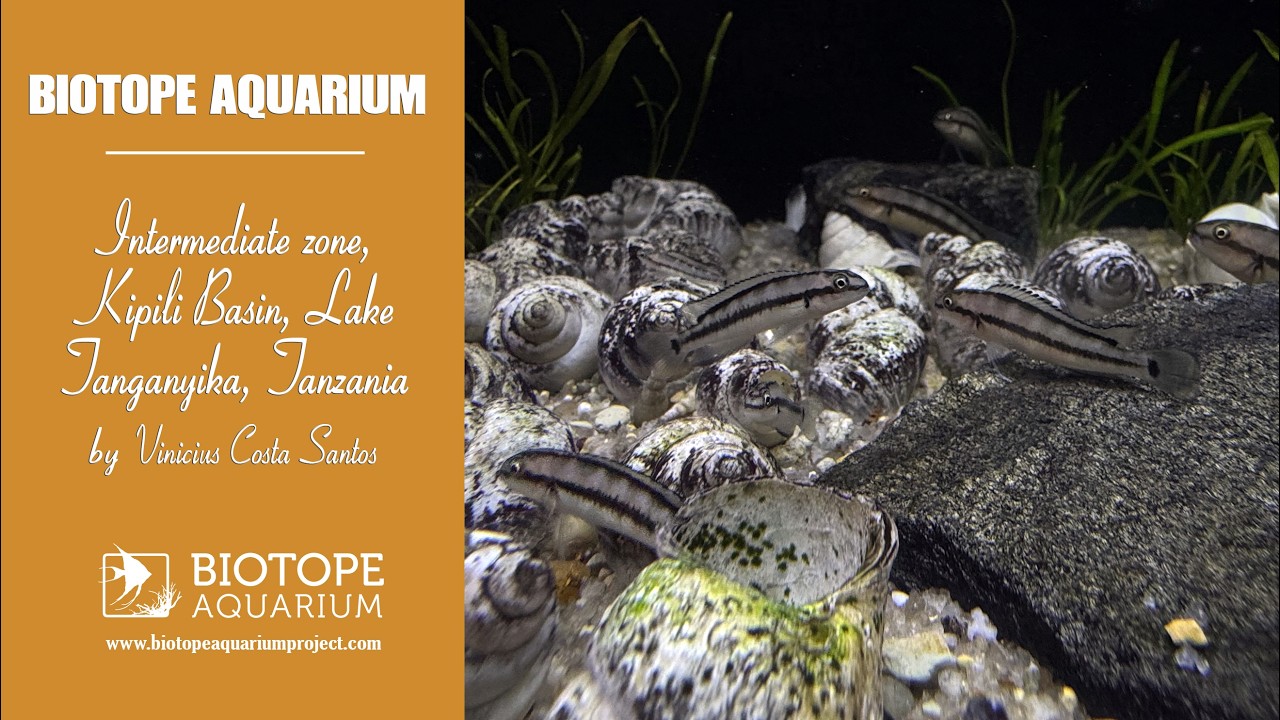
This aquarium recreates the rock–sand transition zone of the Kipili Basin in Lake Tanganyika, inspired by underwater observations of shallow to intermediate habitats where scattered rocks, sandy substrates, empty gastropod shells, and sparse aquatic vegetation coexist. The layout was designed to reproduce the natural heterogeneity of this environment, with granite rocks and rock fragments providing shelter and territorial boundaries, while extensive open sandy areas allow natural foraging and movement. Clumps of Vallisneria spiralis were included to represent the sparse vegetation occasionally found in protected shoreline areas.
Particular attention was given to substrate composition. The sand was created by mixing beach sands from Rio de Janeiro with contrasting grain sizes: one very fine and the other considerably coarser. The aim was to achieve a broad grain-size distribution similar to that observed in the natural habitat, where particles of different sizes coexist and contribute to habitat complexity.
Telmatochromis vittatus was selected as the sole fish species because of its strong association with this habitat and its characteristic behaviours, including territoriality, use of rock crevices and shells as refuges, and continuous grazing on biofilm-covered surfaces. These behaviours have been consistently observed in the aquarium.
The decision to maintain a single-species aquarium was made to emphasise the natural behaviour of T. vittatus and avoid interspecific interactions that could obscure habitat-driven behaviours. Although the natural biotope also contains species of Julidochromis, Neolamprologus, Lamprologus, and various invertebrates, they were not included due to space limitations and the objective of creating a more focused ecological representation.
In the future, small sympatric shell-dwelling cichlids could be added, potentially increasing territorial interactions and habitat partitioning. Filtration and water circulation are provided by discreetly positioned equipment that minimises visual impact while ensuring excellent water quality, oxygenation, and stable environmental conditions characteristic of Lake Tanganyika.
- Aquarium equipment
The aquarium is equipped with a side sump (sixth glass) measuring 15 × 40 × 40 cm, divided into three compartments to provide efficient and reliable filtration while minimising visual impact inside the display tank.
The first compartment functions as a sedimentation chamber, where suspended particles settle before entering the filtration system. The second compartment is filled with high-porosity ceramic media, providing a large surface area for beneficial nitrifying bacteria responsible for biological filtration. A filter floss pad placed above the ceramic media performs mechanical filtration by retaining fine suspended particles before they reach the biological media.
The third compartment houses an EHEIM Thermocontrol 100 W heater and an 800 L/h return pump, which returns filtered water to the aquarium. This configuration ensures stable water temperature, efficient circulation, and continuous biological filtration, contributing to the high water quality required to maintain a stable Lake Tanganyika biotope.
Three LED aquarium light bars and two 10 W spotlights from China were used to achieve different lighting conditions. The LED bars (warm white 3000 K, cool white 6000 K, and RGB) are adjustable in intensity and allow the simulation (manually, not automatically) of different lighting conditions, including twilight and full sunlight.
- Fish care
Fish care begins with maintaining appropriate biotope aquarium conditions. This BAM aims to go beyond aesthetic considerations by focusing on the physicochemical parameters of the water, promoting the long-term health and well-being of the fish.
The lighting system turns on and off gradually by using the intensity adjustment capabilities of the LED bars, avoiding abrupt changes in lighting conditions.
Fish are fed once daily in small quantities. NLS foods and Dr. Bassleer’s functional foods containing vegetable extracts of garlic, açaí, and lapacho tree are used. Weekly, pellets are offered after being soaked and subsequently dried in an alcoholic extract of propolis. Propolis is a natural functional additive that, when used at appropriate dosages, may support fish health by acting as an immunostimulant, food additive, antimicrobial agent, and therapeutic supplement (De la Cruz-Cervantes et al.).
Fishes:
- Telmatochromis vittatus (Cichlidae)
- Plant care
-
Aquatic plants:
- Vallisneria sp. (Hydrocharitaceae)
- Water care
Water care is a fundamental requirement of this project. Water chemistry was designed to reproduce the ionic composition of the southern basin of Lake Tanganyika, based on the studies of Degens et al. and Tiercelin et al. Target parameters were pH 8.8-9.0, conductivity 620-680 μS/cm, GH 11-12 °dH, and KH 15-16 °dH.
For each 50 L of replacement water, the following salts were added: 42 g sodium bicarbonate (NaHCO₃), 3.7 g sodium carbonate (Na₂CO₃), 33 g magnesium chloride hexahydrate (MgCl₂·6H₂O), 4 g calcium chloride dihydrate (CaCl₂·2H₂O), and 3.5 g potassium sulfate (K₂SO₄).
This approach allowed the independent adjustment of Na⁺, K⁺, Mg²⁺, and Ca²⁺ concentrations, avoiding the limitations of commercial Tanganyika salt mixes and providing a closer approximation of the ionic ratios reported for the Kipili Basin.
Water changes of 50 L were performed every two weeks. Replacement water was prepared 24 hours in advance, conditioned, remineralised according to the recipe above, and heated to aquarium temperature before use.