bin
Intermediate zone, Kipili Basin, Lake Tanganyika, Tanzania
Tanzania, Rukwa, Kipili
The Kipili Basin, located in the southern region of Lake Tanganyika, is an ecologically significant area recognized for its exceptional biodiversity and high level of endemism. The basin contains a wide variety of aquatic habitats, including rocky littoral zones, sandy substrates, pelagic waters, and deep-water environments, each supporting distinct biological communities.
Its most notable characteristics include extreme depth, strong water-column stratification, and pronounced gradients in light availability, oxygen concentration, and nutrient distribution. These environmental conditions create numerous specialized ecological niches, allowing a remarkable diversity of species with different adaptations to coexist within the same lake system.
The Kipili Basin represents one of the world’s most important natural laboratories for studying freshwater biodiversity and evolutionary processes. The coexistence of contrasting habitats within a single ancient lake ecosystem provides valuable insight into ecological specialization, species diversification, and the evolutionary history of Lake Tanganyika’s unique fauna.
- Submitted by
- Vinicius Costa Santos
- Approved by
- Ad Konings & Anton Lamboj
- GPS
- -7.4445710, 30.6006641
- Geographical region
- Eastern Africa
- Drainage Basin
- River catchment
- Water body type
- Lake
- Water body name
- Tanganyika
- Water body part
- Open water
- Water body course
- Water body: tributary of
- Tributary name
Videos above and below water
Warning: Undefined variable $fish_parent in /home/biotopea/public_html/wp-content/themes/bap/content-bin.php on line 55
Water Chemistry
Water information
- Water type
- Freshwater
- Water color
- Clear water
- Water transparency
- High
- Concentration of sediments
- Low
- Water temperature
- 24-27 °C
- Water flow/curent
- None
Chemical parameters
- pH
- Conductivity
- GH
- dGH
- KH
- dKH
- Dissolved Oxygen
Substrate in nature
- Sand
- Pebble/Gravel
- Stone
- Stone form
- Silt/Mud
- Leaves
- Driftwood
- Submerged terrestrial vegetation
Aquatic Biotope
- Date of collecting
- Collecting area
- Water depth
- Air temperature
- Sunlight
Environment
- Surrounding area
-
- Underwater landscape
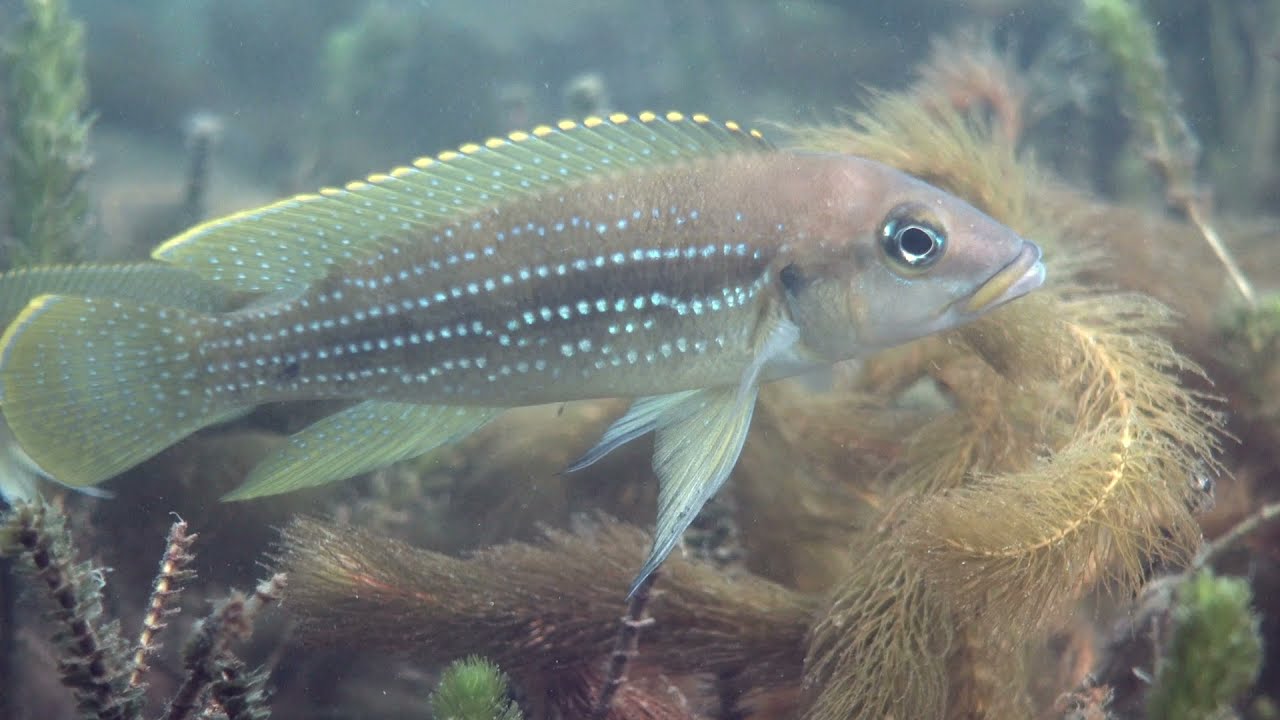
Below the surface, the habitat consists of a mosaic of rocky structures, scattered stones, and sandy areas. The transition zone between rock and sand provides shelter, feeding areas, and breeding sites for numerous cichlid species, including Telmatochromis vittatus. The water is exceptionally clear, allowing sunlight to penetrate to considerable depths and supporting the development of algae and aufwuchs biofilms on rocky surfaces, which form an essential component of the local food web.
Fishes:
- Altolamprologus compressiceps (Cichlidae)
- Bathybates hornii (Cichlidae)
- Benthochromis horii (Cichlidae)
- Callochromis macrops (Cichlidae)
- Callochromis sp. ‘pleurospilus Tanzania’ (Cichlidae)
- Chalinochromis cyanophleps (Cichlidae)
- Cunningtonia longiventralis (Cichlidae)
- Cyathopharynx sp. ‘Neon Streak’ (Cichlidae)
- Cyphotilapia gibberosa (Cichlidae)
- Cyprichromis leptosoma (Cichlidae)
- Cyprichromis sp. ‘leptosoma Jumbo’ (Cichlidae)
- Ectodus descampsii (Cichlidae)
- Eretmodus cyanostictus (Cichlidae)
- Jabarichromis pfefferi (Cichlidae)
- Julidochromis marksmithi (Cichlidae)
- Lamprologus callipterus (Cichlidae)
- Lamprologus lemairii (Cichlidae)
- Lamprologus ornatipinnis (Cichlidae)
- Lepidiolamprologus attenuatus (Cichlidae)
- Lepidiolamprologus sp. ‘meeli Kipili’ (Cichlidae)
- Neolamprologus brichardi (Cichlidae)
- Neolamprologus cylindricus (Cichlidae)
- Neolamprologus furcifer (Cichlidae)
- Neolamprologus sexfasciatus (Cichlidae)
- Neolamprologus sp. ‘caudopunctatus Kipili’ (Cichlidae)
- Neolamprologus tetracanthus (Cichlidae)
- Ophthalmotilapia boops (Cichlidae)
- Ophthalmotilapia cf. nasuta (Cichlidae)
- Paracyprichromis brieni (Cichlidae)
- Paracyprichromis nigripinnis (Cichlidae)
- Perissodus microlepis (Cichlidae)
- Petrochromis sp. ‘kasumbe rainbow’ (Cichlidae)
- Petrochromis sp. ‘red Mpimbwe’ (Cichlidae)
- Petrochromis sp. ‘Texas blue’ (Cichlidae)
- Shuja horei (Cichlidae)
- Telmatochromis vittatus (Cichlidae)
- Tropheus sp. ‘Kipili’ (Cichlidae)
- Xenochromis hecqui (Cichlidae)
- Xenotilapia boulengeri (Cichlidae)
- Xenotilapia flavipinnis (Cichlidae)
- Xenotilapia sp. ‘papilio sunflower’ (Cichlidae)
- Xenotilapia spilopterus (Cichlidae)
- Threats to ecology
This biotope faces several threats, including climate change, which affects water temperature, stratification, and nutrient cycling within the lake. Additional pressures arise from increasing human populations along the shoreline, leading to habitat degradation, sedimentation, deforestation, and localized pollution. Overfishing may also alter ecological balances and impact native fish communities.
Bibliography
-
→ Environ Fluid Mech 23, 103–123 (2023) - The impact of seasonal variability and climate change on lake Tanganyika’s hydrodynamics
by Kevin Sterckx, Philippe Delandmeter, Jonathan Lambrechts, Eric Deleersnijder, Piet Verburg & Wim Thiery
-
→ AAPG Bulletin, 80(3), 382-409 - Textural and compositional variability across littoral segments of Lake Tanganyika: The effect of asymmetric basin structure on sedimentation in large rift lakes
by Soreghan, M. J., & Cohen, A. S.
-
→ Proc Natl Acad Sci U S A. 2016 Aug 23;113(34):9563-8 - Climate warming reduces fish production and benthic habitat in Lake Tanganyika, one of the most biodiverse freshwater ecosystems
by Cohen AS, Gergurich EL, Kraemer BM, McGlue MM, McIntyre PB, Russell JM, Simmons JD, Swarzenski PW
-
→ Journal of Great Lakes Research, Volume 46, Issue 2, 2020, Pages 243-254 - Geophysical benthic habitat mapping in Lake Tanganyika (Tanzania): Implications for spatial planning of small-scale coastal protected areas
by Joseph S. Lucas, Michael M. McGlue, Ismael A. Kimirei, Michael J. Soreghan, Athanasio Mbonde, Kevin M. Yeager, Peter Limbu, Colin Apse, Peter B. McIntyre
-
→ Nature 424, 766–768 (2003) - Climate change decreases aquatic ecosystem productivity of Lake Tanganyika, Africa
by O'Reilly, Catherine M. ; Alin, Simone R.; Plisnier, Pierre-Denis; Cohen, Andrew S.; McKee, Brent A.
-
→ Quaternary Science Advances, Volume 3, 2021, 100023 - Climate, vegetation, and weathering across space and time in Lake Tanganyika (tropical eastern Africa)
by Sarah J. Ivory, Michael M. McGlue, Cara Peterman, Patrick Baldwin, Joseph Lucas, Andrew Cohen, James Russell, Justina Saroni, Emma Msaky, Ishmael Kimirei, Michael Soreghan
-
→ Journal of Great Lakes Research, Volume 46, Issue 5, 2020, Pages 1067-1078 - The taxonomic diversity of the cichlid fish fauna of ancient Lake Tanganyika, East Africa
by Fabrizia Ronco, Heinz H. Büscher, Adrian Indermaur, Walter Salzburger
-
→ Hydrobiologia 407, 45–58 (1999) - Limnological annual cycle inferred from physical-chemical fluctuations at three stations of Lake Tanganyika
by P.-D. Plisnier, D. Chitamwebwa, L. Mwape, K. Tshibangu, V. Langenberg & E. Coenen
-
→ Limnology and Oceanography, 38 - Nutrient chemistry of the water column of Lake Tanganyika
by J. M. Edmond, R. F. Stallard, H. Craig, V. Craig, R. F. Weiss, G. W. Coulter
Comment by the expert
Ad Konings: Only one section of BIN description/parameters is given. Literature is focused on future changes due to global warming. It is of course a threat, but it should not be a focus in researching the conditions of the lake as it is now with the fish species still alive in it.