- Set-up date
- November, 2024
- Aquarium decoration
This aquarium recreates a section of the middle reaches of the Kunthi River as it flows Thootha in the State of Kerala, India.
I would like to take this opportunity to encourage aquarists to keep fish in a biotope aquarium. Contrary to what some may think, this is the way to avoid the dissapearance of many species of fish, here they are protected replicating the conditions of nature and respecting the necessary space for each species, we can keep them, reproduce them, study them, their behaviour, courtship, reproduction, feeding and so on.
Their most suitable place is nature, no one doubts that, but nature is punished, mainly because of the mistakes made by humans, and several species disappear forever. We can prevent this and give them a healthy and happy life.
Let’s show the rest of the world these little jewels and raise awareness about respect and care for nature.
In this case, I imitate one of the those pools surrounding those large, stone slabs, where Cryptocoryne retrospiralis are very numerous.
Although the river initially rises and flows within the Western Ghats, this area represents its transition to flatter terrain in the foothills of the Western Ghats.
The ecosystem is characterised by calm waters, surrounded by agricultural plantations and coconut trees. A riverbed composed of reddish gravel mixed with some grey sand with dry leaves and coconut branches, that have come here from the coconut and Ficus religiosa trees, and bamboo plant along the river bank, which reproduce the accumulation of organic matter in still waters.
I got the bamboo leaves from a lush plant in my uncle’s garden, who tells me that he never planted it, so I imagine that it was a little bird that probably left its seed inside its poop, and that served to germinate in the garden, surely that gift is because the bird knew about the excellent benefits of bamboo. I firmly believe in the wisdom of nature and the instinct of animals.
Rounded rocks and botanicals are distributed in a natural manner, evoking the elements carried by the river and accumulated in the river bed. The vegetation includes a large Cryptocoryne crispatula, it is the plant most similar to retrospiralis and I have been unable to find it, at least in Spain. Simulates a main plant where the Dawkinsia denisonii can spawn between the plant and the rock crevices. In addition, Eriocaulion is arranged in small groups, reflecting is natural arrangement in the environment.
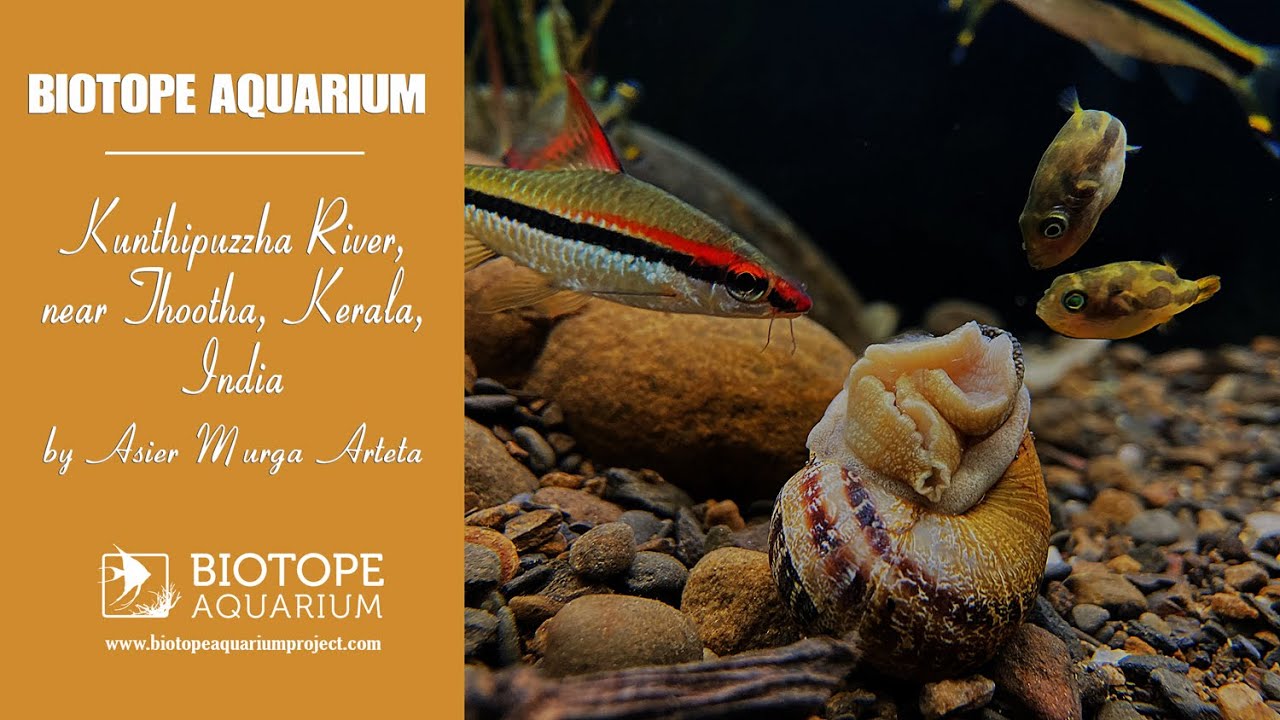
This habitat support native fishes such as Dawkinsia denisonii and Carinotetraodon travancoricus, which are well adapted to calm waters with a gentler flow. The key to peaceful coexistence lies in respecting their groups needs, their territorialy and how the aquarium layout help, each species feel secure and stable.
Group behaviour:
Both groups prefer to be in their own group, which minimises conflict. A couple or 2 females and a male also get along well. Dawkinsia denisonii, being fast barbels, are not threatened by Carinotetraodon travancoricus and can move freely without generating altercations.
Territoriality, nooks and crannies:
The aquarium offers suficient hidding placed and delimited territories for each group, which help keep territoriality whitin acceptable limits and avoid disputes.
Diet:
Both groups have complementary diets, the travancoricus enjoy the snails and worms, while the denisonii feed and food dry. Although with time and seeing that I add a snail to the aquarium every day, the barbels seem to be getting a taste for pecking at its flesh. They just want to know what it is that has entered the aquarium. They like to peck the ground in search of food and I also see them doing it on the rocks, probably to eat the small algae.
They both like live and frozen food, I distribute it in small portions throgout the aquarium, so that it reaches everyone.
In my case, I put what appear to be two females and a male puffer fish, he is a bit more colourful and they are a bit chubbier, but the good thing is that they get along very well.
The water temperature in the aquarium varies between 24,5º and 26º, depending of the season.
The PH is kept close to 7,1 and the flow is gentle, recreating the characteristics of this part of the river.
The filtered highting, generated by stones , plants and branches, emulates the natural shadows of the environment.
This aquarium reflects the biodiversity and tranquility of the middle reaches of the Kunthi River, near Thootha, highlighting the importance of preserving river ecosystems and their coexistence with human activities such as agriculture.
- Aquarium equipment
My aquarium is a 240L, measuring 120cm long and 50cm high. It is equipped with two exterior filters, which I have loaded with biological and mechanical material and five sponges each, as a prefilter.
I have placed them one on each side to generate a circular current on the surface, which avoid having to place them inside the aquarium, while maintaining a clean and functional design. In addition, I have the flow rate of the filters, set to the minimum to simulate the still waters and the pond I am recreating.
The two filters are Oase Biomaster 350 thermo, i.e. with both thermo heaters inside, so as not to spoil the decoration of the biotope, I do not like devices in the water, besides it heats the water better, as it constantly passes through the thermo heaters of the filters and makes the temperature very stable.
And if one should fail, the other would always be in support, so that the water temperature would not drop, and the same would happen with the beneficial bacteria for filtration or with the out put of water from the filter, as long as one works, it would be oxygenating the aquarium and promoting gas exchange, so you can be calm while you solve the issue of the broken filter.
As for the lighting, I use two Led plants Eheim and a Dimmer, which allows me to simulate sunrise and sunset.
In this way, I manage to mimic natural conditions and avoid scaring the fish.
Behind my aquarium, I’ve placed a custom-cut sheet of acrylic with a thoughtful touch: one side features a light blue background, mimicking the open, sunlit waters of daytime, the other side is a deep black, evoking the calm of the night. Each morning, as the day begins, I place the blue side facing inwards to gently welcome the light.
In the evening, just before the aquarium lights go out , I flip it to the dark side, as if the tank itself were settling into nightfall. It’s a simple gesture that takes only a few seconds, the acrylic rests easily on the rear ledge of the tank and leans securely against the tubes at the top. All I need to do is slide it out and turn it around.
With this small daily ritual, I aim to mirror the natural rhythm of life, helping my fish experience a changing, lifelike environment-as close to nature as possible, filled with harmony and gentle transitions.
- Fish care
The best way to keep these two species healthy and active is to replicate, as for as possible, the conditions at their place of origin.
When Heiko Bleher, on one of this expeditions, measured the pH, it was 7,1, conductivity 64µS and a temperature 31°C. When Aravind went, the temperature was just under 26°C.
And that’s how I keep them: pH 7.1; KH 3.0; GH 142-160 and temperature 24.5-26°C, depending on the season.
The Dawkinsia denisonii is a cyprinid, and therefore fast and voracious. In the wild, they are usually found in shoals or groups. In an aquarium, to help them feel at ease, there should be no fewer than 6 individuals. These fish love to swim, and a tank at least 120cm long is the minimum that should be provided. They usually move together throughout the day, are non-territorial, and interact peacefully with each other.
I am aware that in the future, this aquarium will be a little tight for these 8 Dawkinsia denisonii, although they do not breed in aquarium, but they will be more comfortable in a large litter, something I’m already working on. At the moment, it is not a problem. They are happy, they measure about 7-8cm and meanwhile I am saving for a bigger aquarium.
In this 120 cm-long tank, they – along with the three dwarf pufferfish – form a healthy and happy team, except when a snail appears. The puffers compete for it and sometimes start circling each other (one on top of the other), eventually giving a harmless nip. They also try to keep the barbs away – their food is sacred. The best solution is to give one snail to each pufferfish.
This species has a reputation for biting the fins of slow or long-finned tankmates. However, I’ve only seen one of them try to do so, and it was while defending its snail. The barbs are much faster and never get bitten. In fact, they only approach the snail out of curiosity—they’re not competing for food.
When there’s no snail involved, both species ignore each other completely. Dwarf puffers enjoy being in a group, but at the same time, they are solitary. If there’s no food around, they spend their time pecking at stones or resting among the vegetation.
In my case, I keep 3, which have turned out to be two females and a male, there is a good coexistence between them and do not show territoriality. The aquarium is long and they have many nooks and crannies to be at their leisure.
First I added them to the aquarium, and a month later, I added the Dawkinsia denisonii, so that they would feel at easy in the field and not intimidated by the barbel, now they are dwarf, like a fingernail, but when they entered the aquarium, they were the size of a lentil.
I feed them 3 times a day, in small portions and always varied. Dry food composed of insect meal, spirulina, chlorella, Aloe vera, catappa leaf extract, fresh shrimp, garlic and fruits. Mosquito larvae paste and live or frozen artemia.
Be sure to catch the snails in a safe place, away from roads or polluted places, mine are from the big Aloe vera plant, which my mother has in her field. They are always stuck to the big leaves. It is a joy see how the fish enjoy the live food, awakening their natural instinct and helping them to bring out their best colours.
When the puffer fish is a juvenile, it does not bite the shell of the snail, but directly bites into its skin, according to the size of its minuscule mouth. It is beautiful to see how they fly over the snail, moving their tiny fins, like a helicopter, waiting for the snail to move, to launch a very aggressive attack. Something that at first glance you wouldn’t imagine because they look adorable… and they are, but not with snails. Please watch the slow motion video to see what I’m saying, it’s spectacular.
Of the three dwarf puffer fish in the aquarium, two are completely harmless, they simply eat snails and peck at stones, searching for small algae and biofilm, as they do not interact with the rest of the inhabitants.
However the third of them is somewhat more territorial, as I said before, only when there is a snail, he wants it for himself and no one to get close. He has sometimes tried to peck at the tail of a barb while defending his treasure, but puffers are very slow compared to the Dawkinsia denisonii, which seem to enjoy making him angry.
Fortunately, there aren’t any fish in the aquarium with a bitten fin, strange behaviour, or that are frantically refusing to respond to food calls.
Distributing the food in various locations around the aquarium is very effective in preventing any problems.
But not every time there is a snail, he gets angry, some days he shares it with two friends without complaining, other days something crosses his path and brings out the grumpy little dwarf in him. Luckily, his companions already know him and leave him alone for a while.
The snail is the only thing he really likes, at first he used to bite live earthworms, but he doen´t pay any attention to them anymore. It doesn’t touch mussels or prawns either, probably because they are not alive. Even the artemia, I have seen how they put in their mouths, and after tasting it, they spit it out, even though it is the favourite food of all fish.
My 3 Carinotetraodon travancoricus only want their live snail and then supplement their food by pecking algae, biofilm and microorganisms off the rocks and dry leaves. I suppose that if there were no live snail, they would eat the other alternatives, but it is clear which is their favourite food.
As for the barbs, they form a very peaceful group. Dawkinsia denisonii barbs thoroughly enjoy pecking at dried Ficus religiosa leaves. As soon as one starts, the others quickly follow, driven by their natural curiosity and strong social instincts. While they don’t form tight shoals like some species, they are social fish that need to live in groups and constantly interact with one another.
This pecking behaviour is likely, due to the presence of microorganisms, biofilm or tiny algae that develop on the surface of the leaves as they begin to break down. In addition, to offering occasional plant matter, the leaves provide natural enrichment and stimulate their social behaviour.
We should always take some time every day to observe what’s happening inside the aquarium. Besides enjoying and learning from what we see, we must also ensure the health of the living beings in this small ecosystem we have created.
This biotope aquarium was created in honour of the “Princess of Kerala”, but this tiny puffer fish have won my heart. I encourage you to keep the exciting Carinotetraodon travancoricus in an aquarium, but make sure you don’t lack snails¡.
I would like to put more species in the aquarium, as there are many in this biotope, as we can see in the bag of Aravind’s catch, but in an enclosed space, you have to think twice, a minimum space for the well-being of living beings must be a priority.
I would have placed two large groups of Cryptocoryne retrospiralis, but I had the feeling that it left little space for the swimming of the denisonii, so I decided on a mother plant of Cryptocoryne and another group of Eriocaulion, which are much smaller.
Apart from more space to move freely around the aquarium, I left it was more balanced and beautiful to look at. The dimmer is important because it simulates sunrise and sunset, just like in natural. As well as generating shadows zones with the lighting, for to more timid fish and the spawning of the females.
The tannins in the dried leaves and branches, also contribute to a stable, stress-free environment with that natural amber hue.
I have plently of biological and mechanical material, with two external filters, 8 baskets in total for a good bacterial colony, and plenty of sponges in the pre-filters for pristine particle-free water.
When it is time to clean a filter, I always have the other filter as a back-up, beacuase no matter how well it is done, cleaning it reduces the bacterial colony, and with a filter it would be like playing Russian roulette. A renewall live-bacteria in the form of a liquid capsule is neccesary after filter cleaning or after adding fish to the aquarium.
On the surface, a water outlet on each side of the aquarium, generating a circular current over the entire surface, so that there are no dead zones. In this way the water is well oxygenated, no biofilm is created and gas exchange is promoted. I set the water flow to a minimum, so that it is not a strong current and resembles the calm pool where the two species live.
As for the layout of the decoration, I tried to imitate and are where those large Cryptocoryne retrospiralis are abundant, which grow between rocks and provide security for the “Princess of Kerala”, as this is their preferred spawning site.
Another important factor for the care and health of the fish, is a generous weekly water change with dechlorinated water at a temperature similar to that of the aquarium, and vacuuming the accumulated dirt from the bottom with a hose.
Once a month, after throghout cleaning of one of the filters, I add a capsule of live bacteria reinforce the bacterial colony. This makes the water look clear and healthy.
Something I have not mentioned before, is the way to add the fish to the aquarium for the first time. It is always good to have a secondary aquarium to quarantine them, in case they have some kind of disease, during a week we have to observe if they have any abnormal behaviour or if they stop eating, scratching against the decoration… This secondary aquarium should have a backpack filter and a thermo-heater, we add an capsule of live bacteria, after filling it with water from the biotope aquarium.
If they develop a disease, we will treat the secondary aquarium with a suitable medication and thus leave the main aquarium free of the treatment, as almost all medications kill a good amount of beneficial bacteria.
Of course the first thin to do is to acclimatise the fish before putting them in any aquarium, the changes in parameters and temperature should be very slow, if there is one thing that fish like, it is stability.
Fishlist:
- Carinotetraodon travancoricus (Tetraodontidae)
- Dawkinsia denisonii (Cyprinidae)
- Plant care
The maintenance of the plants in my aquarium is based on a balanced and customized approach, tailored to the specific needs of the ecosystem.
I use a daily 7-hour photoperiod, powered by two LED plant lights. These LEDs emit red, blue, and green wavelengths, which fall within the photosynthetically active spectrum—perfect for plant growth. The aquarium also receives indirect natural light from a nearby window, and about 30 minutes of direct sunlight each day, which creates beautiful and natural lighting effects.
The lighting setup is complemented by a gradual sunrise and sunset system, simulating natural conditions. This reduces stress for the fish and creates an optimal environment for photosynthesis.
During the first few months, I monitored water parameters closely to understand the actual nutrient consumption by the plants. This led me to reject the standard dosing recommendations from manufacturers, which often result in excess nutrients and algae blooms.
I initially started with minimal daily liquid fertilization, but algae began to appear. I then reduced fertilization to every other day, but the algae persisted.
The plants were “speaking” – especially the Cryptocoryne, which showed signs of poor nutrient uptake through their leaves. So I stopped liquid fertilization and began using root tabs, burying them near the roots. The plants responded immediately—they began to grow, looked healthier, and the algae disappeared.
Cryptocoryne species prefer slightly acidic and nutrient-rich substrates, though mine is only lightly enriched. Yet, they adapted beautifully.
Every day is a learning experience in the wonderful world of biotope aquariums.
The capsules I use contain:
- 3% nitric nitrogen (NO₃⁻)
- 13% ammoniacal nitrogen (NH₄⁺)
- 0.2% phosphorus pentoxide (P₂O₅)
- 0.6% magnesium oxide (MgO)
- 0.01% chelated iron (Fe)
Every two months, I insert one capsule into the substrate near the roots—and the plants “smile.” I no longer use liquid fertilizers.
I keep water parameters low and stable, ideal for my slow-growing plants:
- Nitrates: 1–2ppm
- Phosphates: 0.1–0.2ppm
- Potassium: 4–6ppm
- Iron: 0.01–0.02ppm
When I notice old or weak leaves, I prune them so the plant can focus its energy on producing new, healthy growth. I also carry out a 30–40% water change each week, using pre-treated, dechlorinated water at a temperature matching the tank.
These water changes, in my opinion, are the best medicine for all living organisms in the aquarium, ensuring both fish and plants stay healthy and thriving.
Finally, I see the nitrogen compounds produced by the fish and their food as part of the overall balance. In this system, the key to healthy plants isn’t just fixed parameters—it’s constant observation and learning. Color, growth rate, and plant behavior guide my adjustments.
Sometimes, less is more – and paying close attention makes all the difference.
- Water care
The maintenance and care of the water in my aquarium focus on ensuring a healthy and natural environment, replicating the conditions of the Kunthi River.
I use two external filters, each with four baskets filled with mechanical and biological media, which ensures efficient and stable filtration. The filters are set to the lowest flow rate to simulate calm water and maintain a circular current, which oxygenates the surface and prevents dead zones in the aquarium.
Every week, I change 30–40% of the water, always using dechlorinated water at a temperature similar to that of the aquarium (24.5–26°C) to avoid thermal shock. During water changes, I take the opportunity to clean the glass panels to keep them free of algae. I also vacuum the substrate using a hose to remove organic debris and keep the bottom clean. When I need to add sand or gravel, I wash it thoroughly outside the tank to eliminate residue and avoid clouding the water.
The tap water in my home is slightly more alkaline than the parameters I want to recreate for the Kunthi River. Before introducing fish, I spent a week adjusting the water by adding Seachem Acid Buffer once a day (according to the manufacturer’s dosage), until I reached the desired values: pH 7.1, KH 3, and GH 142–160. This process must always be done **before** adding any fish to avoid stressing them due to parameter fluctuations.
Now, every time I change the water, I prepare the new water in advance using 1 gram of Acid Buffer per 20 liters, measured with a precision scale. I stir it thoroughly and add it gently to the tank. Acid Buffer is phosphate-free and suitable for planted aquariums. Once you find the right mix, there are no noticeable fluctuations. I stress that testing and adjusting should be done before introducing fish. Afterward, the product should only be used to treat the water during weekly changes.
Acid Buffer must be completely dissolved in the new water and added to the tank without delay. This method works best in large aquariums, where the parameters are more stable and where a water change has little impact on overall balance.
Acid Buffer is effective as long as you don’t need to drastically alter the original water parameters. For larger adjustments, I would recommend using reverse osmosis water. In small aquariums, bottled water from the supermarket can also work – you simply choose a brand that closely matches the water you’re aiming to recreate for your biotope, and add it to the tank after removing the old water. When using Acid Buffer, it’s essential to know your tap water parameters, as they can change—especially depending on the season.
In some areas, water sources may vary throughout the year. During summer or drought, for example, the water supply network might draw from a different source. In my case, the parameters stay consistent year-round: pH 7.4–7.5, KH 4, and GH 178-214. A pH of 7.2 down to 7.0 is fine—as long as the KH does not fall below 3. That level (or higher) ensures a stable buffer.
It’s crucial to know your baseline water parameters, and that means measuring them regularly. I test every week using liquid drop tests – not visual estimations. As mentioned, always add the exact amount of Acid Buffer, along with dechlorinator, and stir vigorously for a couple of minutes in a bucket. Then pour the prepared water directly into the aquarium. Never let treated water sit; prepare and use it immediately, as recommended by the manufacturer.
Personally, I enjoy measuring the parameters of both tap and tank water, even when the results are always the same. It brings peace of mind and helps prevent unpleasant surprises.
The basic parameters I track are pH, KH, GH, and temperature, as well as nitrogen compounds like nitrite (always at 0), nitrate, phosphate, potassium, and iron (in the case of a planted tank).
This way, the fish display their best colors, natural behavior, and instincts—just as they would in their natural habitat. For Dawkinsia denisonii, reproduction in home aquariums is nearly impossible without hormone induction, which is unnatural and best left to breeders. But simply observing the healthy, satisfying life of all living creatures in the tank – including plants – is already a great reward for any biotoper.
That’s why one of the most important aspects is replicating the natural water of the biotope they come from.
Every two weeks, I replace the dried leaves in the tank with new ones, ensuring they continue to provide benefits to the fish such as shelter, natural food, and compounds that improve water quality.
I clean one of the two filters every four months, making sure to space the cleanings at least one month apart. This is always done using water from the tank to preserve beneficial bacteria. Having two filters is a huge advantage, because if one needs maintenance or malfunctions, the other keeps the system running.
On the other hand, relying on a single filter is risky – any issue could seriously affect the health of the fish. The filter is the heart of the aquarium; it’s the most important component and definitely worth investing in.
Additionally, every two months, I clean the filter tubes and hoses to prevent buildup and ensure constant water flow.
Once a month, I add a capsule of live bacteria to support the biological colony and maintain balance.
Daily observation of the aquarium is essential to anticipate potential problems and respond early. I pay attention to unusual fish behavior, such as lethargy, color changes, or difficulty swimming – these can be signs of stress or illness.
I also watch out for potential power outages, equipment malfunctions, or any signs of water quality issues. This constant vigilance is key to maintaining a stable and healthy environment.
This holistic approach – combining water changes, routine maintenance, observation, and careful feeding – allows me to maintain an aquarium that truly respects the characteristics of the biotope I’m recreating.