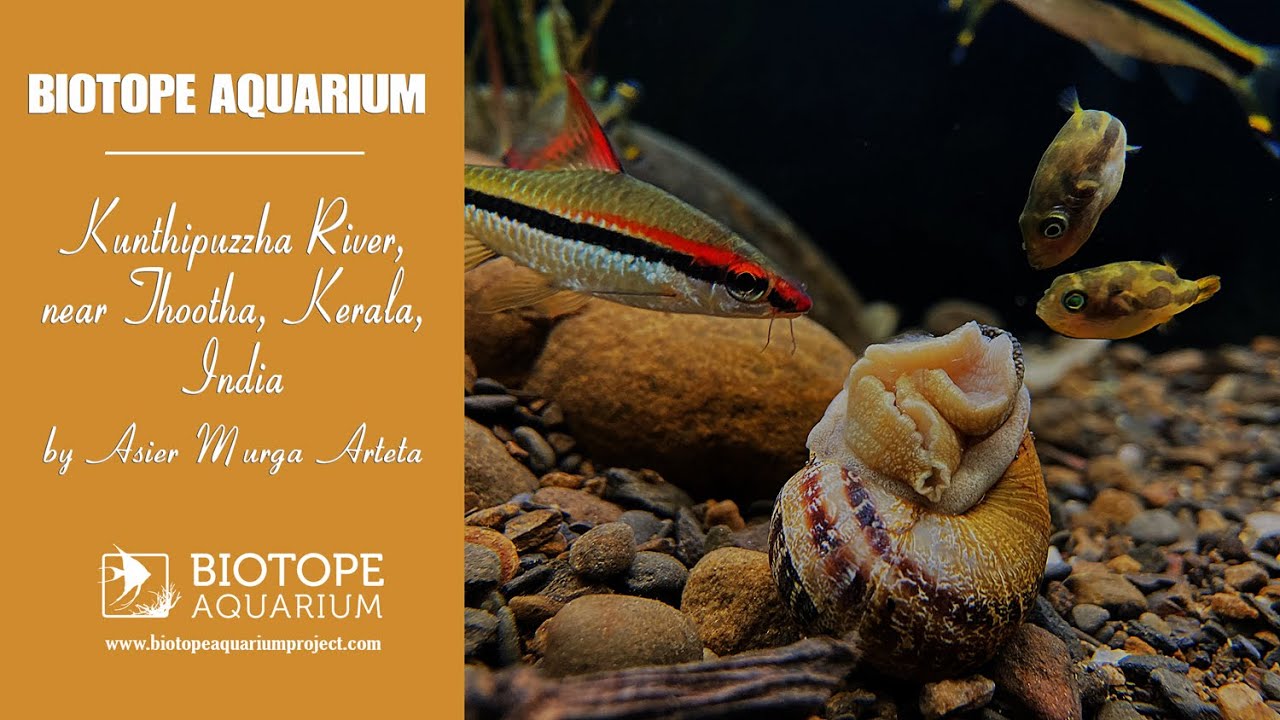
To call it “Western Ghats of India biotope” would not be correct, it is a gigantic place. For me, to say “Kunthi River biotope” is not accurate either, because it has more than 100km, and it does not have much to do, for example the upper part of the river, in Silent Valley, a protected, pristine and almost wild place, with the middle course of the river, near Thootha, where nature has had to adapt to the hand of man, with daily urban life and agriculture, that makes it quite different. And I live far, far away from this place, so everything gets complicated, but what gets difficult, I like, it’s a challenge.
The location on the Youtube video is not exactly the place I am trying to recreate, it is recorded about 70 km from Thootha, in Kannur district, Kerala, a protected area.
But here Aravind Manoj and his team got a spectacular work where the water is transparent and we can observe “The Princess of Kerala” in all her splendour.
On social media or in books, I could not find a single underwater video or photo of the Kunthipuzzha River, not even of the famous Silent Valley, let alone the middle course near Thootha.
To properly document this work, I was fortunate to have the help of photographer and friend, Aravind Manoj, who did a great job on the ground. I met him thanks to Meenkaran, another great professional. With his videos on Instagram and Youtube , we get to know and enjoy these wonderful aquatic ecosystems of India.
Aravind asked me if I was sure that the Dawkinsia denisonii would steel exist in that location and at those coordinates marked by Heiko Bleher.
Withouth hesitation, I answered that yes, “if Heiko says so, they are there”. Then, thinking about it more carefully, I asked myself the question.
“If has been 18 years since Bleher made that expedition, what if due to pollution, climate change and the hand of man, this fish has become extinct in the Kunthi River, near Thootha? What if I movilised Aravind and his team for nothing?” It was a risk that had to be taken, it was worth the effort and the work.
On Friday 14 February 2025, Aravind and his team arrived at the site and started filming. The next day he started sending me photos and videos and it was just as Heiko descibed it.
It wasn´t that easy, though, because the first thing they found was that they were doing some construction work, right there, under the bridge and over the river cutting it and redirecting it through a small dam, so that they could repair the bridge. A real pity because we would have liked to find it intact, but expectations are one thing and reality is another.
Summer has already started, so the water is not transparent and it was difficult to record good underwater videos, but still you can appreciate them reasonably well, and get and idea of the biotope I am trying to recreate, with it big Cryptocoryne retrospiralis and rocks and gravel on the bottom.
When the rainy season comes, these plants will be semi-submerged, just like in my aquarium. Now they were practically all out of the water. In other higher and deeper areas, the water is clearer, but everything was difficult to work with, due to the dept.
The videos show barbel of various types and other types of fish, which are difficult to identify due to the turbidity of the water. Fortunately they had the good idea to catch a few fish in the area near the bridge, put them in a bag and film them, to certify their existence there.
I have so say that while I was downloading the video that Aravind sent me, my hearth was beating fast and strong, it was the only possibility to corroborate the presence of the Kerala Princess and the small puffer fish in that place chosen to recreate in the aquarium.
After several attemps in the vinicity, they were only able to capture 1 beautiful Dawkinsia denisonii, which gives food for throught about the possible decline of the population of this species there, but at least it also indicates that is not extinct in that area. 18 years ago, Bleher saw them spawning in droves underneath the Cryptocoryne retrospiralis, now it’s a different story.
As for the Carinotetraodon travancoricus, there doesn’t seem to be much of a problem, there are 3 specimens in the bag.
What is clear, fortunately, is that in the Kunthi River near Thootha and its bridge and throghout the river system there is still a great variety of fish.
Among those caught were:
- Pangio ammophila (Cobitidae)
- Pristolepis marginata (Pristolepididae)
- Glyptothorax anamaliensis (Glyptothorax anamalaiensis)
- Mastacembelus armatus (Mastacembelidae)
- Devario malabaricus (Danionidae)
- Pseudolaguvia austrina (Sisoridae)
- Mesonoemacheilus herrei (Nemacheilidae)
- Bhavania australis (Balitoridae)
- Puntius amphibius (Cyprinidae)
I hope the master Heiko Bleher can reed this, because I think he will be happy to know that all these fish still inhabit the waters of this peculiar and the same time wonderful place, as he could see in his book “Bleher’s Biotopes“, a book that changes my life and my way of understanding the aquarium hobby.
Out of the water, on the river bank, Aravind Manoj observed many coconut trees, banana plants, Ficus religiosa (the “sacred fig tree” it comes from Sree Bhagavathy Temple, located next to the bridge, which is the exact location of the biotope I am recreating), Areca catechul, Cassia fistula, Pandanus kaida, Arundo donax, Limnocharis flava and some Bamboo, thanks to the musician and environmentalist Feben, concerned about lethal soil erosion in Kerala, joined forces with NGO Director Abrayam Krishnan, other environmentalists and nearly a thousand Panchayat leaders, hired by the Mahatma Ghandi National Rural Employment Guarantee Scheme, to plant Bamboo all over the state, convincing everyone of the great benefits on this plant.
Krishnan told the media:
“We have planted in many places, including the banks of the Thootha River”, as the locals call the Kunthi River, passing through Thootha.
It is a paradise for those of us who love native fish and their biotopes, a shelter where nature is at its flows, in harmony and balance, taking us to a world of life and preserved beauty.
The Kunthi River is a tributary of the Bharathapuzha River. Is one of the least torrential rains in the Ghats Westerners.This river, flows through the Silent Valley National Park, from there it descends to its middle course downstream towards the coasted region of the State of Kerala.
Thank to the “Save Silent Project Valley” is an area of dam-free catchment hydroelectric and pesticides, at least in its uper flow, in that region the soil is blacklish and slightly acidic in the evergreen forests, where there is a good accumulation of organic matter.
However, downstream and in the surrounding of Thootha both banks of the river are occupied by infraestructure and land agricultural. This river is used mainly because of the people of Mannarkad taluk from the district of Palakkad.
The protected areas are located in the upper flow of the Kunthi River. In this middle course of the river, there is an are of agricultural plantation area, coconuts, mangoes, jackfruit, banana, black peper, rice, jenjibre, cardamom, robber, bamboo and oil plam, among others are grown.
We will talk about the oil plam later. Coconuts and bamboo are a reflection of the cultural and ecological influence in the area, forming part of the Kunthi River riparian landscape.
Bamboo could be the answer to Kerala’s persistent soil erosion and deadly landslides, say passionate environmentalists. Who plant hundred of saplings and sing sounds supporting their further spread.
“Did you know that bamboo releases 35% more oxygen than other trees, or that bamboo was the only plant to surving the bombing of Hiroshima and was used to green the city? It also has nutritional and medicinal benefits.
That’s why I want to keep planting bamboo. Bamboo roots cant prevent soil erosion and landslides. We need to plan them as torrential rains and landslides are becoming common in Kerala”, said Abrayam Krishnan. Beyond bamboo baskets, passion for bamboo spreads further affield of forests. Increasingly the alternative to plastic.
This grass variety is being promoted by many agencies due to its resilience against climate change. From its traditional uses for wood and household items, it is becoming a lifestyle product used to make a wide range of items. In Kerala every house has a coconut tree. For people who get coconuts or money by selling them, bamboo plants did not have much appeal.
“We sing about the importance of bamboo and the need to grow them, using bamboo musical instruments. People contribute generously, helping us to plant more saplings”. Many of his friends buy saplings and plant whenever possible as well.
Turning a little further upwards, Silent Valley lovated 40 km from the town of Mannarkad in Palakkad district, has wildlife and beautiful flora and fauna, typical of the Western Ghats.
The Valley of Silent National Park is home to an antonishing variety of 1000 species of butterflies and 35 species of reptils. Many of these are endemic to the Western Ghats. The Lion-tailed macaque, tigers, leopards, wild dogs, flying squirrels and deer are part of the wildlife near the pristine Kunthi River. The majestic river that nourished and fed the Pandavas was named after their mother, Kunthi. From the course of the river, upwards on or near the river banks, grow towering tree such as Amla, Semal, Rosewood, Teak and Bamboo.
Terrestrial vegetation list:
- Ficus Religiosa (Moraceae)
- Musa Paradisiaca (Musaceae)
- Areca Catechul (Arecaceae)
- Cocos Nucifera (Araceae)
- Cassia Fistula (Fabaceae)
- Kaida Pandanus (Pandanaceae)
- Tectona Grandis (Lamiaceae)
- Bambusa Bambos (Poaceae)
- Magnifera Indica (Anacardiaceae)
- Artocarpus Heterophyllus (Moraceae)
- Dalbergia Sisso (Fabaceae)
- Bombax Ceiba (Malvaceae)
- Phyllantus Emblica (Phyllantaceae)
- Arundo Donax (Poaceae)
- Limnocharis Flava (Alismataceae)
Wetland plants list:
- Bolbitis Appendiculata (Lomariopsidaceae)
- Ranunculus Sceleratus (Ranunculaceae)
- Isachne Globosa (Graminae)
- Juncus Effusus (Juncaceae)
- Wiesneria Triandra (Alismataceae)
- Crinum Viviparum (Amayllidaceae)
- Cyperus Papyrus (Cyperaceae)
- Typha Angustifolia (Typhaceae)
- Arundo Donax (Poaceae)
- Limnocharis Flava (Alismataceae)
Here was documented the plant known as Cryptocoryne retrospiralis in a large cuantity. Along this river, more aquatic plants can also be found, some growing emerged, such as Cryptocoryne cognata, Eriocaulion cinereum, Pogostemon stellatus, Trapa natans, Ceratophyllum demersum, Bacopa monieri, Landolta punctata and Blyxa japonica.
Others are partially submerged only roated in water, such as Chara braunii, Azolla pteropsida, Isoetes coromandelina, Ranunculus sceleratus, Isachne globosa, Juncus effusus, Aponogeton satarensis, Crinum viviparum, Potamogeton crispus, Cyperus papyrus and Typha angustifolia.
As for as fish concerned, Heiko Bleher in his expedition collected “Princess of Kerala” females full of eggs, hardly 10 cm in TL and with many babies alongside Dawkinsia filamentosa. Both had almost identical juvenile colour pattern, 4 black bars, they where spawning at 31.4°C, the pH was 7.1 and the conductivity 64µS. Throghout the year the temperature varies between 22-34°C, in the water, slightly less.
Many extremely golden coloured Carinotetraodon travancoricus were swimming in the open waters often together with gorgeus Aplocheilus lineatus with their eyes coloured like a rainbow.
Also swimming here in the crevices on the rocks were yellow-golden Mesonoemacheilus triangularis, often next to beautiful Awaous (possibly Awaous grammepomus) and a single Syciopterus griseus, with is amazing teeth perfectly adapted to scrape the Aufswuchs from the rocks. Puntius amphibius, Salmosphasia boopis, Hypselobarbus furmuca, Laubuca fasciata, Pseudolaguvia austrina and Caridina shenoyi, have also been documented.
At the bottom, dark and rounded stones, grey sand mixed with gravel, reddish slit, leaves and few branches from nearby trees. Beneath the Kunthi River, calmly it lies, grey sand and red gravel in gentle ties. Submerged branches whisper tales as they sway and the Jewell of India shines in its display.
Fish list:
- Carinotetraodon travancoricus (Tetraodontidae)
- Pristolepis marginatus (Pristolepididae)
- Sicyopterus griseus (Gobiidae)
- Glyptothorax anamaliensis (Siluriformes)
- Salmosphasia boopis (Cyprinidae)
- Mastacembelus arnatus (Mastacembelidae)
- Awaous grammepomus (Gobiidae)
- Devario malabaricus (Cyprinidae)
- Puntius amphibius (Cyprinidae)
- Etroplus maculatus (Cichlidae)
- Sahyadria denisonii (Cyprinidae)
- Mesonoemacheilus Triangularis (Baltoridae)
- Mesonoemacheilus herrei (Baltoridae)
- Dawkinsia filamentosa (Cyprinidae)
- Puntius mahecola (Cyprinidae)
- Garra menoni (Baltoridae)
- Homaloptera pillaii (Baltoridae)
- Puntius fasciatus (Cyprinidae)
- Bhavania australis (Baltoridae)
- Hypselobarbus curmuca (Cyprinidae)
- Laubuca fasciata (Cyprinidae)
- Pseudolaguvia austrina (Eretistidae)
- Caridina decapodae (Atyidae)
- Pangio ammophila (Cobitidae)
- Aplocheilus lineatus (Aplocheillidae)
Aquatic plant list:
- Blyxa japonica (Hydrocharitaceae)
- Chara braunii (Characeae)
- Azolla pteropsida (Azollaceae)
- Marsilea minuta (Marsileaceae)
- Isoetes coromandelina (Isoetaceae)
- Pogostemon stellatus (Lamiaceae)
- Trapa natans (Trapaceae)
- Landoltia punctata (Lemnaceae)
- Ceratophyllum demersum (Ceratophyllaceae)
- Aponogeton satarensis (Aponogetanaceae)
- Eriocaulion cinereum (Eriocaulaceae)
- Potamogeton crispus (Potamogetonoceae)
- Cryptocoryne cognata (Araceae)
- Cryptocoryne retrospiralis (Araceae)
The Western Ghats, which rise above 1000m, strecht like a curtain parallel to the West coast of India. Like the folds of a curtain, the mountains have folds. They also rise steeply in place, literally forming and impenetrable wall the blocks the rain-laded southwest monsoon clouds. When the clouds find it difficult to overcome the wall, they drop their pay load the rain.
Thus, Kerala which occupies the thin strip of land west of the mountains, receives an average annual rainfall of close to 3000mm, making in the envy for other plants of the country.
Near Bharathapuzha flows the Thootha River, also known as Kunthi River. It never dried up completely even in this worst period.
Closer to the delta, the Kunthi River joins the Bharathapuzha giving it some flow in its final strecht. There are two reasons, why the Kunthi River flows all year round, ever during the worst summers. First, it emerges from of the richest and most biologically diverse rainforests in the Silent Valley. Second, it has no dams, to obstruct its course.
The people’s movement to stop the Silent Valley Project was the first significant milestone in India’s environmental history that brought national and international attention the forests and the intervention of a prime minsiter. Thank to them, the Kunthi River has never dried up. Although the struggle always continues, there are other threats, and these, climate change aside, always come at the hand of humans.
Another problem, Kerala’s Government is planning a big push to more than double the area under oil palm cultivation over the next five years, attracting farmers through subsidies and price supports mechanisms to reduce the state´s heavy reliance and palm oil imports for domestic use.
This is where the conflict of interest comes in, because what seems to be good for the economy is not all good for nature. If oil palm plantations come close of the Kunthi River, the health of the river is at risk.
There are plently of arguments, as we can see bellow:
Palm oil is a very productive crop. It offers a much higher yield at a lower production cost than over vegetable oils.
Global production and demand for palm oil is increasing rapidly. Plantations are spreading across Asia. But such expansion comes at the expenses of the tropical forests, which from critical habitats for many endangered species and a lifeline for some.
-Atmospheric pollution:
Burning is a common method of clearing vegetation in both natural forests and oil palm plantations.
Burning of forests releases smoke and carbon dioxide into the atmosphere, polluting the air and contributing to climate change.
Fires in peatlands are particularly difficult to extinguish. Smoke and haze from these fires have health consequences through South east Asia.
-Loss of critical habitats for species threatened:
Large-scale conversion of tropical forests to oil palm plantations has a devastating impact on a large number of plant and animal species.
Oil palm production also leads to increased human-wildlife conflicts, as populations of large animal and reduced to increasingly isolated fragments of natural habitat.
Destroyed habitats often contain rare and endangered species or serve as corridors between areas of genetic diversity.
Even national parks has been severely affected.
-Soil and water pollution:
A palm oil generates 25 metric tons of effluent for every can cause freshwater pollution, which affects downstream biodiversity and people.
While oil palm plantations are not large users of pesticides and fertlizes overall, the indiscriminate groundwater sources.
-Soil erosion:
Erosion occurs when forests are being cleared to stablish plantations, and can also be caused by planting trees in inappropiate arrangements.
The main cause of erosion is the planting of oil palm on steep slopes. Erosion causes increasing flooding and silt deposits in rivers and ports.
Eroded areas require more fertilizer and other inputs, including repair of roads on other infraestructure.
-Climate change:
The practice of draining and converting tropical peat forests in North India is particularly damaging, as these “carbon sinks” stone more carbon per unit area than any other ecosystem in the world.
Additionally, forest fired used to clear vegetation in the stablishment of oil palm plantations are a source of carbon dioxide that contributes to climate change.
Fortunatelly, however, the Supreme Court of India, has banned the burning of crop fields, as pollution in New Delhi is very high.
On the other hand, the giant Brahmapuram landfill in the State of Kerala is the latest mountain of rubbish to go up in flames in the country, generating dangerous hect and methane emissions and agravating India´s grown climate problems India generates more methane in landfill than any other country, according to GHGSat, which monitors emissions by satelite.
Methane is the second most abundant greenhouse gas after carbon dioxide, but contributes more to the climate crisis because it traps more heat.
As part of his “Clean India” initiative, India´s Prime Minister , said that efforts are being made to remove these rubbish dumps and turn them into Green Zones.
That goal, if achieved, could alleviate some of the suffering of residents living in the shadow of these huge dumps, and help the world reduce its greenhouse gas emissions.
It is never too late to do things right.
As a wise Indian proverb says:
“When the last tree is cutdown, the last river poisoned and the last fish is caught, people will realise that money cannot be eaten”.