bam Demanding level

Lake Xochimilco, Mexico City, Mexico

Sponsored by

Mexico, Mexico City, Xochimilco

This aquarium recreates the shallow, plant-filled freshwater canals of Xochimilco – the last remaining natural habitat of the critically endangered Axolotl Ambystoma mexicanum. Inspired by the slow-moving, murky waters shaded by native willow and aquatic vegetation, the setup mimics the cool, oxygen-rich conditions with submerged driftwood, and fine silt substrates. The tank reflects the delicate balance of this urban wetland, where amphibians and native plants survive amidst growing human impact. My motivation was to highlight the fragility of this ecosystem while offering a naturalistic refuge for the Axolotl.

Submitted by
Shivansh Rajpoot
Approved by
Michael Köck, Jairo Arroyave & Juan M. Artigas Azas
GPS
19.2891579, -99.1017532
Geographical region
Central America
Drainage Basin
Lerma–Santiago Basin
River catchment
Lake Xochimilco Sub-basin
Water body type
Lake
Water body name
Lake Xochimilco
Water body part
Marsh land
Water body course
Middle course
Water body: tributary of
Tributary name

Videos above and below water

Warning: Undefined variable $fish_parent in /home/biotopea/public_html/wp-content/themes/bap/content-bam.php on line 85

Warning: Undefined array key "additional_species" in /home/biotopea/public_html/wp-content/themes/bap/functions/bap-fields.php on line 349

Water Chemistry

Water information

Water type
fresh-water
Water color
Clear water
Water transparency
High
Concentration of sediments
Low
Water temperature
22 °C
Water flow/curent
Slow

Chemical parameters

pH
7.5
Conductivity
100
GH
60 mg/l
dGH
KH
30 mg/l
dKH
Dissolved Oxygen
85 %

Aquarium information

Aquarium description

Set-up date
22/02/2025
Aquarium decoration

To recreate the naturalistic environment of the Xochimilco wetlands in Central Mexico—native to Ambystoma mexicanum (Axolotl) – the aquarium was arranged with fine river sand as the substrate, mimicking soft lakebeds. A carefully sculpted pile of large, round basalt and lava rocks provides shaded burrow-like spaces while resembling the volcanic geological background of the native basin.

Dried Indian almond and jackfruit leaves were added to replicate the tannin-rich, slightly acidic microhabitats. A central hardscape arrangement includes driftwood branches that imitate submerged root systems along Xochimilco’s canal edges. These elements are layered to encourage shelter-seeking behavior and induce a sense of natural seclusion, essential for stress-free axolotl behavior.

No artificial background is used; instead, a gentle gradient blue sheet simulates underwater depth and clarity, similar to the open channels of Xochimilco. The water remains shallow (under 40cm) to allow easy breathing access and to maintain the cooler temperature range essential for axolotls.

Aquarium equipment
  • Lighting: NeoHelios 13 Watt RGB Light – Offers a soft, evenly diffused glow across the tank, imitating the filtered sunlight typical of shallow lakebeds. The light intensity is kept moderate to reduce stress and overheating for axolotls.
  • Filtration: EHEIM Classic 600 canister filter – Known for its silent operation and large capacity, it ensures efficient mechanical and biological filtration. Filled with sponge and ceramic media to support beneficial bacteria without creating excessive current.
  • Cooling: A dedicated aquarium fan is installed to regulate temperature, maintaining it between 17–20°C, crucial for axolotl health during warmer periods.

Amphibian list:

  • Ambystoma mexicanum (Ambystomatidae)
Fish care

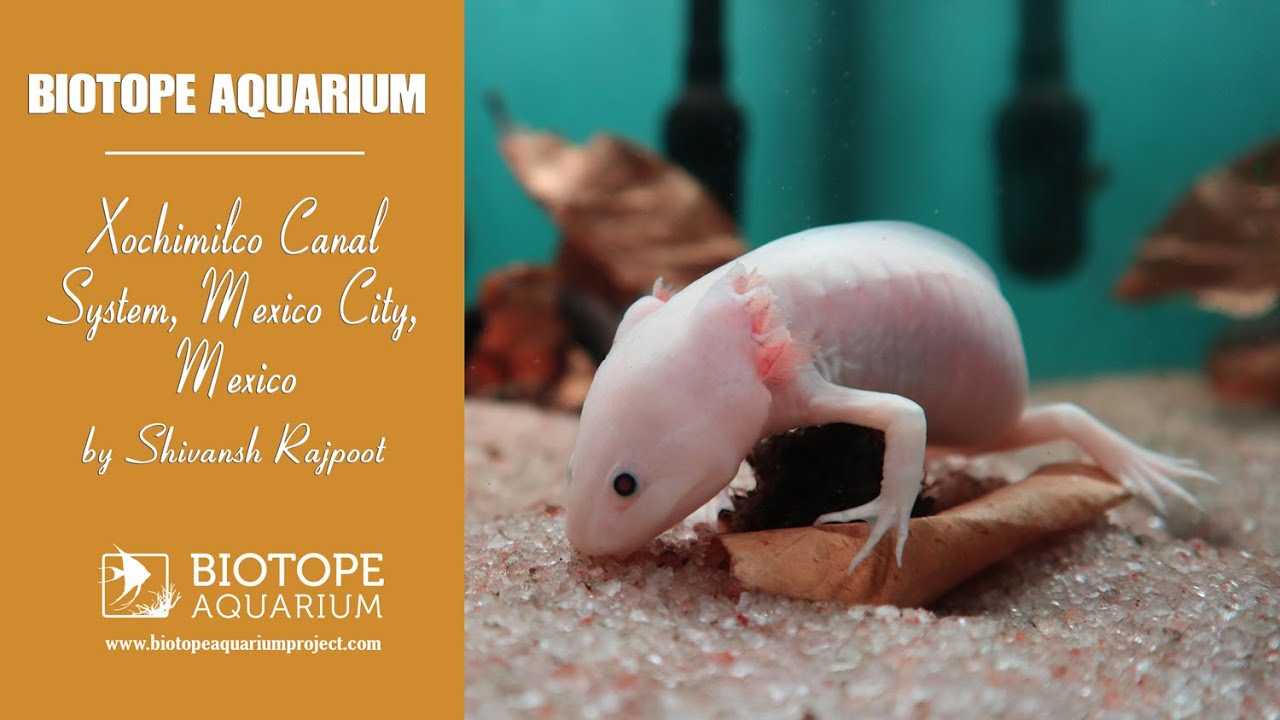
Three leucistic Axolotls (Ambystoma mexicanum) are housed in this biotope. The tank layout supports their nocturnal and bottom-dwelling behavior. Each individual has its own shaded retreat formed by driftwood crevices or the central rock cluster.

Feeding occurs at dusk, consisting of:

  • Earthworms
  • Sinking carnivore pellets
  • Occasional bloodworms or raw shrimp as treats

Care is taken to maintain a sand-only base to prevent substrate ingestion. The tank is uncovered to avoid sudden temperature spikes. Partial water changes (30%) are carried out biweekly, with frequent monitoring of ammonia levels to ensure pristine water quality.

Plant care

Due to the coldwater and low-light nature of the axolotl habitat, this setup contains no rooted aquatic plants. Leaf litter and decaying matter serve as the primary organic base. Occasionally, floating Ceratophyllum demersum or duckweed may be introduced temporarily but are not sustained for long due to the active movements of the axolotls.

Water care

To ensure ideal conditions for the axolotls, a consistent and low-stress maintenance routine is followed:

  • Water Changes: 20–30% of the tank water is changed every 3 days, using dechlorinated, temperature-matched water to avoid sudden shifts in water chemistry or temperature.
  • Gravel Cleaning: Uneaten food and waste are removed using a siphon during water changes, especially from around leaf litter and under driftwood.
  • Filter Maintenance: The EHEIM Classic 600 is cleaned every 2 months, rinsing media in tank water to preserve beneficial bacteria colonies.
  • Cooling Check: The fan system is inspected weekly to ensure it maintains a stable 17–20°C temperature, ideal for axolotls.
  • Monitoring: Parameters like ammonia, nitrite, and nitrate are tested biweekly, and pH is monitored monthly.
  • Top-offs: Evaporated water is topped up with RO or dechlorinated water daily or as needed, avoiding salinity build-up.

This method promotes a stable, clean, and safe environment mimicking the cool, slow-moving waters of native axolotl habitats.

Dimensions

Length
45 cm
Depth
45 cm
High
45 cm
Volume
90 L

Substrate in aquarium

Sand
White
Pebble/Gravel
Grey
Stone
Grey
Stone form
Roundish
Silt/Mud
None
Leaves
Few
Driftwood
Few
Submerged terrestrial vegetation
None

Bibliography

  • Oxford University Press - The Biology of the Axolotl by Griffiths, Richard A.
    ISBN 978-0198540624
  • Bulletin of the Museum of Comparative Zoology - Natural history, ecology, and evolution of the axolotl by Shaffer, H.B.

Comment by the expert

Michael Köck: I must admit that evaluating this aquarium was the most difficult task for me. I know that it may seem a little arrogant when a judge awards few or, as in this case, no points at all for certain categories, so I will now provide a more detailed explanation. The description of the natural habitat is not reflected in the aquarium in any detail. The volcanic origin, which could have been imitated with a little volcanic rock, was not achieved with large round stones. Underwater vegetation, which does occur, is emphasized in the habitat description, and plays an important role in the axolotl’s habitat, was completely omitted. The lighting situation was missed and – which is an absolute no-go for me – the albino variant of an axolotl hybrid was used. Almost all axolotls on the market are hybrids, including all color variants, and it is admittedly difficult, but not impossible, to obtain proven homozygous animals. At the very least, a wild-colored variant should have been used, in fact, it should have been. Improvements could have been made by dimming the lighting, adding muddy substrate, underwater vegetation with cleverly placed organic material (roots, branches) as hiding places, and at least one wild-colored variant as stock, which would have made it possible to overlook the fact that it was a hybrid. This would have significantly improved the result. Unfortunately, the aquarium largely misses the mark, which, given the quality of other entries, does not allow for a top result.

Jairo Arroyave: While this BAM includes a beautiful specimen of the iconic axolotl, the rest of it is in my opinion very bare bones and hardly reproduces the complexity and intricacy of this biotope. Hence my rather low scores.

Juan M. Artigas Azas: I found the aquarium perfect to keep axolotl.