- Set-up date
- March, 2025
- Aquarium decoration
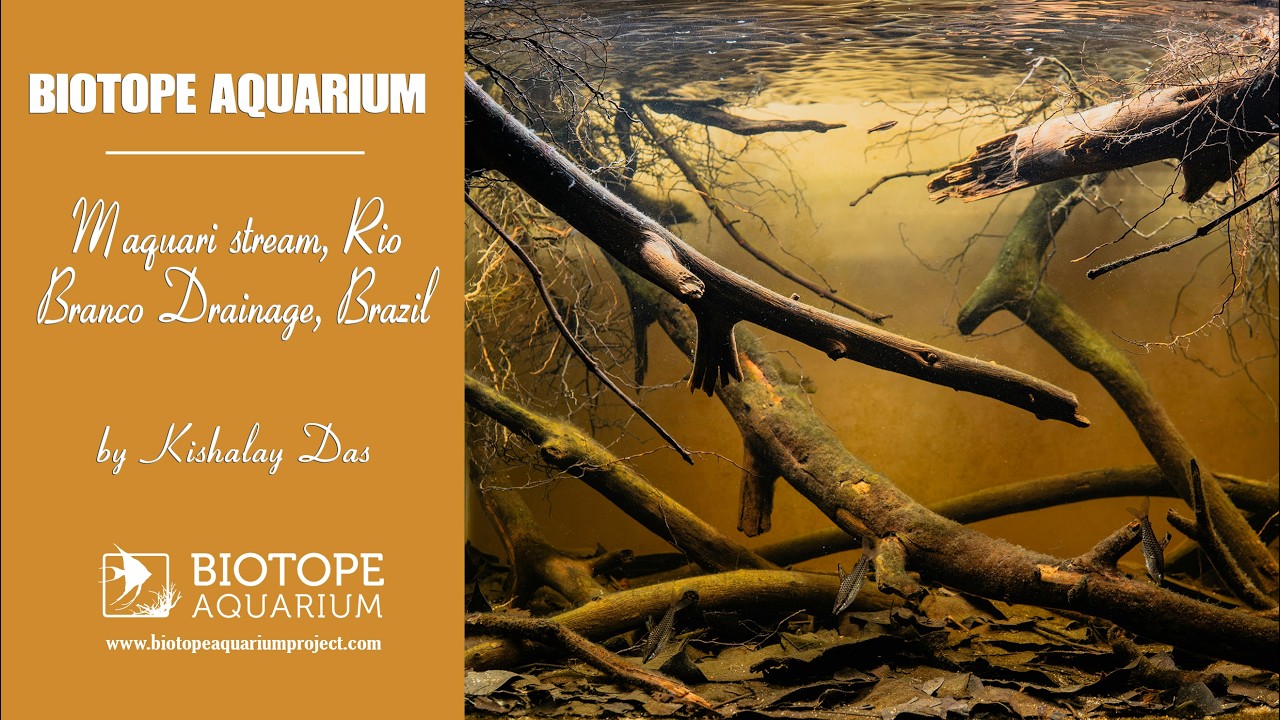
The aquarium was designed to closely replicate the structure and ecological characteristics of a small clearwater creek within the Rio Branco drainage. A fine sand substrate was used as the base layer to mimic the natural streambed and provide a suitable environment for benthic species. Over time, a layer of naturally accumulated detritus developed among the leaf litter, reproducing the organic-rich substrate commonly found in these habitats.
The hardscape consists primarily of weathered driftwood, roots, small twigs, and abundant leaf litter, arranged to create a complex network of shaded areas and natural cover. As the aquarium matured, biofilm naturally developed on the wood surfaces, further enhancing the ecological authenticity of the setup and providing an additional food source for grazing fishes.
The species selection was intentionally limited to maintain ecological accuracy and represent a specific locality rather than a generalized Amazonian community. The occurrence of Apistogramma agassizii and Nannostomus beckfordi within the target creek was confirmed through discussions with Jackie Anderson of Project Piaba and further supported by GBIF occurrence records from the Rio Branco drainage. This evidence provided confidence in including these species within the biotope.
The fishes display behaviours consistent with those observed in their natural habitat. Nannostomus beckfordi primarily occupies the surface layer, frequently seeking shelter among overhanging roots while foraging in the upper water column. Chilodus punctatus spends much of its time grazing on biofilm, decomposing organic matter, and submerged wood, contributing to natural nutrient cycling within the aquarium. Apistogramma agassizii remains closely associated with the leaf litter and sandy substrate, where it forages for small invertebrates and establishes territories in sheltered areas.
One species that was originally intended for inclusion was Dicrossus filamentosus. Its distribution overlaps with the selected habitat and it would have complemented the community both ecologically and behaviourally. However, due to the lack of recent imports and its limited availability in my region, it was unfortunately not possible to acquire this species for the aquarium.
Fish:
- Apistogramma agassizii (Cichlidae) — 2 specimens
- Nannostomus beckfordi (Lebiasinidae) — 6 specimens
- Chilodus punctatus (Chilodontidae) — 5 specimens
- Aquarium equipment
Filtration: Dophin C500 external canister filter (1,000 L/h), filled with Seachem Matrix, ceramic rings, and filter floss to provide efficient biological and mechanical filtration while maintaining clear water.
Lighting: Two AST X5 LED fixtures and one SOBO COB AL-580 LED light.
Heating: RS Electrical 150W heater, used during the winter months to maintain stable water temperature.
- Fish care
The fish are maintained on a varied, high-quality diet that closely reflects their natural feeding habits. Their primary foods consist of live Grindal worms and frozen bloodworms, with Hikari Micro Pellets offered occasionally as a supplementary prepared food to ensure a balanced nutritional intake. A slow water current is maintained to replicate the gentle flow characteristic of Maquari Creek.
Every effort has been made to recreate the natural habitat as accurately as possible, allowing the fish to display their natural behaviour in an environment that closely resembles their native ecosystem. Stable water parameters and careful observation of fish health help maintain optimal welfare and long-term stability within the biotope.
- Plant care
No aquatic plants were observed at the collection locality during habitat documentation. Therefore, no aquatic plants have been included in the biotope.
- Water care
A 30-40% water change is performed every two weeks using stored, treated RO water to maintain stable water chemistry and closely replicate the soft, acidic conditions of the natural habitat.
The leaf litter bed is intentionally left undisturbed to preserve its natural appearance and ecological function, providing a more authentic biotope environment. Maintenance is kept to a minimum, with only the front and side glass panels cleaned when visible algae develops, ensuring the aquarium retains the natural character of Maquari Creek while providing a healthy environment for its inhabitants.