- Set-up date
- September, 2023
- Aquarium decoration
This biotope is based on the Río Cocotis. I have chosen to recreate the coastal areas of the river, as this is where there is generally the most vegetation. At the same time, I have tried to recreate a riverbed dominated by stones in both round and more angular shapes. Rocks are a mix of “normal” stones and volcanic stones. This is done to mimic the look of the river even more, sense volcanic stones are very common in rivers in Costa Rica.
I have attempted to create a rock formation that slopes down towards the bottom, partly for obvious visual reasons and partly to recreate the way the stones slope up towards the river’s edge in the original biotope.
The substrate in the aquarium is a mix of sand, crushed lava, and soil-like pebbles. This was done to replicate some of the substrate commonly found in this area, as it is not just regular sand.
I have chosen to add some Vallisneria nana and Bacopa caroliana to the setup as well. Which is not biotope correct plants, but I have deliberately chosen that anyway. The Bacopa caroliana is an invasive species, and could be living in the biotope. The Vallisneria is not correct at all, but I have chosen this specific plant to help create the look of grass-like areas located in the transition zone between land and water.
These grassy types of vegetation get flooded and exposed during the seasonal changes of the river. Most natural present plants from the biotope are not available in the aquarium trade anyway, so some kind of compromise needed to be done.
- Aquarium equipment
- Aquarium: Aquael Optiset 125: 81x36x51 cm (125 liters)
- Filter: Fluval 207
- Lighting: Twinstar 90B RGB-W.
- Fish care
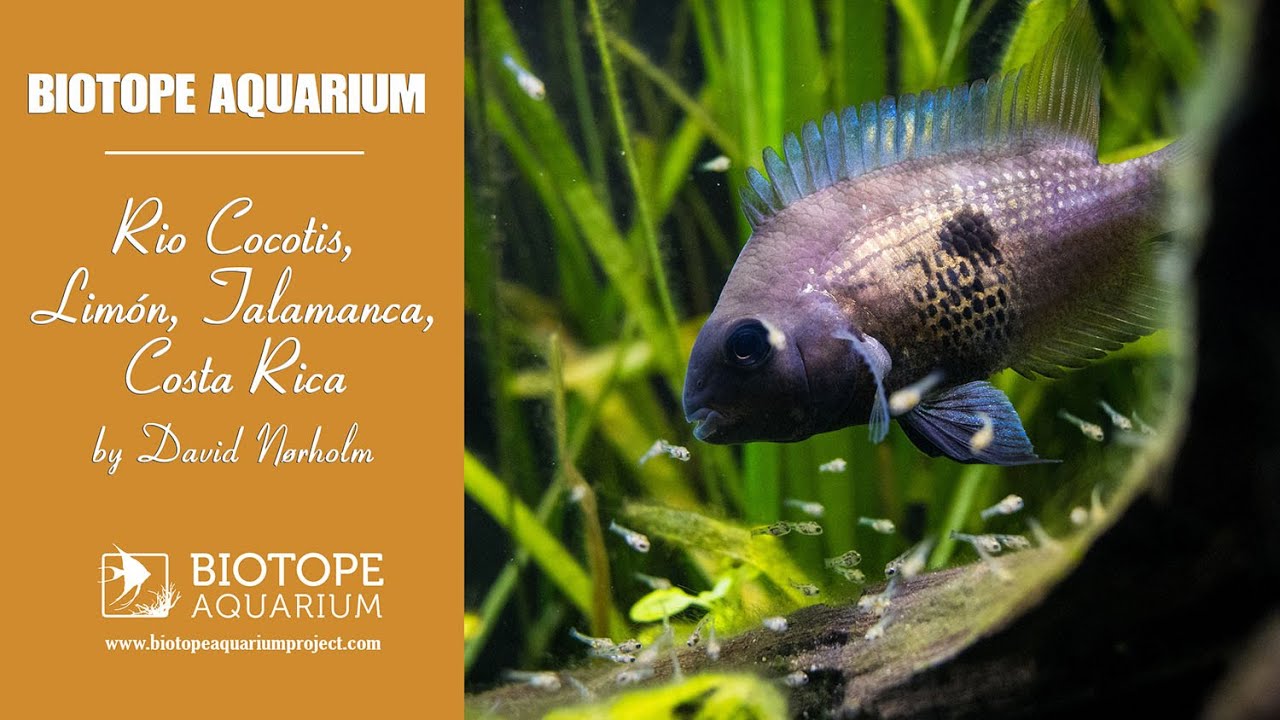
The aquarium is created in such a way, that the Amatitlania myrnae have plenty of hiding spots between the rocks. In this way, they can feel secure and exhibit the most natural behavior possible. As a result, they also frequently have offspring.
When it comes to the choice of fish, there is again a deliberate compromise, as I have chosen to use Poecilia sphenops in the aquarium. This specific Poecilia does NOT live in Costa Rica, but was chosen because Poecilia gilli is impossible to find in the aquarium hobby. At the same time, I was fortunate enough to catch some wild-type Poecilia sphenops, which are as close to gilli as one can get. Both in terms of appearance and behavior.
In some of the reports I have read while researching this project, Poecilia mexicana, Poecilia sphenops, and Poecilia gilli are even referred to as geographical subvariants of the same species. Therefore, I found it suitable as a substitute for Poecilia gilli.
The relatively tall aquarium is ideal for Poecilia sphenops, as they often swim in the upper part of the water. This way, they do not feel pressured or stressed when the cichlids have offspring and expand their territory.
Fishes:
- Amatitlania myrnae (Cichlidae)
- Poecilia sphenops (Poeciliidae )
- Plant care
I have chosen to plant Vallisneria in the background of the aquarium to mimic some of the grasses and reeds that grow in the transitional zones of the river. Vallisneria is, of course, not a native species to the area, as it originates from Africa, but the plants that naturally grow in these rivers are simply not realistic to keep in an aquarium.
Moreover, I have chosen to plant Bacopa caroliniana among the stones to imitate some of the small vegetation that grows scattered in the river. Bacopa caroliniana is also not native to Costa Rica, but it does grow close by in the USA. It was chosen for visual reasons and because it is the art of the possible.
Plants:
- Bacopa caroliniana (Plantaginaceae)
- Vallisneria sp. (Hydrocharitaceae)
- Water care
- Tropica Liquid fertiziler are added daily.
- 25% water change once a week.