bin
Río Cocotis, Limón, Talamanca, Costa Rica
Costa Rica, Talamanca, Limón
Río Cocotis is a small river located in the southeastern part of Costa Rica, near the border to Panama. This little river offers a beautiful setting with its rocky bed and lush surroundings. The river flows through a dense and varied landscape with rich biodiversity.
The clear, gently flowing waters of Río Cocotis meander through a landscape that is rich in natural beauty. Many different fish live in the river, with a couple of aquarium types living here as well.
- Submitted by
- David Nørholm
- Approved by
- Michael Köck & Jairo Arroyave
- GPS
- 9.5747805, -82.9322586
- Geographical region
- Central America
- Drainage Basin
- East coast, Caribean Sea
- River catchment
- Río Telire
- Water body type
- Rio
- Water body name
- Cocotis
- Water body part
- Channel
- Water body course
- Middle course
- Water body: tributary of
- Rio
- Tributary name
- Tilere
Videos above and below water
Warning: Undefined variable $fish_parent in /home/biotopea/public_html/wp-content/themes/bap/content-bin.php on line 55
Water Chemistry
Water information
- Water type
- fresh-water
- Water color
- Clear water
- Water transparency
- High
- Concentration of sediments
- Medium
- Water temperature
- 23 °C
- Water flow/curent
- Slow
Chemical parameters
- pH
- 7.5
- Conductivity
- GH
- dGH
- KH
- dKH
- Dissolved Oxygen
- 85 %
Substrate in nature
- Sand
- Beige
- Pebble/Gravel
- Mixed
- Stone
- Mixed
- Stone form
- Roundish
- Silt/Mud
- Beige
- Leaves
- Few
- Driftwood
- Few
- Submerged terrestrial vegetation
- Yes
Aquatic Biotope
- Date of collecting
- 19 March, 2022
- Collecting area
- River bank
- Water depth
- 1,0m
- Air temperature
- Sunlight
- Partial shade
Environment
- Environment
- Affected by human activity
- Affected by human activity
- Agriculture
- Agriculture
- Advanced
- Surrounding area
Costa Rica boasts an exceptional variety of flora and fauna, containing about 5% of the world’s biodiversity despite covering only 0.03% of the Earth’s surface. Over 25% of the country’s land area is dedicated to national parks and reserves. This remarkable biodiversity is largely due to Costa Rica’s unique geographic location, situated between North and South America, which facilitates the movement of species.
The country is home to a wide array of wildlife, including 10,000 species of plants and flowers, 7.000 species of butterflies, 850 species of birds, 208 species of mammals, 220 species of reptiles, 160 species of amphibians, 34,000 species of insects, and 1,600 species of fish.
Costa Rica is among the 14 nations that have more than 23% of their territory under protection.’
Río Cocotis is a small river located in the southeastern part of Costa Rica, near the border to Panama. This little river offers a beautiful setting with its rocky bed and lush surroundings. The river is located in an area of dense and wild-growing forest that stretches along the river on both sides. Many different kinds of animals live along the river and benefit from the conditions it provides.
The clear, gently flowing waters of Río Cocotis meander through a landscape that is rich in natural beauty. Many different fish live in the river, with a couple of aquarium types living here as well.
The Río Cocotis is a relatively quiet flowing river, and cannot at all be compared to the nearby Río Telire, which is far bigger and has a faster current.
- Underwater landscape
The underwater landscape of Río Cocotis in many ways resembles the classic Central American river, and yet it doesn’t. On one hand, it is very similar to other rivers in the area, being dominated by round stones and driftwood. However, what sets this small river apart from many others in the region is the presence of plants growing within it, and in some places, there is even dense vegetation, especially during periods when the banks are flooded.
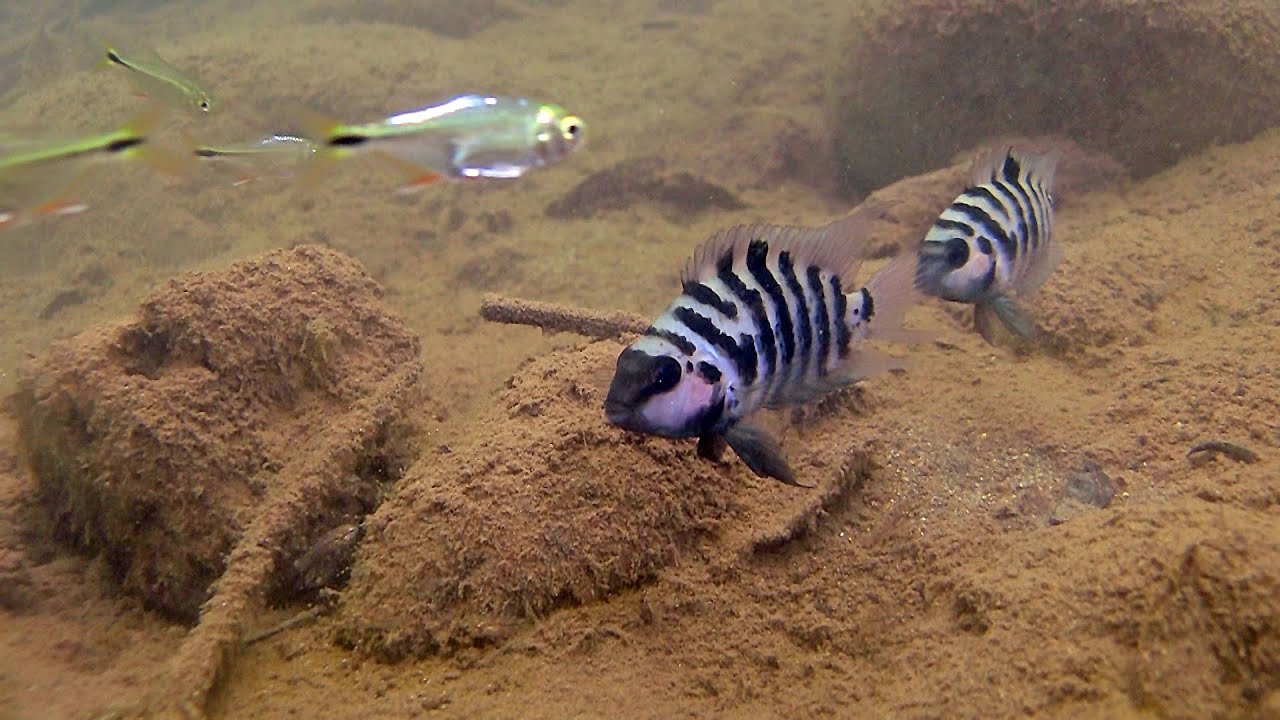
The relatively small size of the river and its limited current make it an ideal habitat for various small fish. I have not been able to identify all the species in the associated videos but have identified a number of them.
Beneath the surface, there are areas with numerous stones piled up, covered in a thick layer of algae. It is often difficult to see the bottom in some parts of the river. In some areas of the river you can also find vulcanic stones, that originates from some of the volcanoes located some distance from there.
Along the banks, there are flooded areas with various species of reeds that resemble underwater grass.
Fishes:
- Poecilia gillii (Poeciliidae)
- Amatitlania myrnae (Cichlidae)
- Cribroheros bussingi (Cichlidae)
- Amatitlania kanna (Cichlidae)
Plants:
- Utricularia foliosa (Lentibulariaceae)
- Najas arguta (Hydrocharitaceae)
- Cyperus articulatus (Cyperaceae)
- Threats to ecology
Although Costa Rica is among the countries in the world with the strictest nature protection, there are still several threats to this area. Among the biggest threats are the establishment and operation of banana plantations. Both deforestation associated with the establishment of plantations and their general operation pose a threat to nature.
Additionally, there are threats in the form of more general human activities, such as wastewater and tourism, which put pressure on the area as well.
Riparian zone
- Trees near the aquatic habitat
-
Many -
Comment by the expert
Michael Köck: The biotope has been adequately studied, though the list of water parameters shows some gaps. It is not easy to compose a biotope aquarium just after descriptions, videos and pictures without having been at the place, therefore the amount of time dedicated to the research needs to be appreciated.
Jairo Arroyave: Information presented about the BIN appears sufficient yet not exhaustive. There is a few underwater photographs but not video below water, and only a few photos of BIN from surface. The descritpion of the BIN is also not very detailed but enough.