- Set-up date
- 31 November, 2023
- Aquarium decoration
To recreate this biotope I started by placing the beige (non-calcareous) river stones in a similar way as seen in the BIN, leaving several natural caves between them, where the fish can shelter or rest. Some algae can bee seen attached to the stones, as seen in the biotope. A beige-coloured sand of medium gray size (as seen on the river banks).
I have imagined that the current has dragged here a trunk from one of the many, trees that surround the river, and it got wedged between rocks, along with some branches, as it happens in the rainy season, when the water flow is quiet low and leaves a glimpse of the natural elements that are sunk to the bottom.
Such as the leaf litter (left and back of the aquarium) of Terminalia catappa, a species of tree that the authorities were in charge of reforesting in the forest near the Guarumo. Banana twigs in the background, from the banana plantations of the farmers who live here. In the background of the left, you can see some woody fruits of Cariniana pyriformis, a common tree on Panamá.
Finally I put some Leptodictyum riparium moss between rock cavities, a moss that grows practically everywhere in the world, except in the Pacific Islands and Australia.
- Aquarium equipment
- 240L aquarium with two Oase Biomaster 350 filters loaded with biological material and pre-filters with sponges, with two circular water outlets on the surface.
- Thermo-heater incorporated inside.
- And two Led lights with Dimmer.
- Fish care
The lighting is important, the two Leds had a photoperiod of 6 hours a day to provoke the algae to grow on the rocks, this is appreciated by the Poecilia butleri, which love to peck at them.
The Dimmer simulated sunrise and sunset in a progressive way, imitating nature and not scaring the fish.
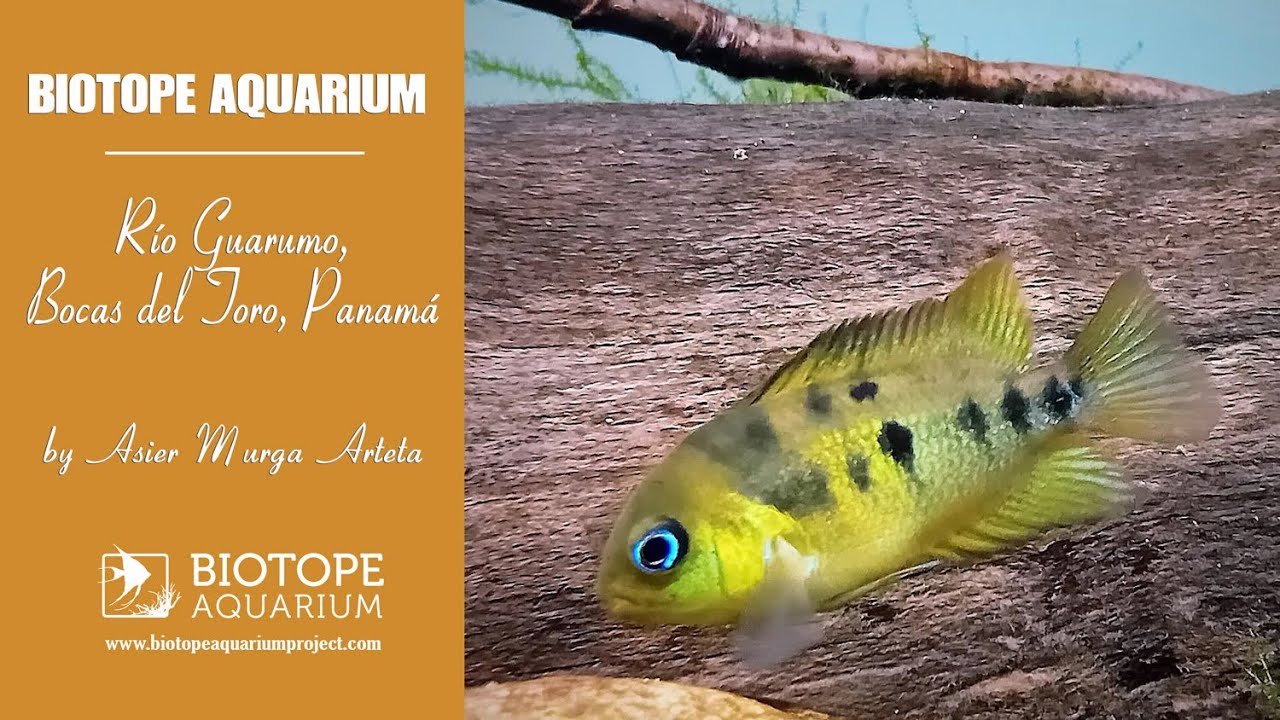
The placement of cavities between stones is specially useful for the females of Amatitlania and Poecilia, the former uses them to spawn with the help of the male and protecting those caves with a lot of insistent from other curious people, and the females of Poecilia butleri usually take refuge from the continuous and excesive harassment of the male, although I placed 3 males and 12 females to mitigate it. At the same time space to swim on top on the rocks and from side to side of the aquarium.
I have tried to get as close as possible to the water parameters of the biotope and the water temperature of the biotope, which we know is ideal for the health of the fish. As well as stability and no significant changes. Weekly water changes of 20%, vacuuming the bottom with a hose.
As for feeding, I offered them a dry food with a very high percentage of a Spirulina algae for the Poecilia butleri and other dry food with high percentage of protein for the Amatitlania nanolutea. Because cichlids meed more protein and Poeciliids need more vegetables.
Twice a week I give them frozen brine shrimp with garlic.
I don’t skimp on the quality of the food, for me it is fundamental for the health of the fish, as well as giving them small quantities and several times a day, for better digestion.
Fishlist:
- Amatitlania nanolutea (Cichlidae)
- Poecilia butleri (Poecilidae)
- Plant care
Moss does not require fertiliser or any special care. With the preceding nitrogen compounds from fish waste and 6 hours of light, they are well maintained.
Aquatic mosses:
- Leptodictyum riparium (Amblystegiaceae)
- Water care
Weekly water changes are the best medicine for fish, you can’t go wrong with that. I always vacuum the bottom to remove debris and clean the glass.
Every 3 weeks I introduce new Catappa leaves, so that the fish can take advantage of their benefits.
Once a month, I provided a live bacterias to enrich the bacterial colony, while changing the sponges in one of the pre-filter for clean ones, so the impact on the bacterial colony is minimal. I always let at least a month pass between filter cleanings.
And once every 4-5 month I cleaned the biological material of a filter and the tubes, all in order not to reduce the powerful flow on the filter.
This water flow was circulating from side to side of the aquarium, by placing the water outlets on the surface, and this also favouring the exchange of gases and oxygenation of the water.