bam Demanding level

#11486 Río Mamoré basin, Bolivia

Sponsored by

Warning: Undefined variable $related_bin in /home/biotopea/public_html/wp-content/themes/bap/content-bam.php on line 34

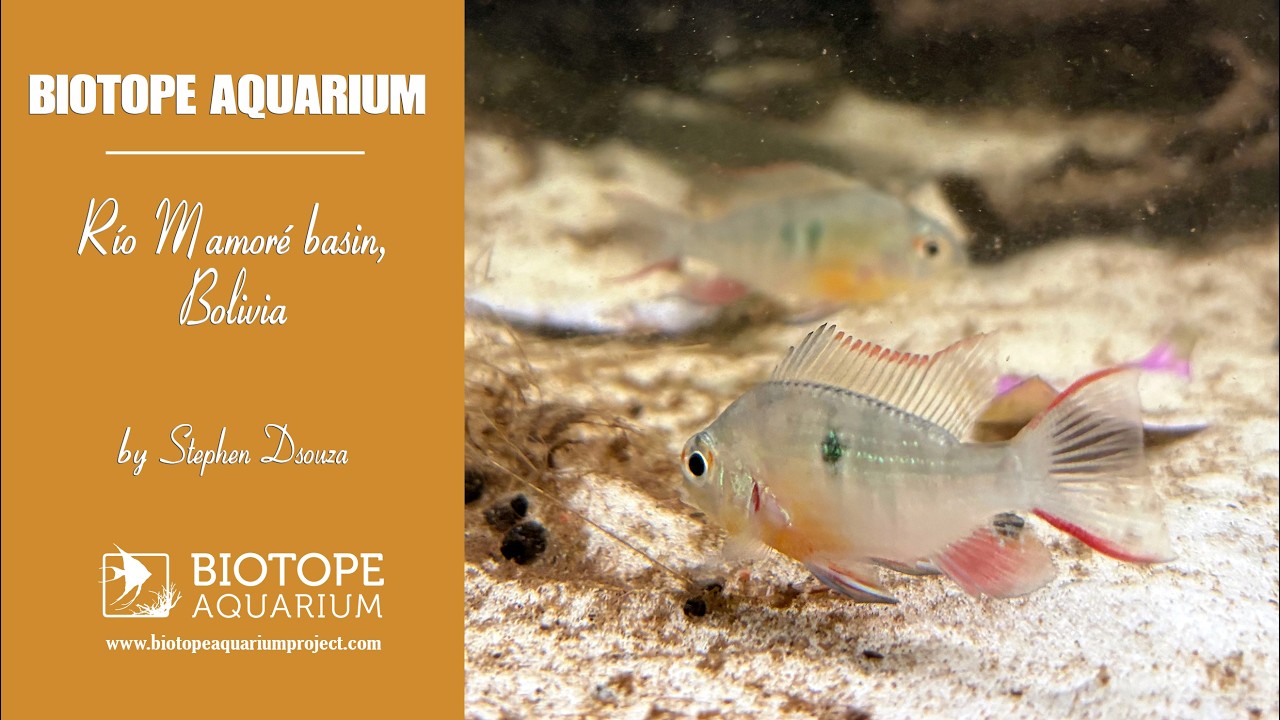
The Biotope Aquarium Model represents a shallow marginal section of the Río Mamoré floodplain in Bolivia during the seasonal flood period, inspired by the natural habitat of Mikrogeophagus altispinosus. The aim was to recreate the quiet simplicity of a flooded forest rather than create a decorative aquascape.

The layout is dominated by tangled submerged driftwood, open areas of fine white sand, accumulated mulm, leaf litter, and sparse floating vegetation, reflecting the structural complexity found in these habitats. The open substrate provides natural foraging areas, while the intricate wood structure offers shelter and territorial boundaries for the fish.

A group of six subadult Bolivian Rams was selected to showcase their natural behaviour within a habitat designed around their ecological requirements. Every element was chosen to prioritise habitat authenticity, biological function, and natural composition over aesthetic symmetry, creating a faithful aquarium model of a South American floodplain.

Submitted by
Stephen Dsouza

Warning: Undefined variable $related_bin in /home/biotopea/public_html/wp-content/themes/bap/content-bam.php on line 68

Videos above and below water


Warning: Undefined variable $fish_parent in /home/biotopea/public_html/wp-content/themes/bap/content-bam.php on line 85

Water Chemistry

Water information

Water type
Freshwater
Water color
Clear water
Water transparency
High
Concentration of sediments
Low
Water temperature
26 °C
Water flow/curent
Slow

Chemical parameters

pH
7.0
Conductivity
GH
dGH
KH
dKH
Dissolved Oxygen

Aquarium information

Aquarium description

Set-up date
January, 2025
Aquarium decoration

The aquarium was designed to replicate a slow-flowing Bolivian lowland stream habitat. A natural sandy substrate was selected to reflect the soft riverbeds where Bolivian Rams forage, combined with driftwood structures that provide shelter, territorial boundaries, and a natural appearance.

Leaf litter and accumulated organic matter were allowed to develop, mimicking the nutrient-rich substrates found in natural habitats. Surface cover from floating vegetation provides shade and contributes to a more natural environment.

The aquascape focuses on open sandy areas, wood structures, and a calm riverine appearance rather than a heavily planted aquarium, reflecting the natural habitats of Mikrogeophagus altispinosus.

Aquarium equipment

The aquarium is equipped with a SunSun HW-302 external canister filter, providing mechanical and biological filtration while maintaining gentle water movement suitable for a slow-flowing river biotope. The filtration system supports stable water quality and adequate oxygenation.

Temperature and water parameters are monitored regularly to maintain suitable conditions for Bolivian Rams (Mikrogeophagus altispinosus).

Fish care

The Bolivian Rams (Mikrogeophagus altispinosus) are maintained in a group to encourage natural social behaviour and reduce stress. They are provided with a varied diet, primarily consisting of Tetra Bits, a high-quality granulated food suitable for cichlids.

Feeding is carried out in controlled portions to minimise excess waste and maintain good water quality. The fish are observed regularly for health, behaviour, and natural interactions. Stable water parameters, gentle filtration, open sandy areas for foraging, and driftwood shelters help replicate their natural environment and support their wellbeing.

Fish:

  • Mikrogeophagus altispinosus (Cichlidae) – Bolivian Ram – 6
Plant care

No submerged aquatic plants are maintained in this aquarium. The biotope design focuses on natural hardscape elements such as sand, driftwood, leaf litter, and open swimming areas. Floating vegetation is allowed to grow naturally without additional fertilisation or CO₂ supplementation.

Water care

Water maintenance consists of regular partial water changes to maintain stable water quality and replicate the clean, slow-moving waters of Bolivian river habitats. Water parameters are monitored periodically, with attention to pH, hardness, temperature, and dissolved oxygen levels.

Organic debris and leaf litter are allowed to accumulate naturally, while excess waste is removed during routine maintenance.

Dimensions

Length
90 cm
Depth
45 cm
High
45 cm
Volume
200 L

Substrate in aquarium

Sand
White
Pebble/Gravel
None
Stone
None
Stone form
Silt/Mud
Beige
Leaves
Many
Driftwood
Many
Submerged terrestrial vegetation
None

Bibliography

  • Aquarium Atlas, Volume 1. Microcosm Ltd. / Mergus Verlag by Riehl, R. & Baensch, H.A. (1997)
    ISBN 189008705X
  • Baensch Aquarium Atlas Volume 1. Mergus Verlag GmbH by Baensch, H.A. & Riehl, R. (2005)
    ISBN 3882440775
  • Check List of the Freshwater Fishes of South and Central America (CLOFFSCA). EDIPUCRS by Reis, R.E., Kullander, S.O. & Ferraris, C.J. (eds.) (2003)
    ISBN 8574303615