- Set-up date
- April, 2025
- Aquarium decoration
To address the contradiction between the territorial behavior of male Macropodus ocellatus and the need for community habitat display, I adopted a scheme of three 30×18×20 cm tanks connected in parallel series.
The tanks are linked by U-shaped tubes, sharing a canister filter and lighting system, which not only meets the independent feeding requirements of bettas but also achieves water circulation and landscaping consistency through the series structure. In terms of water flow design, the outlet is set at the far right shore end to accommodate the habits of iand Mugilogobius myxodermus.
Based on the above hardware framework, the landscaping design constructs ecological layers of wetland habitat starting from the substrate: first, a mixture of peat soil, dried Sphagnum moss, and banyan rootlets is laid as the base, covered with lumpy pond mud on the upper layer, and fine sand on the surface.
After moistening the substrate with a small amount of water (just enough to dampen it), the sphagnum moss and rootlets naturally protrude, forming a staggered terrain. The left and middle tanks are furnished with dead branches and planted with Acorus calamus and Utricularia aurea, while the right tank is dominated by large pebbles. From left to right, the density of reed stalks gradually decreases, and the planting amount of Ceratophyllum demersum increases to simulate the ecological gradient of “shore→deep water”. After adding water, Lemna minor is introduced into the left tank, and the flow direction guides the aggregation of them.
Lumpy pond mud produced in Jiangsu, sterilized at high temperature, is selected to avoid the invasion of uncontrollable foreign microorganisms and maintain water quality stability through native substrates. Other landscaping materials are collected from the wild and strictly disinfected before being put into the tank to ensure water health.
For the background, a blue-green translucent matte film is used, with reed stalks placed behind the rear glass to enhance the depth-of-field effect and further improve the integrity and ornamental value of community habitat display.
- Aquarium equipment
- Lighting: JIYIN-21DF1076 18w, Spectrum 10560K
- Filter: SUNSUN EXTERNAL FILTER HW-603B 400L/H
- Fish care
Based on the natural attenuation characteristics of “weak water flow on the left and strong water flow on the right” in the three-tank series system, combined with the landscaping gradient from the “shore shallow water” to the “deep water area”, the fish distribution follows the principle of habitat-environment adaptation:
The left tank has a gentle water flow, with abundant aquatic plants and roots arranged, which is suitable for the habitat of Oryzias sinensis. It can rely on the complex structure to complete evasion and spawning behaviors. At present, some newly hatched fry in the cylinder have been transferred to a new container.
The middle tank serves as the visual center, raising Macropodus ocellatus, and is equipped with composite shelters composed of aquatic plants, dead branches and fallen leaves, which not only meets its territorial needs but also facilitates the display of its bright body color.
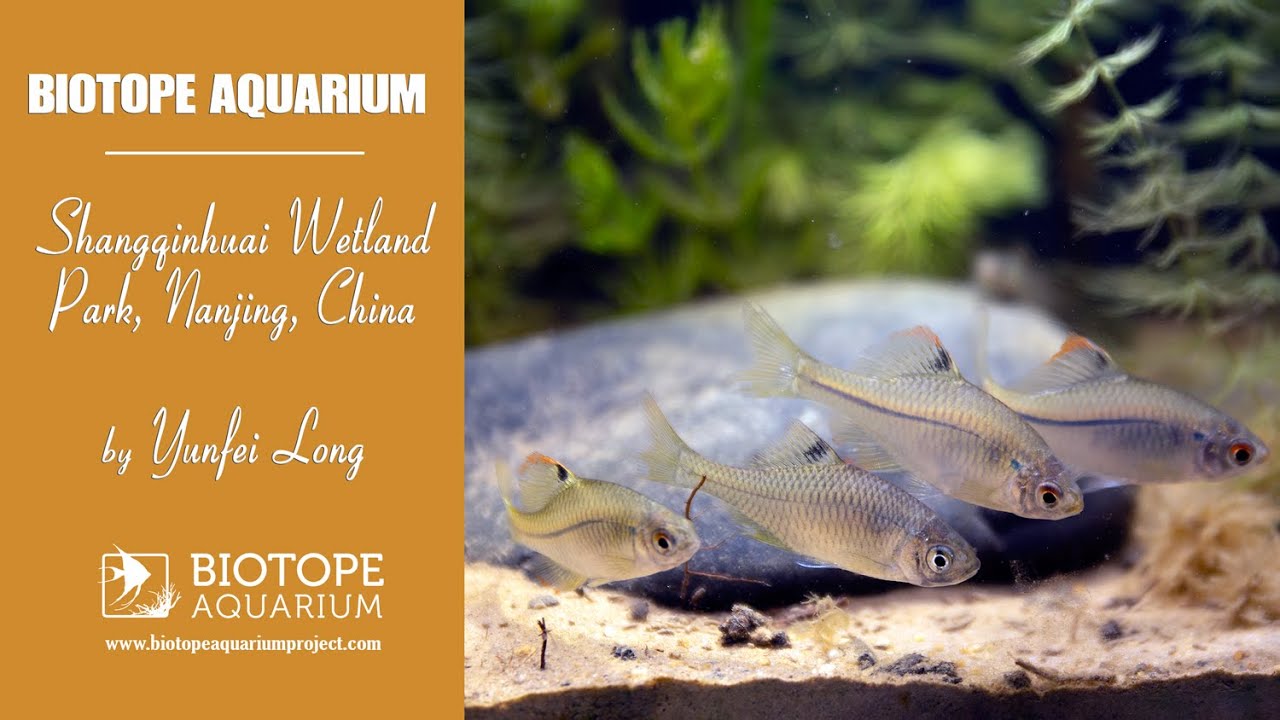
The right tank has a faster water flow, providing an ideal habitat for Rhodeus fangi and Mugilogobius myxodermus, in line with their survival preferences.
In terms of daily feeding, a regular and quantitative strategy is adopted: feeding is carried out 1 hour after turning on the lights every morning. Oryzias sinensis and Rhodeus fangi are fed with pellet feed, while Macropodus ocellatus and Mugilogobius myxodermus are fed with chopped shrimp meat to ensure that fish with different feeding habits obtain sufficient nutrition.
Fish list:
- Macropodus ocellatus (Osphronemidae)
- Oryzias sinensis (Adrianichthyidae)
- Rhodeus fangi (Cyprinidae)
- Mugilogobius myxodermus (Oxudercidae)
Crustacean list:
- Neocaridina denticulata (Atyidae)
Mollusc list:
- Cipangopaludina chinensis (Viviparidae)
- Plant care
Acorus calamus requires good ventilation in the cylinder for growth, while other aquatic plants in the cylinder have strong adaptability. Providing 6-8 hours of stable light daily is sufficient to meet their growth needs, and no additional special management measures are required.
- Water care
Replace one-third of the water weekly, clean the tank walls as needed, and monitor ammonia nitrogen, nitrite, nitrate, pH, and GH. Clean the filter and replace the filter cotton every 2-3 months.