bin
Shangqinhuai Wetland Park, Nanjing, China
China, Jiangsu province
Shangqinhuai Wetland is a vast ecological wetland within Shangqinhuai Wetland Park, located in Jiangning District, Nanjing City, Jiangsu Province, China, covering an area of 28.7km².
Situated in the upper reaches of the Qinhuai River, it serves as a key confluence area of the Qinhuai River system, where rivers such as the Jurong River, Lishui River, and Yuntai Mountain River flow into the Qinhuai River.
The wetland integrates multiple functions including wetland ecological protection, eco-tourism recreation, and science education, making it highly worthy of investigation and research for both its ecological value and scientific significance.
- Submitted by
- Yunfei Long
- Approved by
- Sun Kai & Zhou Hang
- GPS
- 31.8746719, 118.8422165
- Geographical region
- Eastern Asia
- Drainage Basin
- Qinhuai river basin
- River catchment
- Qinhuai river
- Water body type
- Wetland
- Water body name
- Shangqinhuai wetland
- Water body part
- Marsh land
- Water body course
- Upper course
- Water body: tributary of
- Wetland
- Tributary name
- Qinhuai river
Videos above and below water
Warning: Undefined variable $fish_parent in /home/biotopea/public_html/wp-content/themes/bap/content-bin.php on line 55
Water Chemistry
Water information
- Water type
- Water color
- Clear water
- Water transparency
- Medium
- Concentration of sediments
- Medium
- Water temperature
- 5-28℃ °C
- Water flow/curent
- Slow
Chemical parameters
- pH
- 6.5
- Conductivity
- 210
- GH
- 100 mg/l
- dGH
- KH
- dKH
- Dissolved Oxygen
- 95 %
Substrate in nature
- Sand
- Beige
- Pebble/Gravel
- Grey
- Stone
- None
- Stone form
- Silt/Mud
- Brown
- Leaves
- Many
- Driftwood
- Few
- Submerged terrestrial vegetation
- Yes
Aquatic Biotope
- Date of collecting
- May, 2025
- Collecting area
- Side arm
- Water depth
- 0,2m
- Air temperature
- 27 °C
- Sunlight
- Full sun
Environment
- Environment
- Human settlements
- Human settlements
- Urban area
- Surrounding area
Shangqinhuai Wetland is located in Jiangning District, Nanjing City, Jiangsu Province. As the upper reaches of the main stream of the Qinhuai River, it converges water systems such as the Qinhuai River, Jurong River, Lishui River, and Yuntaishan River.
It is not only the source of Nanjing’s “Mother River” but also the largest riverine ecological wetland closest to the main urban area of Nanjing. This wetland encompasses diverse ecological types including shallow water areas, deep water areas, and swamps, forming a complete and complex wetland ecosystem that provides an ideal habitat for numerous wild animals and plants.
In terms of ecological functions, Shangqinhuai Wetland exerts multiple ecological values thanks to its abundant plant communities. Diverse wetland plants such as reeds and calamus not only provide food resources and habitats for birds, fish, and amphibians, making it a key area for biodiversity conservation, but also, through the synergistic effect with microorganisms, effectively degrade water pollutants, significantly improving the ecological environment of surrounding waters and achieving the dual benefits of water purification and ecological restoration.
- Underwater landscape
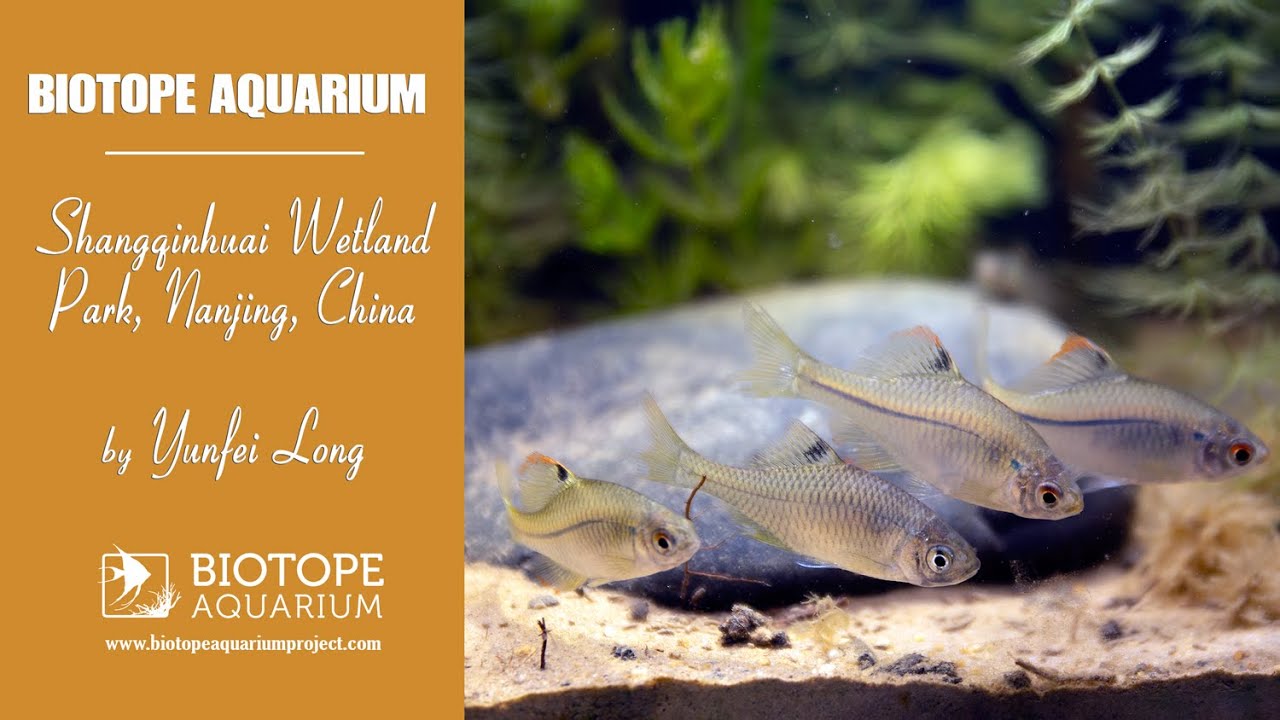
Shangqinhuai Wetland features both shallow and deep water areas. In the shallow water zones, aquatic plants such as Ceratophyllum demersum and Vallisneria natans thrive luxuriantly. Sunlight penetrates directly to the water bottom, creating a rich shallow-water ecological environment that not only supplies oxygen to the water body but also provides food and habitats for aquatic animals.
The underwater sediments are primarily composed of mud, sand, humus, and scattered pebbles. These sediments provide nutrients for the growth of aquatic plants and serve as habitats for benthic animals. Under the action of water flow, the sediments form accumulations and textures in various shapes.
Fish list:
- Macropodus ocellatus (Osphronemidae)
- Oryzias sinensis (Adrianichthyidae)
- Rhodeus fangi (Cyprinidae)
- Rhodeus ocellatus (Oxudercidae)
- Mugilogobius myxodermus (Oxudercidae)
- Channa argus (Channidae)
Crustacean list:
- Neocaridina denticulata (Atyidae)
- Palaemonetes sinensis (Palaemonidae)
Mollusc list:
- Cipangopaludina chinensis (Viviparidae)
- Sinanodonta woodiana (Unionidae)
Amphibian list:
- Pelophylax nigromaculatus (Ranidae)
Aquatic plant list:
- Phragmites australis (Poaceae)
- Sagittaria trifolia (Alismataceae)
- Persicaria hydropiper (Polygonaceae)
- Ceratophyllum demersum (Ceratophyllaceae)
- Vallisneria natans (Hydrocharitaceae)
- Hydrilla verticillata (Hydrocharitaceae)
- Utricularia aurea (Lentibulariaceae)
Wetland plant list:
- Lemna minor (Araceae)
- Acorus calamus (Acoraceae)
- Navicula sp. (Naviculaceae)
Terrasytrial vegetation:
- Salix babylonica (Salicaceae)
- Threats to ecology
As an important ecological barrier of Nanjing, Shangqinhuai Wetland provides living space for numerous organisms and plays a role in maintaining the ecological environment of the Yangtze River basin. This has inspired me to build an aquarium, which to a certain extent reflects the beauty of this place.
Riparian zone
- Trees near the aquatic habitat
-
Few -
Bibliography
-
Freshwater Fishes of China, P453 P629 P698 P721
by Li Fan
ISBN 9787556712861