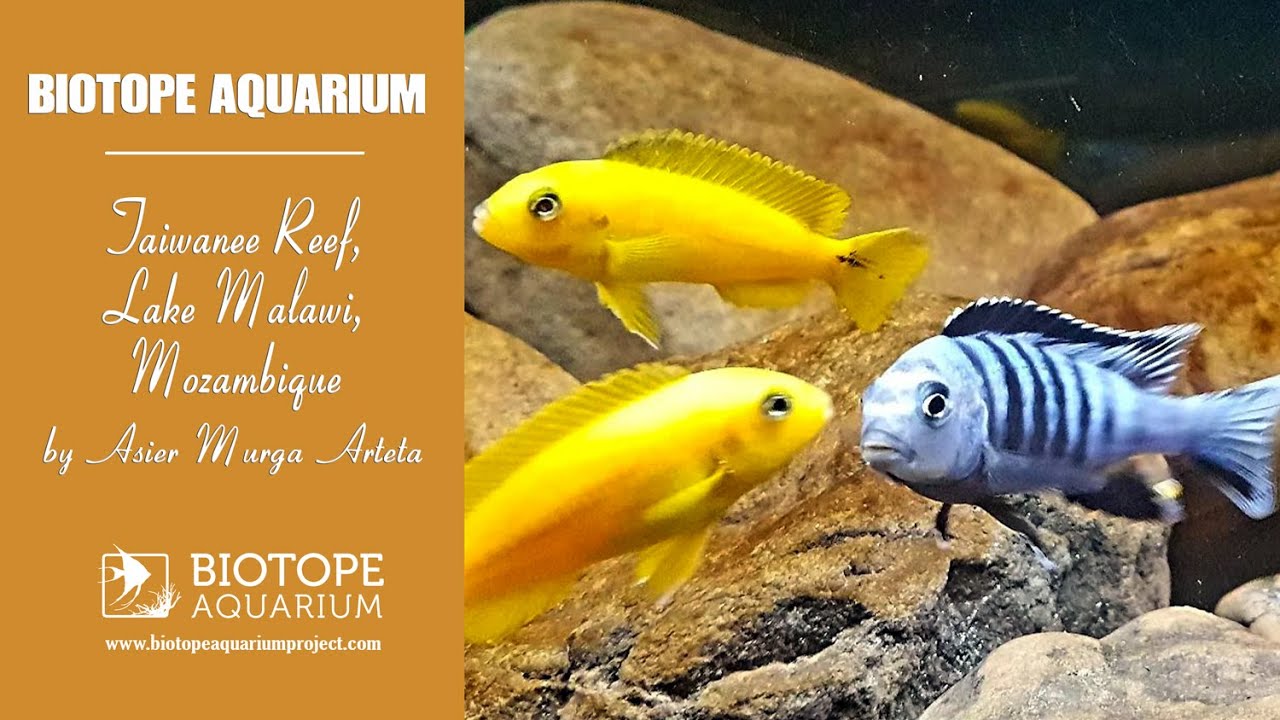
With a small layer of the greyish sand, I try to simulate the remains of sandy debris that is whased off the rocks, due to the strong current of the water over the rocks in Taiwanee Reef.
Many rocks of various shapes with several caves and crevices for the females and fry to hide in, and where algae grow attached over time, which serve as food for these fish and to provoke natural feeding behaviour. I have also placed the rocks in such as way that they from a visual barrier and provide more privacy for the dominated fish. At the same time they have space above to swim from side to side of the aquarium.
Very alkaline, hard, oxygenated water with 2 Oase Biomaster 350 filters at full power to simulate reef currents. Continuous temperature between 24º and 26º, simulate that of the lake.
The water comes from the tap with these parameters so I don`t have to modify in hand thus offer stability to the fish.
So that they can have a behaviour similar to that in nature, I have provided many caves and crevices between rocks, so that females and fry can take refuge from the territoriality of the male.
For this reason, and taking into account the dimmensions of the aquarium, I have placed only this species in the aquarium. I consider that it is the most appropiate to avoid agressions between males. The visual barrier between rocks is also important for the same reason, that is why rocks are higher then others.
The current at full strenght by the two filters, to remind them of the reef where the species comes from. At the same time space to swim on top of the rocks and from side to side of the aquarium.
Parameters practically equal to those of their biotope.
The lighting is important, the two Leds has a photoperiod of 6 hours a day, to provoke the algae to grow on the rocks. The Dimmer simulated sunrise and sunset in a progressive way, imitating nature and not scaring the fish.
They always have to be stable for their well-being, and as my tap water comes out like this, there are never any significant changes, I try to change the water to a temperature similar to that of the aquarium.
Weekly water change 20%, vacuuming the bottom with a hose.
The truth is that it look a few months for the algae to come out, as I always have very low nitrate and phosphate values, by little by little they started to come out, the Saulosi were always grazing on the rocks, and they should be.
As for feeding, I offered them a dry food with a very high percentage of a spirulina algae and once a week live artemia to awaken their hunting instinct and give them a ration of nutritious protein.
Fishlist:
- Chindongo saulosi (Cichlidae)
Once a month, I provided a live bacterias to enrich the bacterial colony, while changing the sponges in one of the pre-filter for clean ones, so the impact on the bacterial colony is minimal. Always at least one month apart from one filter to another.
And once every 4/5 months I clean the biological material of a filter and the tubes, all in order not to reduce the powerful flow on the filter, then I add a vial of live bacteria.
This water flow was circulating from side to side of the aquarium, by placing the water outlests on the surface, and thus also favouring the exchange of gases and oxygenation of the water.