- Set-up date
- March, 2025
- Aquarium decoration
All materials used in this 62L aquarium are collected from the wild and disinfected before being added to the tank. This practice ensures that the water quality will match the natural habitat and will not harm the aquatic organisms in the tank.
First, I elevated the bottom of the tank with biochemical cotton. Not only it saves gravels and avoids excessive weight on the fish tank but also prevents the bottom gravels from being too thick, which could form anaerobic zones and produce toxic substances. Next, I stacked stones of varying sizes in a U-shaped composition according to the direction of water flow. The reserved gaps between stones provide hiding spaces for shrimps, snails, and benthic fish. On this basis, I spread a small amount of pond mud. Over time, the mud, algae, and decomposed biological feces will simulate the detritus layer in a real environment.
Then, I inserted various fallen leaves and dead branches into the stone gaps to mimic their accumulation effect under water flow. Finally, I planted plants such as Acorus gramineus on the exposed large stones on the left side. By using the banyan tree roots and floating dead branches and leaves, I created a scene on the left side of the tank that simulates dead branches fallen by the water’s edge during the dry season. At night, small fish also hide among the roots.
About the background, I used a blue translucent matte film and enhanced the depth-of-field effect by placing stones and bamboo branches behind the rear glass.
- Aquarium equipment
- Lighting 1: Ledesk NX-200 80w, Spectrum 6,000K to 9,000K
- Lighting 2: NETLEA AT3 Pro+ 65w, Spectrum 5700K to 7500K
- Filter: AMTRA ex650 650L/H
- Fish care
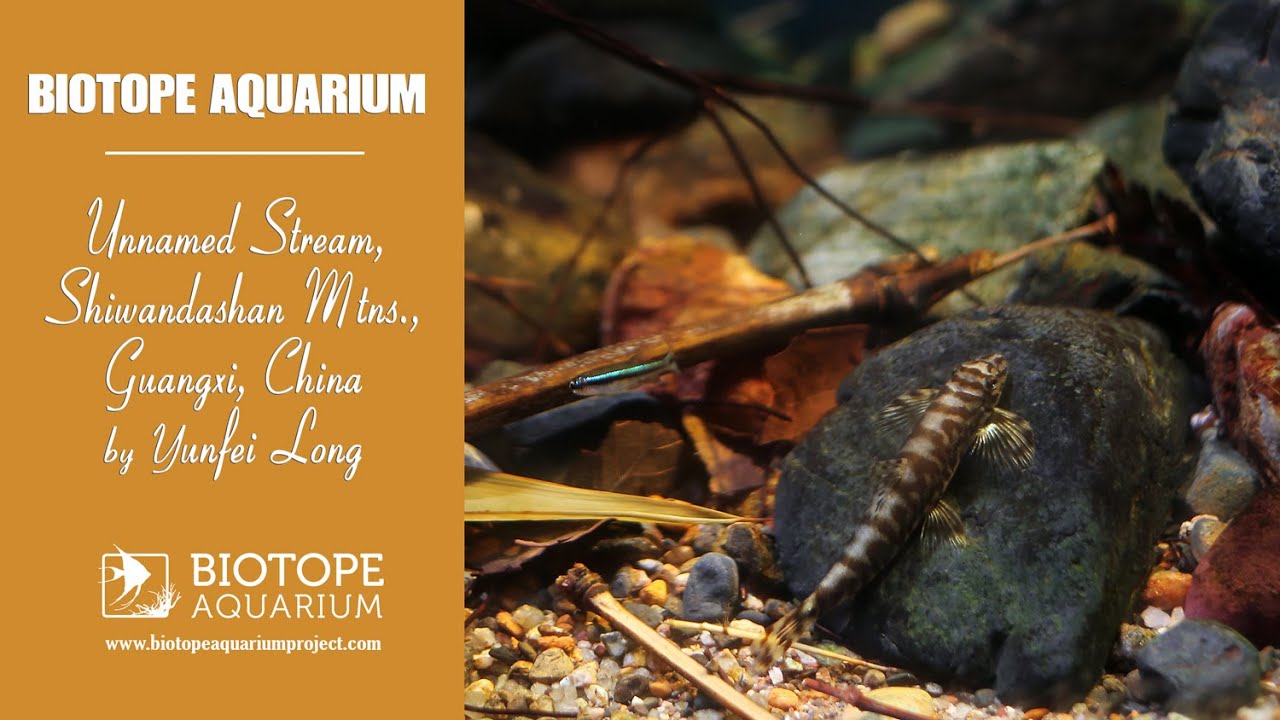
The fish tank houses two species of small-sized fish, one medium-small fish, and one benthic fish. Through long-term keeping and observation, I have found that their behaviors vary significantly. In the tank, they occupy different ecological niches.
Araiocypris batodes has a subterminal mouth, inhabiting the upper water layer and mainly feeding on surface food; Aphyocypris sp. has a terminal mouth, primarily occupying the middle water layer. Sometimes they mix with Araiocypris batodes to compete for surface food, and other times they peck at algae attached to stones; Aphyocypris normalis has a slightly larger terminal mouth but is shyer, mainly inhabiting the middle-lower water layer; Liniparhomaloptera disparis is a benthic fish occupying the lowest layer, moving among gravels. They prefer vegetarian diets, mainly grazing on algae.
In terms of feeding, I provide slow-sinking pellet feed once every morning to ensure fish in all niches have feeding opportunities. Once a week (in the evening), I feed artemia nauplii or frozen bloodworms to supplement animal protein. Liniparhomaloptera disparis prefers foraging in the evening, and evening feeding of animal feed helps them compete for food, otherwise it would be snatched up by other fish.
For the environment, the filter creates a gentle water flow, simulating the current speed in their natural habitat. Since there are almost no aquatic plants in their native environment, I use an aeration tube on the filter to increase water oxygenation. The water level in the tank is shallow, maintaining about 20cm or more, like the natural habitat. Among the mixed-size gravels underwater, there are numerous gaps that:
- provide ample shelter for Liniparhomaloptera disparis, shrimp and snails;
- make the substrate more natural, benefiting fish coloration.
Additionally, I placed a decumbent Ficus root on the left side of the tank, with its submerged roots offering plenty of hiding spots – they usually gather around it when the lights are turned off at night.
Incidentally, I also observed reproductive behavior in Neocaridina denticulata after a month of cultivation.
- Plant care
Using Ledesk NX-200 at low light intensity, irradiate for 10 hours daily to maintain the reproduction and growth of algae in the tank. Use NETLEA AT3 Pro+ at low light intensity, irradiate for 7 hours daily, and regularly spray water on the leaves to maintain the growth of Acorus gramineus, fern, and moss.
Wetland plant list:
- Pteris multifida (Pteridaceae)
- Acorus gramineus (Acoraceae)
- Water care
Replace one-third of the water weekly, clean the tank walls as needed, and monitor ammonia nitrogen, nitrite, nitrate, pH, and GH. Clean the filter and replace the filter cotton every 2-3 months. Meanwhile, I use Brotia herculea as a water quality monitoring organism for the fish tank. They mainly inhabit clean and clear streams, and I can judge the water quality health of the tank through their condition.