bin
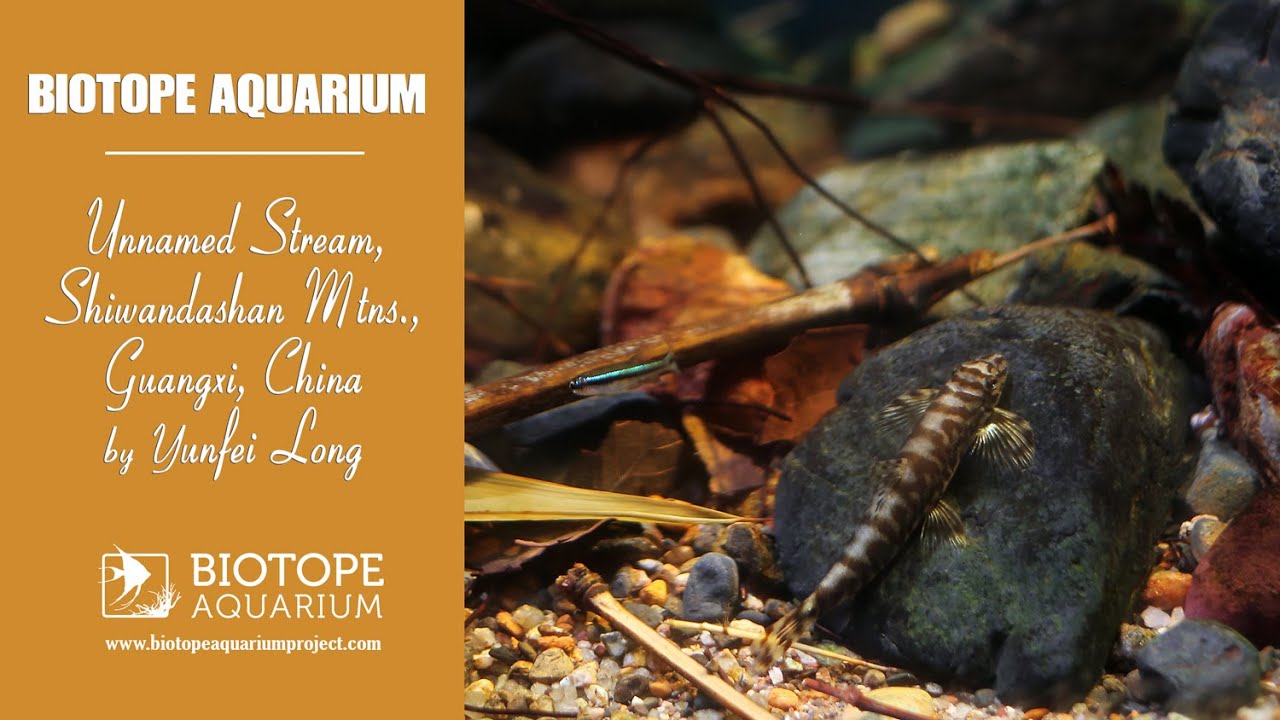
Unnamed Stream, Shiwandashan Mtns., Guangxi, China
China, Guangxi province
The Shiwandashan Mountains in Southwestern Guangxi Province cover 2.600km². Their streams show distinct seasonal changes under monsoon climate, entering dry periods around November each year. The last heavy rains of the wet season scour the riverbeds, then as water levels gradually drop, exposed banks, fallen branches and leaf litter collectively form unique riparian landscapes – the direct inspiration for this aquascape. Aphyocypris sp. in this area are my favorite fish species.
- Submitted by
- Yunfei Long
- Approved by
- Sun Kai & Zhou Hang
- GPS
- 21.5545120, 107.9777908
- Geographical region
- Eastern Asia
- Drainage Basin
- Southern Guangxi Independent Drainage System
- River catchment
- Changhu river
- Water body type
- hill-streams
- Water body name
- Unnamed small stream
- Water body part
- Channel
- Water body course
- Middle course
- Water body: tributary of
- Stream
- Tributary name
- Unnamed stream
Videos above and below water
Warning: Undefined variable $fish_parent in /home/biotopea/public_html/wp-content/themes/bap/content-bin.php on line 55
Water Chemistry
Water information
- Water type
- fresh-water
- Water color
- Clear water
- Water transparency
- Medium
- Concentration of sediments
- Low
- Water temperature
- 23 °C
- Water flow/curent
- Slow
Chemical parameters
- pH
- 6.5
- Conductivity
- 150
- GH
- 55 mg/l
- dGH
- KH
- 74 mg/l
- dKH
- Dissolved Oxygen
Substrate in nature
- Sand
- None
- Pebble/Gravel
- Mixed
- Stone
- Mixed
- Stone form
- Irregular
- Silt/Mud
- Beige
- Leaves
- Adundant
- Driftwood
- Few
- Submerged terrestrial vegetation
- None
Aquatic Biotope
- Date of collecting
- May, 2025
- Collecting area
- River bank
- Water depth
- 0,2m
- Air temperature
- 26 °C
- Sunlight
- Full sun
Environment
- Environment
- Affected by human activity
- Affected by human activity
- Agriculture
- Agriculture
- Massive
- Surrounding area
This stream is situated on the southern slope of the Shiwandashan Mountains in Guangxi. Influenced by the monsoon climate at the northern edge of the tropics, it features abundant rainfall and distinct dry-wet seasons.
The average annual temperature ranges between 20.0-21.8℃, with an average annual precipitation of 2.000–2.700 mm. The stream is surrounded by subtropical evergreen broad-leaved forests dominated by Bambusa textilis and other species. With a forest coverage rate exceeding 98%, the area has nurtured rich biodiversity.
The stream experiences a dry season from November to April of the following year and a wet season from March to October. During the dry season, the water level gradually drops, exposing riverside rocks. In the rock crevices, abundant fallen leaves, dead branches, and toppled tree trunks are piled up, while water currents sweep leaves to gather around the toppled branches, forming a unique natural landscape.
- Underwater landscape
Beneath the water, the stream is paved with gravel of various sizes, forming a beautiful substrate structure. There are almost no aquatic plants underwater, except for some emergent plants growing along the water’s edge. Large stones in the water are covered with algae, while small gravels are blanketed by mud particles, bamboo leaves, and dead branches—most of which are deposited along the current direction.
The narrow waterway prevents most large fish from entering, making it an ideal habitat for small fish to thrive. During the breeding season, juveniles of Parazacco fasciatus can be seen mixed among them. Additionally, a small population of Tanichthys albiventris inhabits the upper reaches of the stream.
Fishes, crustaceans & molluscs:
- Aphyocypris sp. (Xenocyprididae)
- Araiocypris batodes (Xenocyprididae)
- Aphyocypris normalis (Xenocyprididae)
- Parazacco fasciatus (Xenocyprididae)
- Macropodus opercularis (Osphronemidae)
- Channa nox (Channidae)
- Rhinogobius duospilus (Oxudercidae)
- Liniparhomaloptera disparis (Gastromyzontidae)
Crustaceans:
- Macrobrachium nipponense (Palaemonidae)
- Neocaridina denticulata (Atyidae)
- Indochinamon lanae (Potamidae)
- Brotia herculea (Pachychilidae)
Wetland plants:
- Acorus gramineus (Acoraceae)
- Pteris multifida (Pteridaceae)
- Dicranopteris pedate (Gleicheniaceae)
Mosses:
- Hypnum plumaeforme (Hypnaceae)
- Fissidens exilis (Fissidentaceae)
- Threats to ecology
Aphyocypris sp. and Araiocypris batodes are both stunning native fish species, patchily distributed across the mountains of Guangxi, China. Unfortunately, with the continuous expansion of human activities—such as agricultural pollution from pig farms upstream of this stream—part of their habitat has been destroyed, leading to the temporary disappearance of wild populations.
In recent years, as awareness of wildlife conservation has grown, more people have joined the ranks of conservation efforts. To help others understand the living environment and underwater landscape of these small fish, I created this Aphyocypris sp. biotope aquarium. The Aphyocypris sp. in my tank are artificially bred to protect these beautiful little fish.
Riparian zone
- Trees near the aquatic habitat
-
Many -
Bibliography
-
Freshwater Fishes of China, P357, P375
by Li Fan
ISBN 9787556712861
-
Classification Atlas of Guangxi Freshwater Fishes, P92, P101, P274
by Xiao Shan, Lan Jiahu
ISBN 9787572511349
-
Colored Atlas of Chinese Melania, P61
by Du Lina, Yang Junxing
ISBN 9787572510458
-
The Raffles Bulletin of Zoology, 2008, Issue 1 - Araiocypris batodes, a new genus and species of cyprinid fish from northern Vietnam (Ostariophysi: Cyprinidae)
by Conway, K.W., Kottelat, M
-
The Raffles Bulletin of Zoology, 2023, Vol. 71, pp.70-86 - A new genus and three new species of freshwater crab (Crustacea: Brachyura: Potamidae) from central and northern Vietnam
by Ng, P.K.L., Ngo, V.T.
Comment by the expert
Zhou Hang: Great observation.