bam Beginner-friendly level

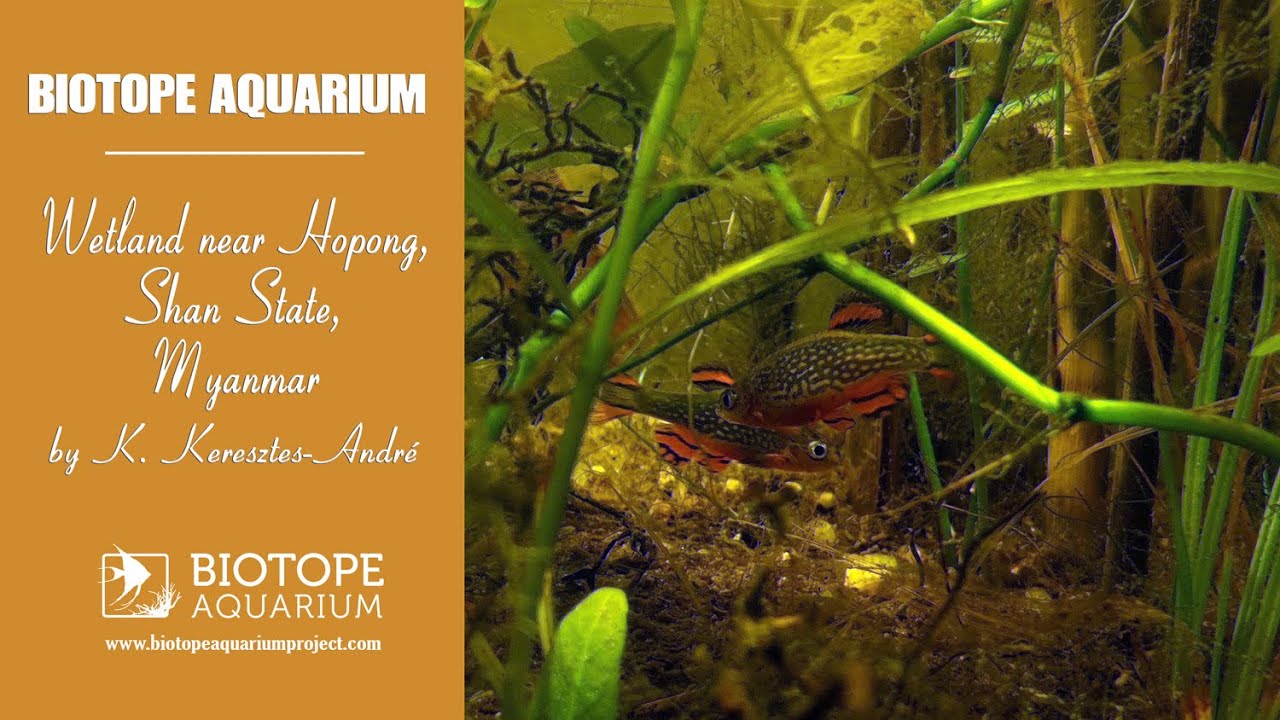
Wetland near Hopong, Shan State, Myanmar

Sponsored by

Myanmar, Shan State

I’ve always been a lover of small fish species, especially the lesser-known ones. However, for my current aquarium, I chose a rather popular species: Danio margaritatus.

But still, few people know much about its natural habitat, which is why I felt it deserved a dedicated setup. As a tank mate, I selected a small loach species — Petruichthys sp. rosy, which is also endemic to this area.

With my 110L aquarium, I aimed to recreate a suitable environment for these tiny and shy fish. Since both species are known from flooded grassy areas and channels around the town, I tried to design a densely planted, maze-like layout, so I used the following plant species: Hygrophila polysperma, Hygroryza aristata, Cyperus helferi, Blyxa japonica, and Salvinia cucullata.

I complemented the setup with dried reeds, small roots, and decaying leaves to form a sediment-like substrate layer. The lighting is not too strong, the water flow is weak, with barely any surface movement.

Submitted by
Klementina Keresztes-André
Approved by
Heiko Blessin, Heok Hee Ng & Greg Martin
GPS
20.7833710, 97.1829910
Geographical region
Southeastern Asia
Drainage Basin
River catchment
Salween River
Water body type
Wetland
Water body name
Wetland
Water body part
Water body course
Water body: tributary of
Tributary name

Videos above and below water

Warning: Undefined variable $fish_parent in /home/biotopea/public_html/wp-content/themes/bap/content-bam.php on line 85

Warning: Undefined array key "additional_species" in /home/biotopea/public_html/wp-content/themes/bap/functions/bap-fields.php on line 349

Water Chemistry

Water information

Water type
fresh-water
Water color
Clear water
Water transparency
High
Concentration of sediments
Medium
Water temperature
23-26 °C °C
Water flow/curent

Chemical parameters

pH
5
Conductivity
GH
16 mg/l
dGH
KH
8 mg/l
dKH
Dissolved Oxygen
60 %

Aquarium information

Aquarium description

Set-up date
July, 2024
Aquarium decoration

With my aquarium, I aimed to recreate a shallow watland area which heavily overgrown with vegetation. To achieve this, I used beige-colored sand and gravel as the substrate, which provides a suitable medium for plant root development.

I covered this with a layer made of leaves, reeds, and peat, the color and texture of which closely resemble the natural sediment found in such habitats. The substrate is slightly sloped to simulate the natural shaping effect of rainwater accumulation. Since rocks, driftwood, and branches are not typical of the area, I chose not to include them in the setup.

The main decorative elements are the reed stems, among which I planted the live vegetation. Hygrophila polysperma and Hygroryza aristata have grown to the water’s surface, and shading the aquarium.

Their aerial roots offer excellent hiding places for these tiny fish. Petruichthys sp. “rosy” especially benefits from the abundance of cover, as they are easily startled by the slightest movement but in this maintance they can quickly find hiding places.

Aquarium equipment

Filtration: Sicce Whale 500, 18Watt, 1300l/h
Lighting: Led reflectors – 2×20Watt, 6500K

Fish list:

  • Danio margaritatus (Cyprinidae)
  • Petruichthys sp. rosy (Nemacheilidae)

Aquatic plant list:

  • Hygrophila polysperma (Acanthaceae)
  • Blyxa japonica (Hydrocharitaceae)
  • Cyperus helferi (Cyperaceae)
  • Salvinia cucullata (Salviniaceae)
  • Hygroryza aristata (Poaceae)
Fish care

Both fish species I’ve chosen are relatively easy to care for, but feeding them may pose a challenge for some. Since both Danio margaritatus and Petruichthys sp. “rosy” are very small, it’s important to pay attention to the size of the food.

I feed them only with live food like bloodworms, Enchytraeus buchholzi, brine shrimp and tubifex to keep them healthy and energetic. But Petruichthys sp. “rosy” is a shy, bottom-feeding species, so it’s essential to ensure that it gets enough food even in the presence of the much braver and gluttonous Danio margaritatus.

In addition to feeding, the other key aspect of their care is providing an aquarium with plenty of hiding places. I rarely trim the plants, which has allowed them to grow thickly and fill out the intended space. As a result, the fish are noticeably more confident and often swim up to the front glass. Another indicator of their well-being is that they spawn continuously, and thanks to the dense vegetation, some of the eggs and fry survive regularly.

I don’t use a heater in the aquarium, as the room where it is located maintains a temperature between 23–26°C. The natural temperature fluctuations mimic the day-night, and summer-winter cycle found in the wild, which helps boost the fish’s activity levels and strengthens their immune system.

Plant care

The aquatic plants found in this aquarium do not need any special care. I rarely trim the Hygrophila polysperma and Hygroryza aristata, as they provide suitable hiding places for the fish. Sometimes I need to thin the Salvinia cucullata when it is cover the water surface too much.

The lighting imitates natural light, which promotes photosynthesis and plant growth and to help this I use liquid plant nutrient every 3-4 days.

Water care

I usually change 20% of the water every 2-3 weeks, in addition I only replace the evaporated water. I only clean the filter when its power has decreased too much. If the leaves in the aquarium are rotten, I replace them with new ones.

Dimensions

Length
90 cm
Depth
35 cm
High
35 cm
Volume
110 L

Substrate in aquarium

Sand
Beige
Pebble/Gravel
Beige
Stone
None
Stone form
Silt/Mud
Black
Leaves
Few
Driftwood
None
Submerged terrestrial vegetation

Bibliography

Comment by the expert

Heok Hee Ng: Petruichthys sp. ‘rosy’ is actually Physoschistura mango (described in 2023).

Greg Martin: A well designed recreation of a shallow wetland.