- Environment
- Affected by human activity
- Affected by human activity
- Deforestation
- Deforestation
- Advanced
- Surrounding area
Horquetas de Sarapiquí, located in the Heredia province of Costa Rica, is a region characterized by its rich biodiversity and significant agricultural activity. The area is predominantly surrounded by expansive banana and pineapple plantations, which play a central role in the local economy. However, these large monocultures heavily rely on aerial fumigation and intensive agrochemical use. These chemicals are easily dispersed by wind and rain, contaminating adjacent ecosystems and water bodies.
The San José River traverses this region, flowing through agricultural lands and near various human settlements. The river also passes directly through some of these plantations, transporting chemical residues and waste materials during seasonal floods. This has significant implications for water quality and aquatic habitats. Despite these pressures, the riverbanks remain rich in wildlife, providing habitats for species such as green iguanas (Iguana iguana) and howler monkeys (Alouatta palliata). The river is also a popular site for recreation and fishing among local communities.
This region experiences consistently high temperatures ranging from 20.3°C to 30.3°C, with heavy rainfall throughout the year, averaging between 3,500 and 4,000 mm annually. The climate is classified as tropical rainforest, supporting dense, very humid tropical forests and remarkable biodiversity. However, the ongoing expansion of monocultures and intensive agricultural practices continue to pose serious threats to these ecosystems.
The specific habitat described here is a small, shallow side arm of the San José River, formed near a site locally known as El Puente de Latas (The Metal Bridge). This is a well-known metal bridge used by large agricultural trucks transporting goods to and from major production centers. Historically, the original bridge at this location collapsed, and to this day, the old metal and concrete foundations remain in the river, just beside where this side channel forms. These large, abandoned structures have become part of the landscape, adding a unique human element to the site.
This side arm of the river is sheltered from the main current and dominated by the roots of the Sotacaballo tree (Zygia longifolia), an evergreen species from the Fabaceae family. Culturally known for its association with finding or attracting water, this small tree grows to heights of 5 to 20 meters, with a slender trunk and low branches forming a rounded, compact canopy. Its roots penetrate the riverbank and extend into the water, while its fallen leaves accumulate on the sandy bottom, creating a natural barrier that prevents them from being washed away.
In this shaded microhabitat, sunlight filters through the dense canopy, creating a mosaic of light and shadow. The calls of the strawberry poison-dart frog (Oophaga pumilio) echo through the vegetation, while Monstera species, bromeliads, and mosses adorn the tree trunks. Just behind this narrow forest strip, which spans approximately 10m, lies an extensive cattle pasture devoid of trees. This thin band of riparian forest serves as a critical refuge for local wildlife, offering shelter and resources in an otherwise heavily altered landscape.
In recent years, the occurrence of axanthic (color-deficient) individuals has been increasingly reported among various species in this region, including howler monkeys (Alouatta palliata), toucans, and fish species such as Parachromis dovii, Parachromis managuense, and Neetroplus nematopus. Although a direct causal link between this condition and agrochemical exposure has not been scientifically confirmed, it is widely suspected that the intensive use of these chemicals contributes to the phenomenon. Further research is needed to better understand the potential environmental and genetic impacts of these contaminants on local wildlife populations.
Efforts are underway to promote sustainable agricultural practices and conservation initiatives in the region. Programs focused on reforestation and the creation of biological corridors aim to mitigate the environmental impacts of intensive farming and preserve the ecological integrity of Horquetas de Sarapiquí.
Terrestrial vegetation list:
- Zygia longifolia (Fabaceae)
- Heliconia rostrata (Heliconiaceae)
- Monstera adansonii (Araceae)
- Thelypteris interrupta (Thelypteridaceae)
- Nephrolepis exaltata (Nephrolepidaceae)
- Underwater landscape
The underwater habitat of this biotope is remarkably different from that of the main channel of the San José River. In the river, the water flow is strong and fast, preventing the establishment of aquatic plants. However, the riverbanks are densely vegetated, and the roots of these plants extend into the water, creating complex shelter structures for aquatic organisms. Many large trees also have their roots submerged directly in the river.
Within the main channel, the substrate is composed of stones completely covered with algae, river sand, submerged logs, and fallen leaves trapped in rock crevices. The water is crystal clear, and under the full force of the sun, it reflects the vibrant colors of the fish. Yet, this lack of shade raises the water temperature significantly, creating harsh conditions where few organisms can thrive near the exposed shallows.
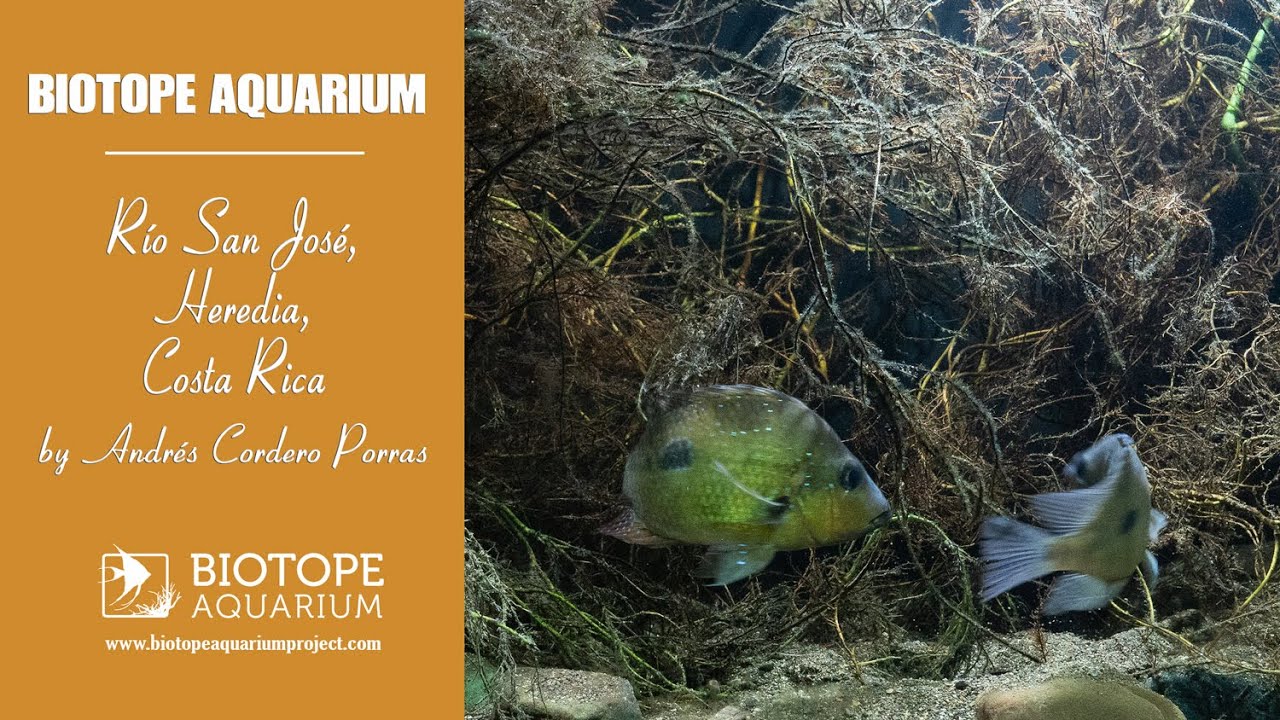
In stark contrast, the small side arm we are describing offers a completely different environment. This area is shaded by dense vegetation, especially by the overhanging branches and roots of the Sotacaballo tree (Zygia longifolia). The temperature here noticeably drops, and the site remains relatively isolated from the sudden, heavy rains characteristic of the region. Unlike the main river, which exerts a powerful current capable of sweeping away anything in its path, this side arm forms a calm, almost stagnant pool.
In this sheltered habitat, organic materials such as stones, branches, and fallen leaves accumulate. The roots of Sotacaballo trees penetrate the riverbank and extend into the water, forming intricate refuges where fish can reproduce safely. Schools of characid fry, likely belonging to the genus Astyanax, can be observed here, along with numerous Poecilia gillii feeding on the algae and microorganisms that grow on the surface of the submerged roots.
This biotope, measuring approximately 3 meters wide and 10m long, becomes a breeding ground for several cichlid species. Breeding pairs of Amatitlania siquia, Amatitlania septemfasciata, Neetroplus nematopus, Cribroheros alfari, and Cribroheros rostratus can be seen utilizing the clearings formed between the roots as nesting sites to protect their fry. These roots not only provide physical cover from predators but also serve as an important food source and microhabitat for juvenile fish.
Among these species, Cribroheros rostratus displays notably shy behavior. While species like Neetroplus nematopus and both Amatitlania species are frequently observed in open areas or even in fast-flowing sections of the river, Cribroheros rostratus appears to prefer the still, shaded zones of the side arm. In fact, it was only observed in this tranquil microhabitat or cautiously crossing sandy patches to return to it. Unlike its more active counterparts, Cribroheros rostratus tends to remain hidden beneath the roots, emerging only briefly and carefully — behavior that closely aligns with its earth-eating habits, where it sifts through the sand in search of food in peace and security.
The calm, shaded waters also make this the perfect ambush site for larger predatory fish like Parachromis dovii, which can often be seen lurking silently, waiting for the right moment to strike unsuspecting prey.
The substrate in this habitat consists mainly of fine brown sand, with few large stones. However, near the riverbanks, stone structures rise gradually from the sandy bottom, forming the foundation for the complex root systems that dominate the shoreline. Fallen Sotacaballo leaves blanket the area, and while the water remains clear most of the time, the sudden movement of a large fish near the roots quickly stirs up a cloud of detritus. This detritus attracts adult Astyanax aeneus, which forage actively in the resulting nutrient-rich cloud.
It is important to note that adult Astyanax typically remain in areas where the river’s current is perceptible, rarely venturing into the still waters of the side arm. This behavior is consistent with the observations of Bussing (1998), who described Astyanax aeneus as preferring more open and flowing environments. In his seminal work on the freshwater fishes of Costa Rica, Bussing also highlighted the ecological importance of lentic (still water) habitats, emphasizing that these areas are critical for the development of certain species. This side arm of the San José River serves as a clear example of this principle, providing a crucial refuge where many species can grow, develop, and successfully reproduce.
Although the San José River itself supports high species diversity, it is these calmer, sheltered habitats that enable key stages of the life cycle for many organisms, ensuring the continuity of the aquatic community within the river system.
Fish list:
- Neetroplus nematopus (Cichlidae)
- Amatitlania siquia (Cichlidae)
- Amatitlania septemfasciata (Cichlidae)
- Tomocichla tuba (Cichlidae)
- Criboheros rostratus (Cichlidae)
- Criboheros alfari (Cichlidae)
- Criboheros longimanus (Cichlidae)
- Parachromis dovii (Cichlidae)
- Parachromis freidrichsthalii (Cichlidae)
- Hypsophrys nicaraguensis (Cichlidae)
- Astyanax aeneus (Characidae)
- Eretmobrycon scleroparius (Characidae)
- Carlana eigenmanni (Characidae)
- Roeboides bouchelli (Characidae)
- Alfaro cultratus (Poeciliidae)
- Brachyrhaphis holdridgei (Poeciliidae)
- Brachyrhaphis parismina (Poeciliidae)
- Phallichthys amates (Poeciliidae)
- Priapichthys annectens (Poeciliidae)
- Poecilia gillii (Poeciliidae)
- Xenophallus umbratilis (Poeciliidae)
- Rhamdia guatemalensis (Heptapteridae)
Amphibian list:
- Dendrobates auratus (Dendrobatidae)
- Oophaga pumilio (Dendrobatidae)
- Threats to ecology
The primary threats to this fragile ecosystem include water pollution from agricultural chemicals and the accumulation of solid waste and livestock by-products. Extensive use of agrochemicals in the surrounding banana and pineapple monocultures leads to the contamination of waterways through runoff, especially during the frequent heavy rains characteristic of the region. Additionally, waste from nearby cattle ranches further degrades water quality, impacting both aquatic habitats and species.
Deforestation also plays a critical role in the degradation of this habitat. Large areas are cleared to make way for cattle pastures and agricultural expansion, preventing the formation of complex riparian ecosystems like the one described here. This biotope and its structural integrity rely heavily on the presence of Sotacaballo trees (Zygia longifolia). The side arm itself was formed as water flow was diverted by a massive Sotacaballo tree, whose expansive root system redirected the current and gradually created this unique microhabitat over the years. If these trees are removed, this essential breeding and nursery habitat for many aquatic species would disappear.
Another significant threat is the introduction of invasive exotic species. Tilapia (Oreochromis spp.), originally introduced for aquaculture, have escaped from nearby fish farms into the river system. Traditional farming practices involve diverting river water to create small earthen ponds for tilapia production. During periods of high rainfall and flooding, many juvenile and adult tilapia escape into the wild, where they compete with native species for food and habitat.
This river eventually flows into the Sarapiquí and San Juan rivers, where the invasive common pleco (Hypostomus plecostomus) has already established large populations. This species has caused severe ecological disruptions in many Costa Rican ecosystems, outcompeting native species and lacking natural predators to control its population.
Overfishing also poses a severe threat. Practices such as cast netting (atarraya) and spearfishing selectively remove large, reproductively important individuals from the population, severely affecting the reproductive capacity of native fish species and disrupting the balance of the aquatic community.
Finally, localized pollution is a growing problem in this area. The large Sotacaballo tree that forms the core of this microhabitat also provides a natural seating area and resting spot for visitors who use this part of the river for recreation. Unfortunately, this has led to improper waste disposal directly within the ecosystem. Litter such as cans, bottles, and disposable cups are often found entangled among the submerged roots of the Sotacaballo, degrading the habitat quality and posing physical hazards to aquatic life.