bin
Stream in Aik Seruk, Spot 2, Sijuk District, Belitung, Indonesia
Indonesia, Belitung Regency, Kecamatan Sijuk
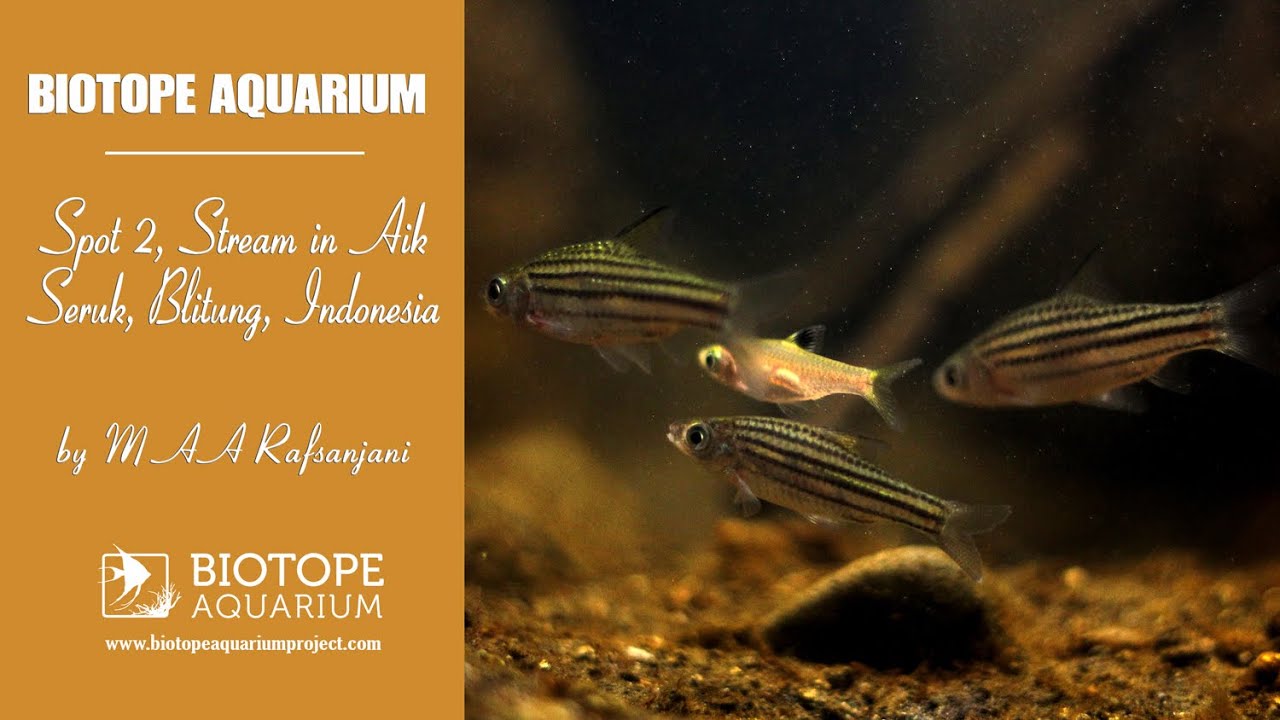
This biotope is located in the same area as the previous one: a stream in Aik Seruk, Sijuk District, Belitung Island, Indonesia. For this second location, we collected samples not far from the first biotope site. In addition to Rasbora sp., we also encountered other fascinating native species such as Desmopuntius gemellus, Brevibora cheeya, and Rasbora einthovenii.
The stream has a moderate current, with banks rich in roots, fallen tree trunks, gravel, and rocks. Water quality varies – sometimes clear, other times slightly tea-colored due to tannins, and occasionally murky after rainfall.
- Submitted by
- MAA Rafsanjani
- Approved by
- Heiko Blessin, Heok Hee Ng & Greg Martin
- GPS
- -2.6598711, 107.7059631
- Geographical region
- Southeastern Asia
- Drainage Basin
- Local Belitung Island coastal watershed, which empties into the surrounding sea (Karimata Strait/Java Sea)
- River catchment
- Aik Seruk
- Water body type
- Stream
- Water body name
- Stream in Aik Seruk
- Water body part
- Open water
- Water body course
- Middle course
- Water body: tributary of
- Stream
- Tributary name
- Aik Seruk
Videos above and below water
Warning: Undefined variable $fish_parent in /home/biotopea/public_html/wp-content/themes/bap/content-bin.php on line 55
Water Chemistry
Water information
- Water type
- fresh-water
- Water color
- Mixed water
- Water transparency
- Medium
- Concentration of sediments
- Medium
- Water temperature
- 27 °C
- Water flow/curent
- Slow
Chemical parameters
- pH
- 7
- Conductivity
- 31
- GH
- 14 mg/l
- dGH
- KH
- 9 mg/l
- dKH
- Dissolved Oxygen
- 81 %
Substrate in nature
- Sand
- Grey
- Pebble/Gravel
- Mixed
- Stone
- Mixed
- Stone form
- Roundish
- Silt/Mud
- Grey
- Leaves
- None
- Driftwood
- Few
- Submerged terrestrial vegetation
- None
Aquatic Biotope
- Date of collecting
- 15/03/2025
- Collecting area
- River bank
- Water depth
- 1,0m
- Air temperature
- 27 °C
- Sunlight
- Partial shade
Environment
- Environment
- Untouched
- Surrounding area
This biotope is located deep within the forest, far from human settlements, and serves as a tributary of the Aik Seruk River. The area is rich in wildlife and native plant species.
It is rarely visited, except by local fishermen, hunters, and researchers. As a result, the ecosystem remains largely undisturbed and well-preserved.
- Underwater landscape
The water conditions in this biotope are quite dynamic. At times, the water is clear; at other times, it is slightly darkened by tannins, likely due to logging activities for oil palm plantations upstream. After rainfall, the water often becomes somewhat murky.
The riverbed consists of a mixture of gravel, soil, and rocks, while the banks are lined with tree roots, driftwood, stones, and fallen branches. As you move deeper into the forest along this tributary, aquatic vegetation becomes more noticeable—though I have yet to identify the specific plant species present. I hope to return and explore this stream further to collect more detailed observations.
Fish list:
- Rasbora cf. patrickyapi (Danionidae)
- Desmopuntius gemellus (Cyprinidae)
- Brevibora cheeya (Danionidae)
- Rasbora einthovenii (Danionidae)
- Threats to ecology
Belitung is currently facing an environmental crisis due to widespread deforestation driven by the expansion of oil palm plantations, posing a serious threat to the island’s native flora and fauna.
We have observed that several areas near the biotope site have already been converted into oil palm fields. Moreover, some locations where wild Betta fish were once commonly found are now seeing a significant decline in their presence. We sincerely hope the Indonesian government will take meaningful action to preserve Belitung’s rich biodiversity.
Riparian zone
- Trees near the aquatic habitat
-
Many -
Bibliography
-
→ UPAYA PELESTARIAN IKAN ENDEMIK KEPULAUAN BANGKA BELITUNG
by Bidayani, E., Robin, R., & Anjani, T. P.
-
Phylogenetic analysis of the genus Rasbora (Teleostei: Cyprinidae)
by Liao, T. Y., Kullander, S. O., & Fang, F.
-
Desmopuntius gemellus. The IUCN Red List of Threatened Species 2019
by Ng, H. H. (2019). Desmopuntius gemellus. The IUCN Red List of Threatened Species 2019: e.T181308A1720074.
-
First record of Saddle Barb, Barbodes sellifer Kottelat & Lim 2021 (Cypriniformes, Cyprinidae), on Belitung, Indonesia, with an update of its geographic distribution
by Hasan V, South J, Valen FS, Andriyono S, Vieira LO, Sambah AB, & Ottoni FP. (2024). First record of Saddle Barb, Barbodes sellifer Kottelat & Lim 2021 (Cypriniformes, Cyprinidae), on Belitung, Indonesia, with an update of its geographic distribution. Check List, 20(2), 524-9. DOI: 10.15560/20.2.
Comment by the expert
Heok Hee Ng: Rasbora cf. patrickyapi is actually Rasbora einthovenii.