- Set-up date
- 9 March, 2026
- Aquarium decoration
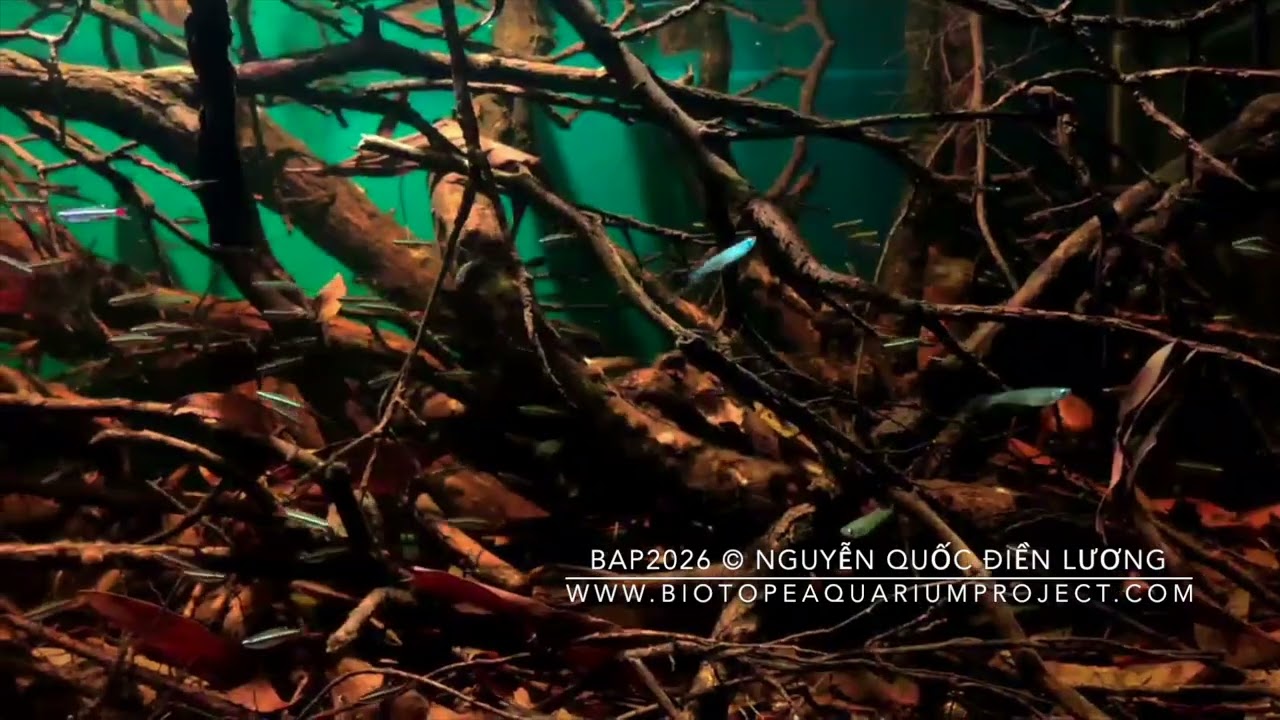
As the floodwaters gradually recede, the underwater landscape emerges as a scene of quiet serenity. Layers of driftwood, fallen branches, and leaf litter overlap naturally, forming a structure that appears both random and organised. Light penetrates through these layers, creating a contrast between open, illuminated areas and darker sheltered zones where the current seems to pause.
Following such a powerful hydrological event, the substrate has not yet had sufficient time to develop a stable layer of organic sediment. The natural materials within the habitat remain relatively fresh, with wood and leaves only partially decomposed. This creates a composition that may appear untidy at first glance, yet accurately reflects the natural conditions of a stream recovering from seasonal flooding.
Over time, accumulated leaf litter and woody debris gradually decompose, forming a new layer of organic matter. As this process continues, dissolved organic compounds — particularly tannins — increase, giving the water a darker amber coloration and a more acidic character.
Schools of Vietnamese Cardinal Minnows (Tanichthys micagemmae) and Pectoral Ricefish (Oryzias pectoralis) move gently through the open spaces, their bodies catching the soft light filtered by tannin-stained water. In deeper, more sheltered areas, Croaking Gouramis (Trichopsis vittata) and Three-spot Gouramis (Trichopodus trichopterus) remain calm and observant, while Cruciatus Loaches (Yunnanilus cruciatus) weave beneath the leaf litter, where microbial life flourishes among decomposing organic material.
This aquarium does not portray a river in full flow, but rather a moment when the stream pauses after the flood. It captures the stage at which nature quietly restores itself following disturbance — a habitat where life has not disappeared, but is silently recovering. Nature does not stop after a flood; it simply shifts into another state of balance.
- Aquarium equipment
Main filtration: Fi250 DIY canister filter equipped with Seachem Matrix as biological media to support beneficial bacterial colonies. Mountain Tree Nitro Ring and Mountain Tree Maifan Ring are used to assist in reducing ammonia (NH₃) and nitrate (NO₃⁻) levels while releasing essential minerals. Sera Super Peat helps stabilise pH, soften the water, create a natural tannin coloration, and provide a long-term release of humic and fulvic acids.
Secondary filtration: Fi168 DIY internal filter filled with coarse-to-fine filter floss to enhance mechanical filtration and maintain clear water.
Water circulation: Channing 3500 pump operated at 25% output, providing gentle water movement to replicate the slow-flowing conditions of the natural habitat while avoiding strong currents.
Lighting: Zetlight UFO F8 Pro Max LED, set to a 10-hour daily photoperiod with gradual sunrise and sunset effects to reduce stress and provide a more natural lighting cycle for the fish.
- Fish care
The tannin coloration in the aquarium is produced entirely through natural materials. For biological filtration, a fully matured filtration system was used, consisting of 13 litres of Seachem Matrix, 3 litres of Mountain Tree biological media, and 500g of Sera Super Peat. In the background, approximately 15kg of feather rock was used as a base to elevate the substrate, create depth, and provide additional surface area for beneficial bacterial colonisation.
During the first two weeks, the return pump was operated at 60% of its maximum output. The inlet and outlet were positioned at opposite ends of the aquarium to generate a strong circular flow, encouraging newly added leaves to become waterlogged and sink more quickly. To accelerate the development of tannin-rich water, dried Queen’s Crape Myrtle (Lagerstroemia speciosa) fruits were placed in a mesh bag behind the hardscape together with cajeput leaves (Melaleuca cajuputi).
Within one week, the water developed a deep reddish-amber coloration, while the pH gradually declined from approximately 8.0 to nearly 5.0. As the pH became too low, part of the crape myrtle fruits was removed and the amount of Sera Super Peat was reduced from 1,000 g to 500 g, allowing the pH to stabilise within a safe range of 6.0-7.5.
Once the water chemistry and biological filtration had fully stabilised, the pump output was reduced to 25%, producing a gentle current that closely replicates the slow-flowing conditions of Don Cat Stream after floodwaters have receded.
To maintain a stable water temperature of 27-28 °C, a high-speed five-fan cooling system was also employed to dissipate excess heat and prevent temperature fluctuations throughout the day.
The fish were provided with a varied and balanced diet to ensure optimal health and natural coloration. Their staple diet consisted of a custom blend of five premium dry foods, formulated to provide high-quality protein, enhance natural coloration, and supply beneficial probiotics to support digestion and strengthen the immune system. In addition, they were regularly fed live foods, including Artemia and live Tubifex worms, to encourage natural feeding behaviour and maintain excellent body condition.
A distinctive feature of the layout is the inclusion of several branches positioned in seemingly unnatural orientations. In the wild, seasonal floods often drive broken branches deep into the substrate, leaving them embedded at irregular angles, sometimes even facing against the current. These subtle irregularities were deliberately recreated, with smaller driftwood pieces used to visually connect the larger structures. Together, they convey the impression of a habitat shaped by natural forces over time rather than carefully arranged by human hands.
Fishes:
- Tanichthys micagemmae (Cyprinidae) – Vietnamese Cardinal Minnow – 150
- Oryzias pectoralis (Adrianichthyidae) – Pectoral Ricefish – 50
- Trichopsis vittata (Osphronemidae) – Croaking Gourami – 9
- Trichopodus trichopterus (Osphronemidae) – Three Spot Gourami – 7
- Yunnanilus cruciatus (Gastromyzontidae) – Cruciatus Loach – 50
- Plant care
None.
- Water care
Approximately 30% of the aquarium water was replaced every seven days. After each water change, essential water parameters were carefully monitored and adjusted when necessary, with particular attention given to maintaining a stable pH within the target range. Beneficial bacteria were also added after each water change to support the stability of the biological filtration system.
The main canister filter was serviced every six months to preserve a healthy and well-established bacterial colony. The secondary mechanical filter was cleaned every two months by replacing or rinsing the filter floss. Because this is a blackwater aquarium rich in leaf litter and organic debris, the mechanical filter accumulates waste much more quickly than in a conventional planted aquarium.
After each water change, additional aeration was provided using an air pump to increase dissolved oxygen levels and help the fish adapt comfortably to the refreshed water before the aquarium returned to normal operation.