bin
Don Cat stream, Phong Thai district, Vietnam
Viet Nam, Thừa Thiên Huế, Phong Thai District
Don Cat is a unique stream formed by underground springs emerging through coastal sand dunes, creating a distinctive freshwater ecosystem in central Vietnam.
During the dry season, water levels decrease and the stream becomes shallow with a gentle current. In the rainy season, increased flow removes algae growing on rocks and submerged branches, resulting in clearer water as algae have limited time to establish.
The stream is located in Phong Thai District, Thua Thien Hue Province, Vietnam. It supports a variety of native freshwater fish, but the species that attracted my attention most is the Vietnamese Cardinal Minnow (Tanichthys micagemmae). Its shimmering golden body, bold black lateral stripe, and bright red fins make it a remarkable small schooling fish.
My interest in this species inspired me to learn more about its natural habitat. The more I researched, the more fascinated I became by the ecosystem of Don Cat, ultimately leading me to choose this location as a biotope reference.
- Submitted by
- Nguyễn Quốc Điền Lương
- Approved by
- Heok Hee Ng & Greg Martin
- GPS
- 16.5466137, 107.4535828
- Geographical region
- Southeastern Asia
- Drainage Basin
- South China Sea
- River catchment
- Central Vietnam coastal plain
- Water body type
- Stream
- Water body name
- Don Cat
- Water body part
- Water body course
- Water body: tributary of
- Tributary name
Videos above and below water
Warning: Undefined variable $fish_parent in /home/biotopea/public_html/wp-content/themes/bap/content-bin.php on line 55
Water Chemistry
Water information
- Water type
- Freshwater
- Water color
- Black water
- Water transparency
- Medium
- Concentration of sediments
- Low
- Water temperature
- 28 °C
- Water flow/curent
- Slow
Chemical parameters
- pH
- 6.8
- Conductivity
- 574
- GH
- 37.5 mg/l
- dGH
- KH
- dKH
- Dissolved Oxygen
- 70 %
Substrate in nature
- Sand
- White
- Pebble/Gravel
- None
- Stone
- None
- Stone form
- Silt/Mud
- None
- Leaves
- Many
- Driftwood
- Many
- Submerged terrestrial vegetation
- Yes
Aquatic Biotope
- Date of collecting
- 8 November, 2025
- Collecting area
- Backwaters
- Water depth
- 0,2m
- Air temperature
- 28 °C
- Sunlight
- Partial shade
Environment
- Environment
- Untouched
- Surrounding area
The stream is a narrow freshwater channel flowing through a sandy landscape. The water is shallow, slow-flowing, and clear, with a light amber tint caused by dissolved tannins from decomposing leaf litter.
The substrate consists mainly of white sand covered by a scattered layer of fallen leaves. Riparian vegetation, including shrubs, ferns, and small trees, provides partial canopy cover, creating a shaded environment with limited submerged aquatic vegetation.
Organic debris such as leaves and small branches provides shelter and feeding areas for native fishes and aquatic invertebrates.
- Underwater landscape
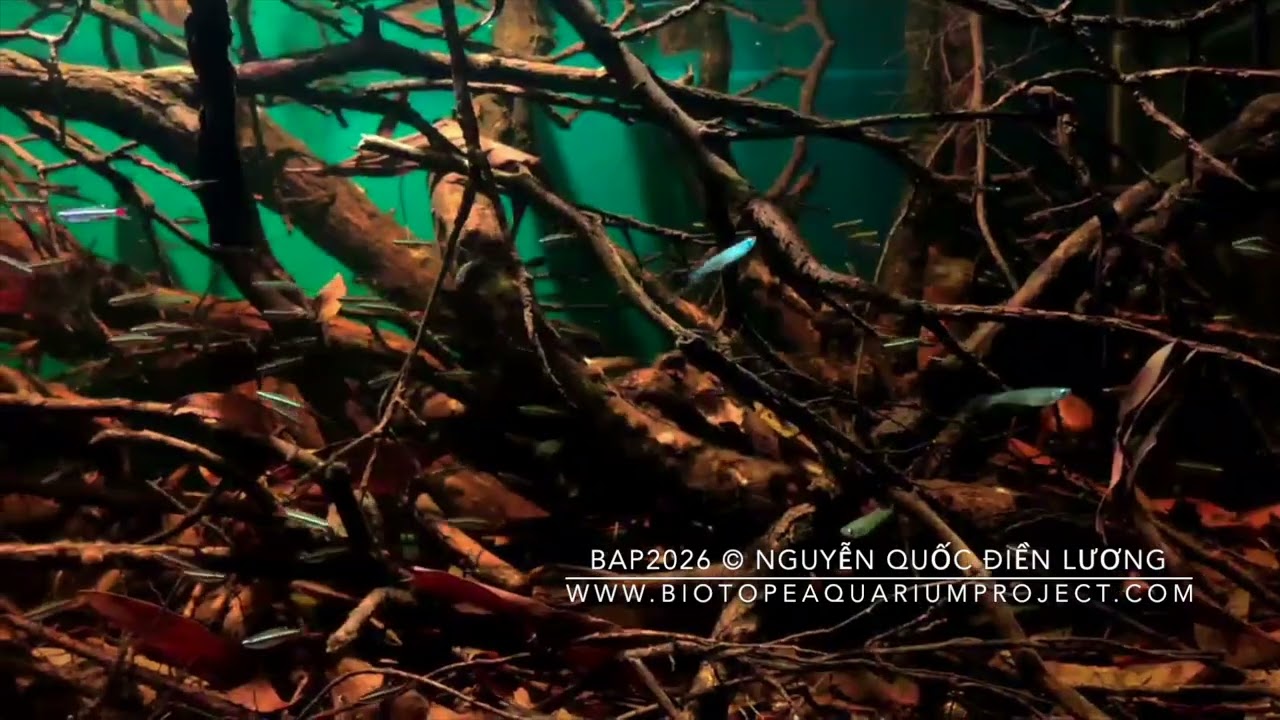
The streambed is composed primarily of white sand covered by a dense layer of decomposing leaf litter. Fallen branches, woody debris, and submerged roots create a complex three-dimensional structure that provides shelter for small fishes and aquatic invertebrates.
The water is clear, with a light amber coloration caused by dissolved tannins released from decaying leaves. Submerged aquatic vegetation is virtually absent, while riparian vegetation provides a continuous input of organic matter.
Small schooling fishes occupy the mid-water column, whereas leaf litter and woody debris serve as important feeding and refuge habitats.
Fishes:
- Tanichthys micagemmae (Cyprinidae) – Vietnamese Cardinal Minnow – 200
- Oryzias pectoralis (Adrianichthyidae) – Pectoral Ricefish – 50
- Trichopsis vittata (Osphronemidae) – Croaking Gourami – 9
- Trichopodus trichopterus (Osphronemidae) – Three Spot Gourami – 7
- Yunnanilus cruciatus (Gastromyzontidae) – Cruciatus Loach – 50
- Threats to ecology
The stream is naturally influenced by seasonal flooding during the monsoon period, which reshapes the sandy substrate, redistributes woody debris and leaf litter, and alters channel morphology.
Additional threats include prolonged dry periods, degradation of riparian vegetation, and potential impacts from climate change. Despite these pressures, the habitat still retains many of its natural structural features, including intact riparian vegetation, abundant leaf litter, and submerged woody debris that support native aquatic biodiversity.
Riparian zone
- Trees near the aquatic habitat
-
Many - Melaleuca cajuputi (Myrtaceae)