bam Demanding level

#11570 Duck Creek Quarry, Howard, Wisconsin

Sponsored by

United States, Wisconsin, Howard

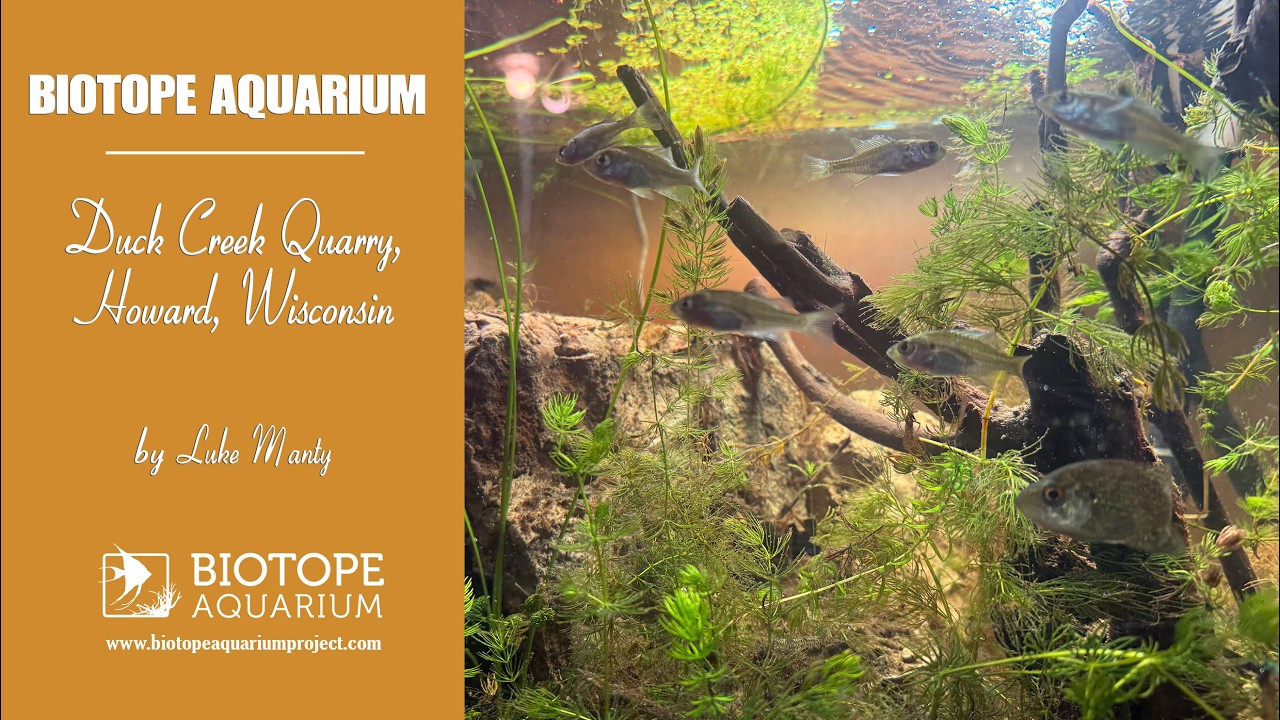
This 254L biotope is a recreation of the unique underwater landscape that fascinated me while growing up. The goal was to create a limestone cliff overlooking a garden of aquatic plants, submerged wood, and organic substrate. Multiple pieces of limestone were carefully arranged to form the central structure. To reflect the natural schooling behaviour of the fish, the upper half of the aquarium is left relatively open. A large piece of wood was positioned upright and partially buried in the substrate. The fish actively school around its branches, especially during feeding.

To recreate the dense underwater vegetation, several plant species, including hornwort (Ceratophyllum demersum) and duckweed (Lemnoideae), were collected and planted in the substrate. Decayed leaves and waterlogged branches were scattered across the bottom.

The aquarium is inhabited by a pair of Rock Bass (Ambloplites rupestris), ten juvenile Bluegill (Lepomis macrochirus), and one Johnny Darter (Etheostoma nigrum).

The vegetation consists of duckweed (Lemnoideae), hornwort (Ceratophyllum demersum), water milfoil (Myriophyllum spp.), and American eelgrass (Vallisneria americana). As the quarry temperature naturally varies with depth, the aquarium is maintained at room temperature (20°C / 68°F).

Submitted by
Luke Manty
GPS
44.5665474, -88.0665970
Geographical region
Northern America
Drainage Basin
River catchment
Water body type
Artificial reservoir
Water body name
Duck Creek Quarry
Water body part
Water body course
Water body: tributary of
Tributary name

Videos above and below water

Warning: Undefined variable $fish_parent in /home/biotopea/public_html/wp-content/themes/bap/content-bam.php on line 85

Water Chemistry

Water information

Water type
Freshwater
Water color
Clear water
Water transparency
High
Concentration of sediments
Medium
Water temperature
20 °C
Water flow/curent
Slow

Chemical parameters

pH
7.9
Conductivity
GH
198 mg/l
dGH
KH
86 mg/l
dKH
Dissolved Oxygen
91 %

Aquarium information

Aquarium description

Set-up date
September, 2025
Aquarium decoration

For this aquarium, I wanted to incorporate features from the various shorelines surrounding the quarry. The collected substrate consists of mud, waterlogged sticks and leaves, limestone gravel, and medium-sized rocks. The large, flat limestone slabs used as the central structure were collected from piles of limestone near the shore. To create the main cliff face, I joined the slabs using non-toxic pond spray foam. The remaining gaps were filled with grout and sealed, resulting in a single solid structure that follows the contours of the upper rock formation. Additional medium-sized rocks create small shelters for the fish. At the base of one limestone wall, a cave was carved to provide both shelter and a shaded refuge.

To recreate the quarry’s distinctive underwater “reef” appearance, I selected a large piece of dead wood and positioned it upright to resemble a submerged tree. The wood was boiled to ensure it would sink before being buried securely in the substrate.

The cliff overlooks a broad bed of substrate and mud, providing an ideal area for aquatic vegetation. The plants were collected by carefully wading through the water and removing individual stems with minimal disturbance. Given the extensive size of the habitat, this collection had no measurable impact on the ecosystem. The upper portion of the aquarium is intentionally left open to allow schooling behaviour, while the lower section is densely planted to recreate the lush underwater vegetation. Intertwining stems form dense underwater thickets, complemented by larger submerged branches.

Although water movement in the quarry is minimal, the filter is adjusted to create gentle surface agitation. This helps maintain adequate oxygen levels for both the fish and the plants. My favourite aspect of the aquarium is watching the fish school around the submerged tree and its branches, particularly during feeding.

Aquarium equipment

Filtration:

  • Fluval 207 Canister Filter

Lighting:

  • Fluval Aquasky 3.0 LED, 24 in, 18 W
  • Viparspectra LED, 165 W (operated at a low setting to support plant growth)
Fish care

The aquarium houses a total of 13 fish. They are fed daily with freshwater flake and pellet foods. Although I was initially sceptical that they would accept prepared foods, all of the fish adapted readily.

Approximately three times per week, they receive frozen foods, including bloodworms, mysis shrimp, small redworms, and waxworms. These provide valuable sources of protein and healthy fats. The different food types are rotated to ensure a varied diet.

Once the fish outgrow the aquarium, they will be relocated to a suitable private pond.

Fish:

  • Ambloplites rupestris (Centrarchidae) – Rock Bass (2)
  • Lepomis macrochirus (Centrarchidae) – Bluegill (10)
  • Etheostoma nigrum (Percidae) – Johnny Darter (1)

Mollusc:

  • Aplexa elongata (Physidae) – Bladder Snail
Plant care

In the beginning, the water was treated with phosphate and a nutrient solution formulated for aquatic plants. The aquarium follows a 12:12-hour light cycle. During the first and last two hours of the day, the light intensity gradually increases and decreases. The plants receive full-spectrum lighting for 8 hours each day and also benefit from nutrients produced by fish waste.

Aquatic vegetation:

  • Ceratophyllum demersum (Ceratophyllaceae) – Hornwort
  • Myriophyllum spicatum (Haloragaceae) – Water Milfoil
  • Vallisneria americana (Hydrocharitaceae) – Freshwater Eelgrass
  • Lemna minor (Lemnoideae) – Duckweed
Water care

Initially, I performed weekly 20% water changes while the mud and suspended sediment settled. As the aquarium matured and the plants became established, they helped maintain water quality. I now perform a 20% water change approximately once a month. Water quality is monitored regularly, and additional water changes are carried out if the water becomes cloudy or uneaten food accumulates.

All replacement water is RO/DI water. Its high purity helps maintain water quality and reduces the introduction of excess nutrients that could promote unwanted filamentous algae growth. The aquarium is maintained at room temperature, averaging approximately 20°C (68°F).

Water parameters are tested regularly.

Dimensions

Length
92 cm
Depth
46 cm
High
61 cm
Volume
254 L

Substrate in aquarium

Sand
Beige
Pebble/Gravel
Grey
Stone
Grey
Stone form
Irregular
Silt/Mud
Brown
Leaves
Few
Driftwood
Few
Submerged terrestrial vegetation
None

Bibliography

  • Hobbyist Guide To The Natural Aquarium - Fresh Water Plant Basics by Chris Andrews
  • Fish Of Wisconsin Field Guide - Micro & Creek Fish by Dave Bosanko

Sitography

→ Youtube