bin
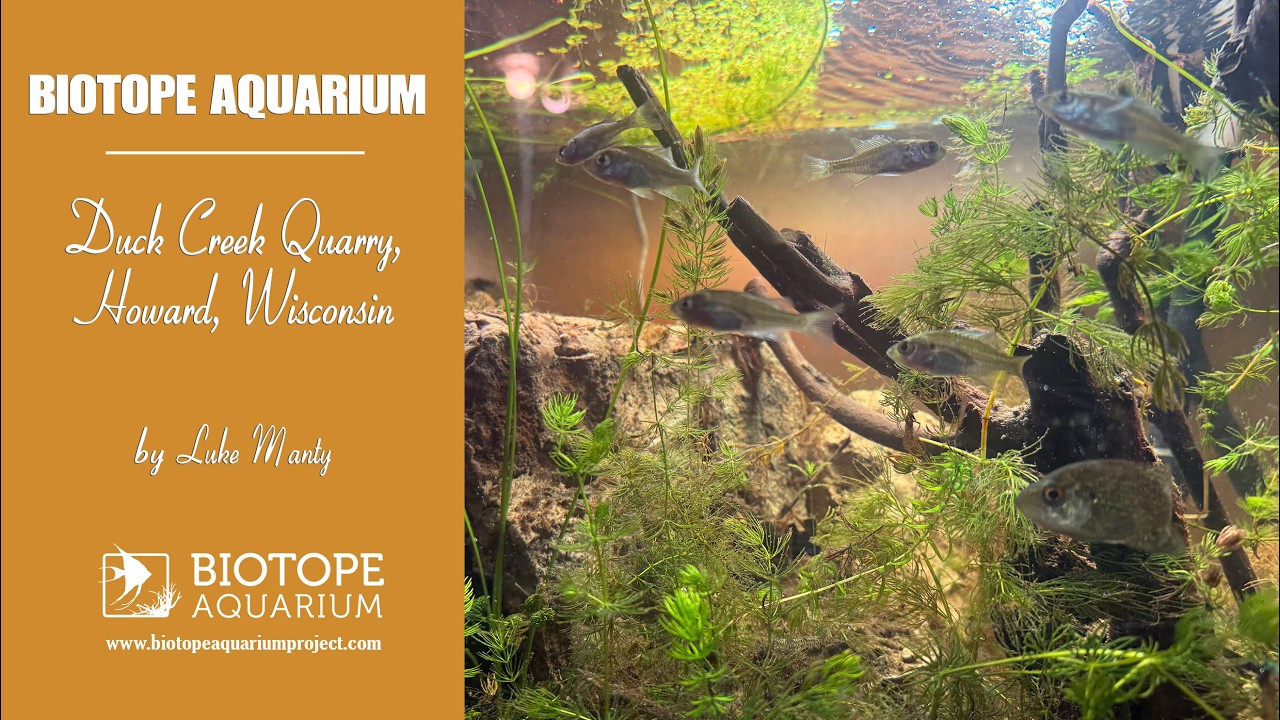
Duck Creek Quarry, Howard, Wisconsin
United States, Wisconsin, Howard
Located in the village of Howard, Wisconsin, the Duck Creek Quarry is a former limestone quarry that operated from 1827 to 2001. After its closure, it was naturally filled by an underground aquifer. The most unique features of this body of water are its steep stone drop-offs and deep blue coloration, caused by the way sunlight interacts with the limestone.
The underwater habitat contains several niches, including muddy and silty bottoms, sandy shorelines, and flat stone floors. With depths reaching up to 170 ft, the water quickly becomes cold just a few feet below the surface. Most biological activity is found along the muddy banks and shallow beds, where dense vegetation grows, including hornwort (Ceratophyllum demersum) and pondweed (Potamogeton spp.).
Along the stone walls, multiple rock shelves create additional habitat complexity. Former water levels exposed these shelves to the air, allowing large trees and bushes to grow on top. Hundreds of fish, including Bluegill (Lepomis macrochirus), school around these submerged tree structures, creating an environment that resembles an underwater reef.
- Submitted by
- Luke Manty
- Approved by
- Lawrence Kent, Fritz Rohde & John T. Baxter
- GPS
- 44.5665474, -88.0665970
- Geographical region
- Northern America
- Drainage Basin
- River catchment
- Water body type
- Artificial reservoir
- Water body name
- Duck Creek Quarry
- Water body part
- Water body course
- Water body: tributary of
- Tributary name
Videos above and below water
Warning: Undefined variable $fish_parent in /home/biotopea/public_html/wp-content/themes/bap/content-bin.php on line 55
Water Chemistry
Water information
- Water type
- Freshwater
- Water color
- Clear water
- Water transparency
- High
- Concentration of sediments
- Low
- Water temperature
- 20 °C
- Water flow/curent
- None
Chemical parameters
- pH
- 7.9
- Conductivity
- GH
- 215 mg/l
- dGH
- KH
- 91 mg/l
- dKH
- Dissolved Oxygen
- 88 %
Substrate in nature
- Sand
- Beige
- Pebble/Gravel
- Grey
- Stone
- Grey
- Stone form
- Irregular
- Silt/Mud
- Brown
- Leaves
- Few
- Driftwood
- Few
- Submerged terrestrial vegetation
- Yes
Aquatic Biotope
- Date of collecting
- 19 June, 2026
- Collecting area
- River bank
- Water depth
- 0,5m
- Air temperature
- 24 °C
- Sunlight
- Full sun
Environment
- Environment
- Human settlements
- Human settlements
- Compacted
- Surrounding area
Surrounding the quarry are several different shoreline habitats. The southern side, which was once composed of rock mounds and cliffs, is now a sandy beach.
To the east, a path runs alongside a dirt and gravel bank. Large trees and bushes line the path, with some trees extending over the edge, shedding leaves and providing shade to parts of the water.
Further north, a forest extends to the water’s edge. In this area, a small creek runs alongside the quarry before flowing into Duck Creek, which eventually reaches the bay of Lake Michigan. The close proximity to the natural water system has allowed fish from the surrounding river network to enter the quarry through natural processes, such as the transport of eggs by birds and other wildlife.
- Underwater landscape
Different shores along the water have different properties. There is a sandy beach that leads down to the deeper parts. One side has stone floors extending out, surrounded by a small forest. The last side has mud and stony banks that slope down and flatten out to a mixed muddy and rocky bed made up of chunks of limestone and smaller pebbles. This is where the majority of the fish and animals are found. Bluegill and other sunfish make beds and spawn in the more gravely areas during the spring. Underwater is a mix of vegetation in the form of algae, weeds and plant types, as well as large dead trees and stronger bodied bushes that have turned into shelter and their own mini habitats for the wildlife..
Previous lower water levels are what allowed trees to grow off of rock shelves. As the water level rises above, microcosms form around the bare trees that have many branches. These provide shelter and hiding places for all of the fish & invertebrates. Green algae hangs from the arms of trees resembling live ones such as a Weeping Willow.
The place is mainly deep open clear water. The limestone bounces off light making the water appear blue. About 40ft down is a layer of sediment suspended in the air, divers have described how quickly the visibility goes dark and how cold the water becomes.
Fish:
- Micropterus salmoides (Centrarchidae) – Largemouth Bass
- Ambloplites rupestris (Centrarchidae) – Rock Bass
- Lepomis macrochirus (Centrarchidae) – Bluegill
- Pomoxis nigromaculatus (Centrarchidae) – Black Crappie
- Etheostoma nigrum (Percidae) – Johnny Darter
Aquatic vegetation:
- Lemnoidea (Araceae) – Duckweed
- Ceratophyllum demersum (Ceratophyllaceae) – Hornwort
- Myriophyllum spp. (Haloragaceae) – Water Milfoil
- Chara spp. (Characeae) – Muskgrass
- Vallisneria americana (Hydrocharitaceae) – American Eelgrass
- Threats to ecology
Although the quarry is relatively strong ecologically, the increase in recreational activities such as kayaking, boating, and the public beach area may represent potential concerns. Visitors may not always follow regulations or may remove more fish than permitted. Littering is another possible threat, although the village maintains the area well. Signs surrounding the quarry provide information about rules and regulations, helping to raise awareness and reduce risks to the ecosystem.
My motivation for choosing this location is to study and recreate the habitat that fascinated me while growing up and continues to inspire me today. As a child, the quarry was a special place, with rope swings, cliff diving, and the opportunity to explore the underwater features that make this ecosystem unique. It is a place that I hope can be enjoyed and protected for many years to come.