bam Beginner-friendly level

#10961 Flooded Canal Margin, Chao Phraya Basin, Ayutthaya, Thailand

Sponsored by

Thailand, Central Thailand, Ayutthaya

This Biotope Aquarium Model (BAM) recreates a shallow floodplain margin connected to an agricultural drainage canal within the Chao Phraya River Basin. The design focuses on replicating early wet-season conditions, when rising water levels inundate terrestrial edges and create low-flow habitats rich in vegetation and organic matter.

Key features of the natural biotope were translated into the aquarium through a gently sloping substrate, a defined marginal embankment zone, and a gradual transition from emergent vegetation to open shallow water. Organic materials such as fine sediments, botanical debris, and root-like structures were incorporated to reproduce the natural accumulation of detritus typical of low-energy floodplain environments.

Submitted by
DionTre Speller
Geographical region
Southeastern Asia
Drainage Basin
River catchment
Water body type
River
Water body name
Chao Phraya River Basin
Water body part
Water body course
Water body: tributary of
Tributary name
Chao Phraya River

Videos above and below water

Warning: Undefined variable $fish_parent in /home/biotopea/public_html/wp-content/themes/bap/content-bam.php on line 85

Water Chemistry

Water information

Water type
Freshwater
Water color
Clear water
Water transparency
High
Concentration of sediments
Low
Water temperature
23 °C
Water flow/curent
Slow

Chemical parameters

pH
6.4
Conductivity
GH
dGH
KH
dKH
Dissolved Oxygen

Aquarium information

Aquarium description

Set-up date
March, 2026
Aquarium decoration

The aquarium is designed to replicate a natural floodplain edge, with a gradual slope extending from a raised embankment to a shallow open sand foreground. The rear and side sections are elevated using aquasoil contained in mesh bags, covered with organic potting substrate, and capped with a layer of fine sand to reproduce natural sediment stratification.

The use of an organic substrate layer beneath the sand cap provides a nutrient-rich foundation that supports vigorous plant growth while maintaining the appearance of a natural sediment profile.

Planting is intentionally irregular and limited to reflect natural colonization patterns rather than a densely planted aquascape. Limnophila aromatica is arranged in loose clusters, Hygrophila polysperma grows in denser groups, while Oenanthe javanica is positioned along the embankment to create emergent growth and vertical structure. The floating plant Salvinia cucullata is used selectively to create shaded surface areas.

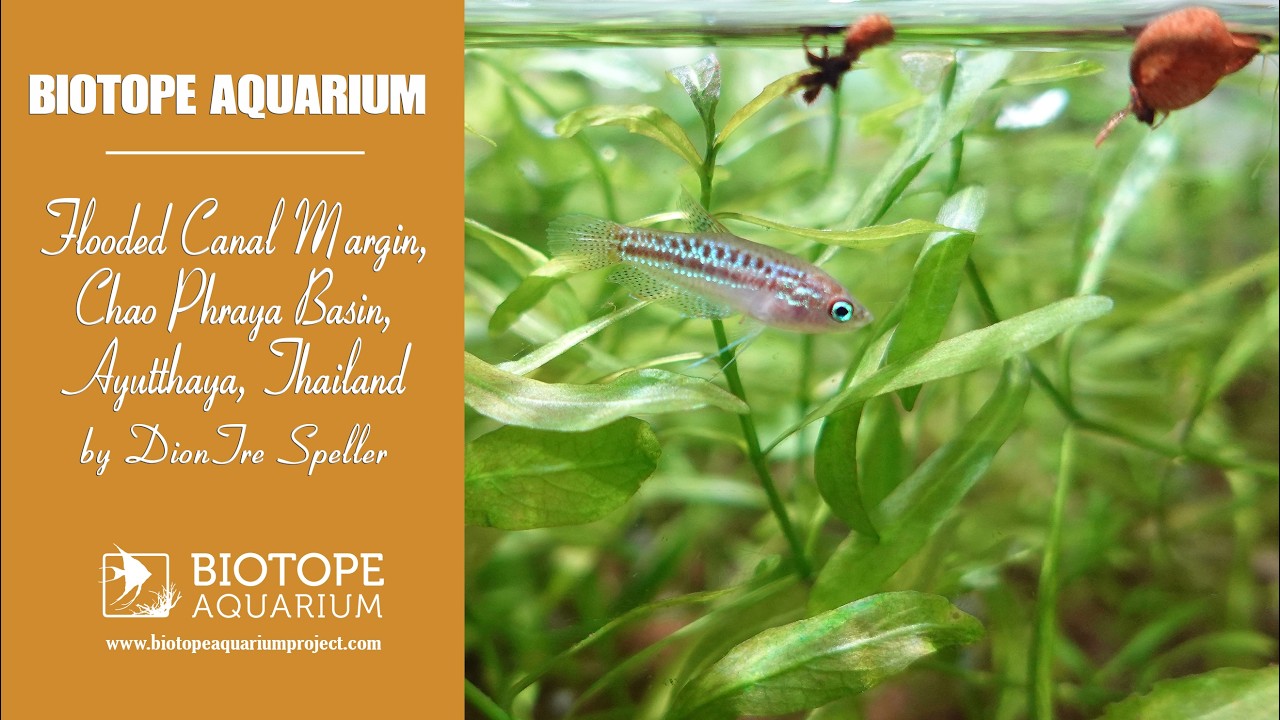
The aquarium contains only Trichopsis pumila to maintain ecological focus and avoid an artificial community composition. A group of six individuals was selected, allowing natural behaviors such as surface interaction, territorial spacing, and the use of vegetation as shelter to be observed.

Fish:

  • Trichopsis pumila (Osphronemidae) -6

Aquatic plant:

  • Limnophila aromatica
  • Hygrophila polysperma
  • Oenanthe javanica
  • Salvinia cucullata
Aquarium equipment

Filtration:
Hang-on-back filter with reduced flow to simulate the slow-moving conditions of a floodplain margin habitat.

Heating:
Submersible heater maintaining a stable tropical temperature.

Lighting:
ASTA 20 LED lighting with moderate intensity, positioned to create uneven illumination and natural areas of shade.

Equipment was removed during photography to preserve the visual authenticity of the biotope representation.

Fish care

Fish are fed a varied diet including small frozen brine shrimp and high-quality prepared foods to support natural feeding behavior and maintain good condition. Observations show active surface interaction, exploration, and natural territorial behavior within the planted areas. Stress is minimized through gentle water movement, surface cover provided by floating vegetation, and stable water parameters.

Plant care

Plants are maintained with minimal intervention to preserve a natural appearance. Trimming is kept to a minimum and carried out selectively, with entire stems removed rather than shaping plant growth. The emergent growth of Oenanthe javanica is encouraged to enhance the realism of the floodplain habitat.

Water care

A 20–35% water change is performed weekly to maintain stable water quality. The dense plant growth contributes significantly to nutrient uptake and helps keep the water clear, making it possible to rely mainly on evaporation top-offs if necessary. However, regular weekly maintenance is continued to monitor the aquarium and maintain a close interaction with the ecosystem.

Dimensions

Length
60 cm
Depth
36 cm
High
18 cm
Volume
38.6 L

Substrate in aquarium

Sand
Beige
Pebble/Gravel
Beige
Stone
None
Stone form
Silt/Mud
Beige
Leaves
None
Driftwood
Few
Submerged terrestrial vegetation
Yes