- Set-up date
- July 2025
- Aquarium decoration
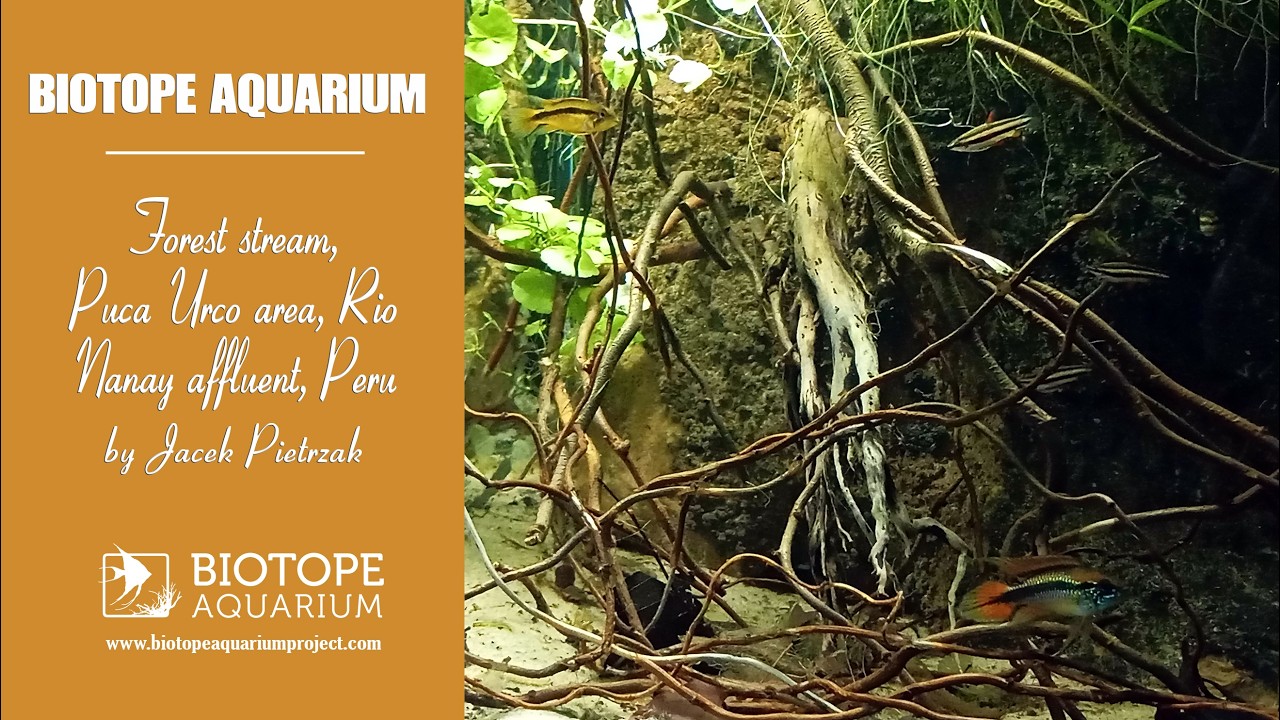
I designed the aquarium myself, and it required a significant amount of effort. Creating the background with the correct dimensions and shape was particularly challenging. I glued ceramic pot fragments together and covered them with expanding foam. I then waited several weeks to allow any residual gases to dissipate.
Afterwards, I coated the background with a mixture of sand, soil, and clay bound with a safe resin. In the upper section of the background, about 6 cm below the water surface, I created a planting shelf for Helanthium tenellum (formerly Echinodorus tenellus). Behind the aquarium, I installed LED lighting between two sections of the background, creating the illusion of a continuation of the stream.
The planting shelf was filled with substrate and covered with sand, and additional sand was added to the bottom. The remaining aquascape consists of numerous twigs and roots, but the most important element is the leaf litter. The leaves are never replaced, only added to over time. There is no need to artificially simulate silt, as the leaves decompose naturally, just as in nature.
The biological filtration works extremely well, and nothing rots or produces unpleasant odours. Everything develops naturally, and I am proud of the stability of the system.
- Aquarium equipment
The filter is an Aquael Ultramax 2000. It is equipped with two baskets of sponges and three baskets of ceramic media. The heater is an Aquael Platinum 100W. The Sinkor White lighting is set to 15W.
- Fish care
The well-thought-out layout provides the fish with comfortable conditions. The light is not too strong, and the current is gentle. If the fish seek shelter, they always have places to hide. The fish are healthy and show no signs of stress or disease.
I mainly focus on water temperature and stability. Water changes are not performed on a fixed schedule; instead, they depend on phosphate levels, which are my main concern. I try to avoid conditions that could favour cyanobacteria. I also observe leaf decomposition, paying attention to its appearance and smell.
This aquarium is very easy to maintain, as it requires relatively little intervention. Occasionally, I fast the fish for a day. When feeding, I alternate between flakes, pellets, and frozen food. The stocking level feels balanced, with no major issues. Most of the time, I simply observe the fish swimming among branches or emerging from beneath the leaf litter.
- Plant care
Aquarium plants are not demanding because they cannot be in this system. Hydrocotyle leucocephala, for example, tolerates acidic water, and I have established clumps growing in the aquarium. The plant has elongated stems and naturally grows towards the light, but its colour and structure remain healthy, so no intervention is needed. There has never been any liquid fertiliser in this aquarium. The plant absorbs nutrients directly from the water column, supplied by fish waste and decomposing leaves.
Helanthium tenellum is a different case. This species requires more light and nutrients. For this reason, during setup I placed a nutrient-rich substrate beneath the sand layer. The plant is positioned approximately 10 cm below the light source, providing adequate conditions for growth. Occasional pruning is necessary to maintain its development.
- Water care
I have learned that water changes should be carried out approximately every two weeks. However, if performed less frequently, no issues arise. The water is produced using an RO filter. I have not opened the filter for almost a year, although I do occasionally clean the pre-filter.
The filter outlet is adjusted to gently agitate the water surface, ensuring proper oxygenation. I once experienced an issue with a thick protein film forming on the surface; in response, the filter was run at a higher flow rate for two days. Under normal conditions, the flow is kept at a lower setting.