bam Demanding level

#10601 Igarapé do Daracua near Barcelos, Brasil

Sponsored by

Brazil, Amazonas, Barcelos

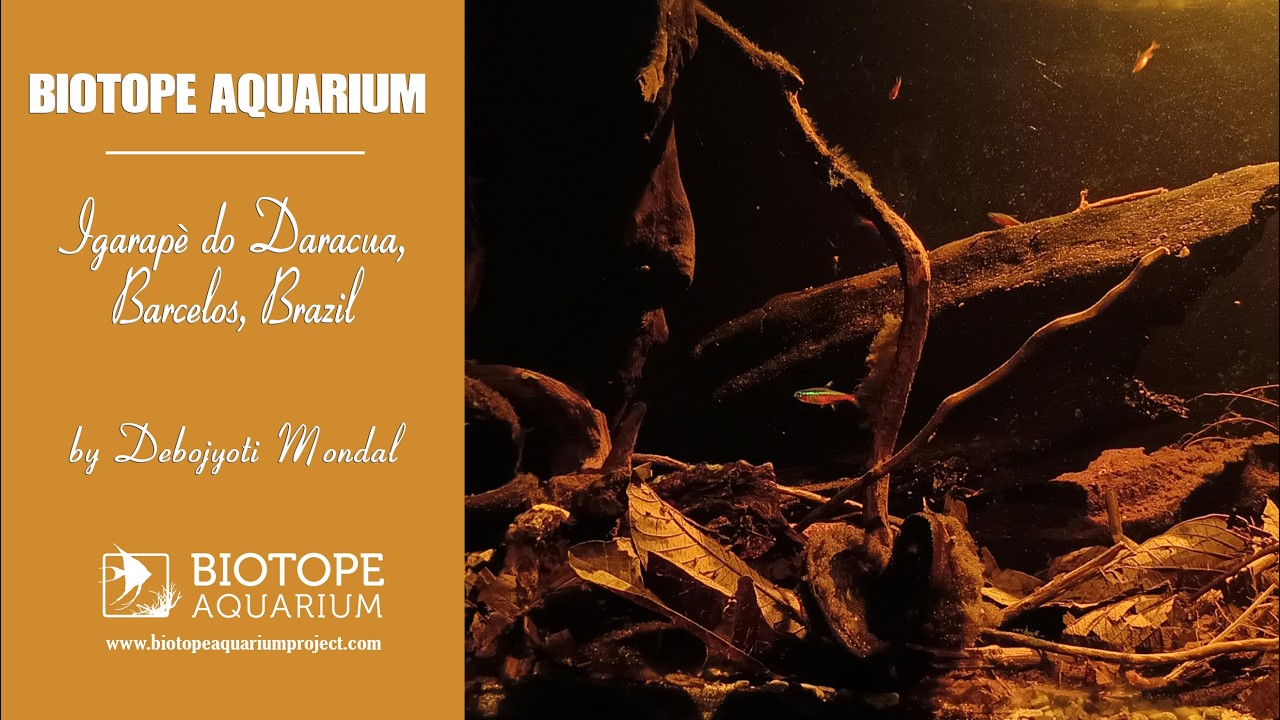
This biotope replicates a dry-season leaf-pack zone of Igarapé do Daracuá, a blackwater forest creek near Barcelos, Rio Negro, Brazil. My motivation was to document the true ecological niche of Paracheirodon axelrodi, moving beyond decorative “Amazon” tanks to recreate the conditions where Cardinal Tetras form dense schools: pH 4.1, conductivity 10 µS/cm, and the absence of a mineral substrate.

The composition centers on a single shaft of light penetrating the igapó canopy, a phenomenon documented in Mikolji’s 2022 footage of Daracuá. This beam illuminates a substrate composed entirely of Mauritia flexuosa palm fronds with branch tangles, replicating the low-PAR environment where true aquatic plants cannot survive, as described by Walker (1995).

The most interesting feature is that 25 Cardinal Tetras exhibit natural monospecific schooling behavior within the leaf pack, foraging on biofilm as described by Knöppel (1970). The absence of sand, aquatic plants, or non-biotope elements focuses attention on habitat function rather than aesthetics.

Submitted by
Debojyoti Mondal
GPS
-0.1415000, -63.1858826
Geographical region
South America
Drainage Basin
Rio Amazonas
River catchment
Rio Negro
Water body type
Igarapè
Water body name
do Daracua
Water body part
River mouth
Water body course
Lower course
Water body: tributary of
River
Tributary name
Rio Negro

Videos above and below water

Warning: Undefined variable $fish_parent in /home/biotopea/public_html/wp-content/themes/bap/content-bam.php on line 85

Water Chemistry

Water information

Water type
Freshwater
Water color
Black water
Water transparency
Medium
Concentration of sediments
Medium
Water temperature
28 °C
Water flow/curent
Slow

Chemical parameters

pH
5
Conductivity
59
GH
dGH
KH
3 mg/l
dKH
Dissolved Oxygen

Aquarium information

Aquarium description

Set-up date
February, 2026
Aquarium decoration

The composition recreates a dry-season leaf-pack microhabitat of Igarapé do Daracuá, Rio Negro, using only materials documented from the natural habitat (Walker, 1995; Mikolji, 2022). The substrate consists entirely of a 5-10 cm deep layer of leaf litter, with no visible sand, gravel, or other mineral substrate, reflecting the complete detrital cover typical of these igarapés.

The leaf litter was conditioned in aquarium water to promote natural decomposition and biofilm development, providing a food source similar to that described for cardinal tetras by Knöppel (1970). Branch tangles were arranged diagonally to mimic fallen riparian trees, while a single main log creates a leading line into the darker areas of the aquarium, reflecting the structure observed in natural cardinal tetra habitats.

The aquarium contains only Paracheirodon axelrodi, as cardinal tetras commonly form monospecific schools within Daracuá leaf packs, and the aquarium size limits the inclusion of additional species. Every element was selected to prioritise ecological accuracy over aquascaping aesthetics. Aquatic plants were intentionally excluded because less than 1% of surface PAR reaches the substrate in natural igarapés. Water movement is provided by a hang-on-back filter, simulating the slow flow of dry-season pools.

Aquarium equipment

Filtration: Seachem Tidal 35 Hang-on-Back Filter

Surface Skimmer: Sicce Shark Surface Skimmer

Lighting: Warm White LED Spotlight

Fish care

The fish are fed twice daily with high-quality pellets. Two different brands are alternated to provide a varied diet.

Plant care
Water care

A 50% water change is performed weekly. The filter is cleaned once a month.

Dimensions

Length
60 cm
Depth
36 cm
High
36 cm
Volume
77 L

Substrate in aquarium

Sand
Beige
Pebble/Gravel
None
Stone
None
Stone form
Silt/Mud
Beige
Leaves
Adundant
Driftwood
Many
Submerged terrestrial vegetation
Yes