- Set-up date
- February, 2026
- Aquarium decoration
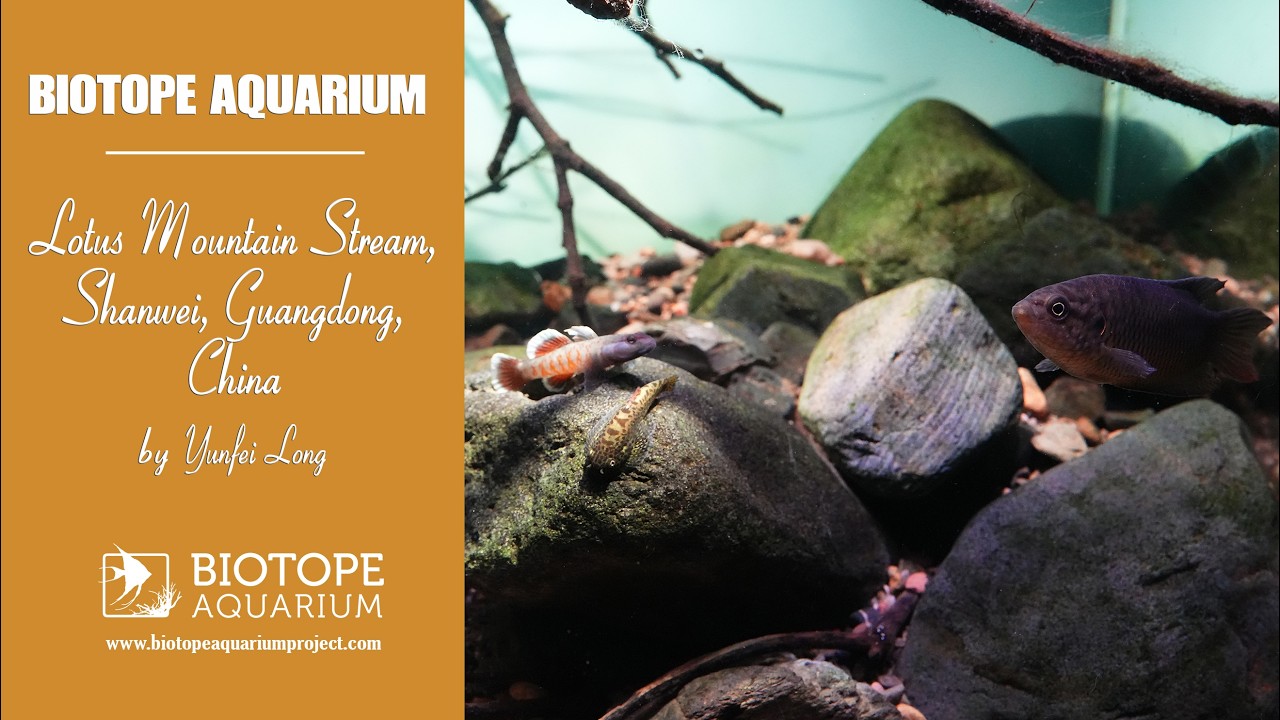
This hardscape recreates a submerged slope along a stream in Lotus Mountain, Shanwei, Guangdong, during the dry winter season. The overall terrain rises from the front toward the rear, with the slope extending diagonally from the rear left to the front right. The stones, mainly ochre and dark cyan in colour, vary considerably in size and orientation, creating a natural arrangement shaped by water flow.
Near the golden ratio point on the right side, a large stone partially buried in the substrate and tilted upward forms the main visual focal point. Beyond its compositional role, this stone also functions as an important territory within the aquarium, where Rhinogobius zhoui display territorial behaviour and interact through visual displays and posturing, transforming the landscape structure into an active ecological scene.
To reproduce the natural stream topography while avoiding excessive substrate depth and the potential accumulation of anaerobic zones, nylon mesh bags (3 mm mesh) filled with quartz filter media were used to elevate the rear section of the aquarium. These structures were then covered with stream gravel and mixed river sand collected from the native habitat, remaining completely concealed beneath the substrate.
Across the slope, fallen branches, bamboo twigs, and dry leaves collected from the original environment were arranged to replicate natural organic debris accumulation. Additional branches extend above the water surface, forming a tangled structure that creates dappled shadows on the rocks below. Commercially heat-sterilised pond mud was ground into powder and added to crevices and depressions to simulate the fine silt and organic deposits naturally accumulated by stream currents.
No aquatic plants were introduced. Only naturally occurring algal growth on the rocks was retained, reflecting the conditions observed in the dry-season habitat. After the aquarium was filled and matured for two weeks, ammonia, nitrite, and nitrate levels were measured at zero.
This aquascape represents the stream during its low-water dry-season phase. As water flow decreases during winter, fallen branches accumulate along the margins, trapping leaf litter and fine sediment while creating sheltered areas of calm water. These seasonal conditions allow Macropodus hongkongensis to occupy sections of the stream that would otherwise experience stronger currents, providing refuge and feeding opportunities among submerged branches.
The intentionally reduced water flow in the aquarium reflects this seasonal habitat condition, making the presence of this species ecologically consistent with the recreated environment.
Fish:
- Rhinogobius zhoui (Gobiidae) – 5
- Macropodus hongkongensis (Osphronemidae) – 1
- Pseudogastromyzon laticeps (Gastromyzontidae) – 4
Molluscs:
- Sulcospira hainanensis (Pachychilidae) – 3
Aufwuchs:
- Diatoms (brown algae) – common on rock surfaces
- Aquarium equipment
Lighting 1: NETLEA AT3 Pro+ LED, 65 W (adjustable spectrum: 5,700–7,500 K)
Lighting 2: 16 W LED spotlight (used for photography only)
Filtration: AMTRA EX650 external filter, 650 L/h, operated at approximately one-third of its maximum flow rate.
- Fish care
This aquarium houses three fish species and one mollusc: Rhinogobius zhoui, Pseudogastromyzon laticeps, Macropodus hongkongensis, and Sulcospira hainanensis. All specimens were collected from the same stream, at a location outside the primary habitat of R. zhoui. Only healthy, active adults with vivid coloration were selected, while unsuitable individuals were released at the original collection site.
The final stocking consists of five R. zhoui (three males and two females), four P. laticeps, one M. hongkongensis, and three S. hainanensis. This community represents the principal trophic groups of the habitat while minimizing the impact of collection on wild populations.
Parazacco spilurus and Pseudobagrus trilineatus, although naturally present in the same biotope, were excluded because their adult size is unsuitable for long-term maintenance in a 54 L aquarium. Neocaridina sp. were also omitted, as they would be rapidly preyed upon by the gobies and the paradisefish and would therefore be unable to establish a stable population.
Within this 54 L aquarium, two main considerations guided the design: minimizing interactions between R. zhoui and M. hongkongensis, and determining an appropriate stocking density for the gobies. After one week of biological cycling, the gobies and hillstream loaches were introduced first. Once they had acclimated and established territories for approximately two weeks, the paradisefish was added.
As an ambush predator, M. hongkongensis benefits from the network of submerged branches extending from above the water surface, which provides cover together with a mosaic of light and shadow. This structure allows the fish to remain well concealed before rapidly emerging to capture food, closely reflecting its natural hunting behaviour.
The aquarium is fed twice daily. Providing sufficient food helps reduce interspecific aggression. Both the gobies and the paradisefish receive a diet of finely minced freshwater prawn, prepared in advance and frozen, with approximately 0.5 g offered per feeding. This feeding regime has been refined through long-term experience and successfully maintains normal growth and coloration.
The suitability of the goby stocking density is assessed by observing territorial behaviour. If individuals are forced to remain attached to the aquarium glass due to excessive competition, the density is considered too high. To minimise conflicts, numerous upright rocks provide observation perches, while abundant crevices allow the excavation of individual burrows.
Water circulation flows diagonally from the rear left toward the front right, striking the front glass before creating a return current along the substrate. As a result, nearly all goby burrow entrances face into the current, closely reproducing their natural orientation in the wild while allowing clear behavioural observation.
In practice, a ratio of three males to two females has proven optimal, maintaining active and visible fish without creating excessive territorial stress or overloading the biological filtration.
Pseudogastromyzon laticeps and Sulcospira hainanensis feed primarily on naturally occurring algae growing on the rocks and are supplemented weekly with Hikari algae wafers and newly hatched brine shrimp. To maintain the dominance of brown algae (diatoms), characteristic of the native habitat, while limiting the growth of green algae, the water temperature is kept below 26 °C and a long, low-intensity photoperiod is maintained (see Plant Care). This management approach preserves an algal community closely resembling that of the natural stream.
- Plant care
-
- Water care
This aquarium employs a modified filtration approach designed to retain fine silt and organic debris within the system. The fine mechanical filter wool has been removed, leaving only a coarse sponge to capture larger particles, while quartz biological media provide extensive surface area for nitrifying bacteria. To ensure stable biological filtration, the aquarium is maintained with a relatively low stocking density and carefully controlled feeding, minimizing the organic load. This approach allows fine sediments to remain within the aquarium, closely replicating the natural substrate conditions. The system has operated successfully for approximately five months, demonstrating long-term stability.
Routine maintenance consists of a weekly one-third water change and cleaning of the aquarium glass as required. Water parameters, including ammonia, nitrite, nitrate, pH, and general hardness (GH), are monitored regularly. Throughout the maintenance period, ammonia and nitrite have consistently remained at zero, nitrate has been maintained between 5 and 10 ppm, pH at approximately 6.9, and GH at around 4°dGH.
Every two to three months, the filter is serviced using aquarium water removed during a scheduled water change. Debris is removed and the coarse sponge is rinsed, while the biological quartz media are left undisturbed to preserve the established bacterial community. No significant fluctuations in water quality have been observed following maintenance.
To maintain the chemical characteristics and natural appearance of the habitat, fallen leaves and small twigs are periodically added to the aquarium.