bin
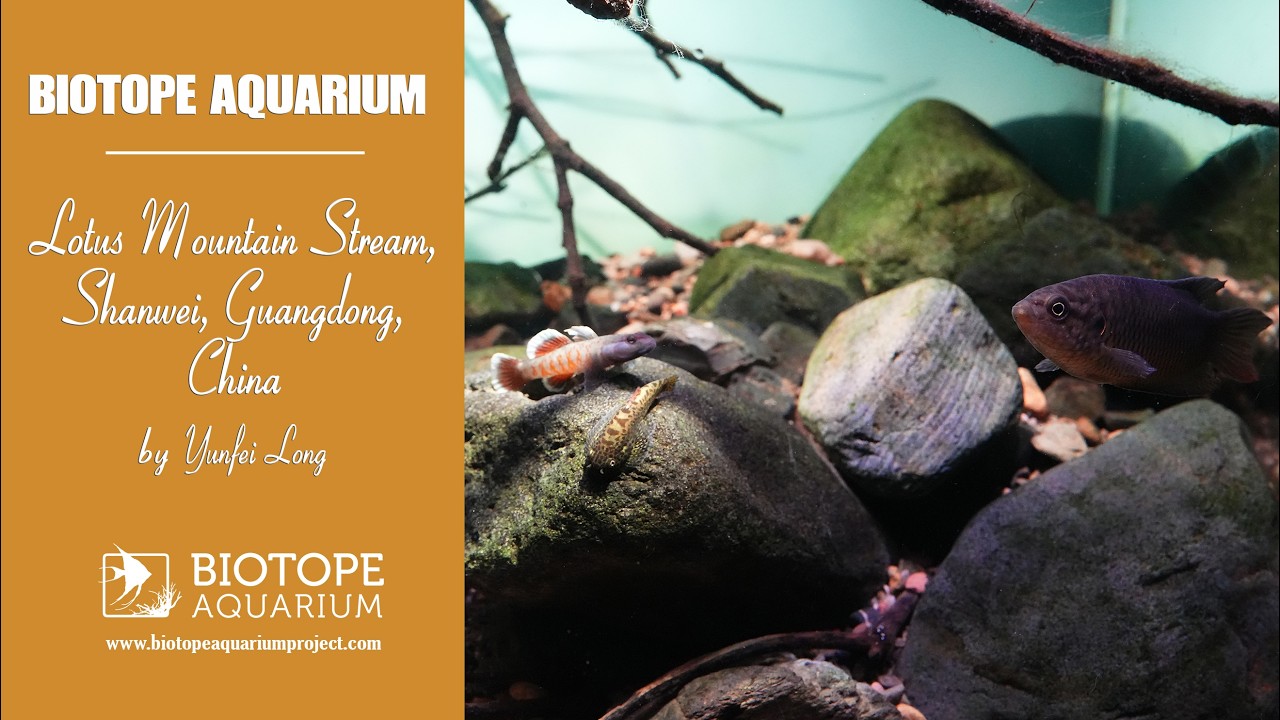
Lotus Mountain Stream, Shanwei, Guangdong, China
China, Guangdong, Shanwei
Lotus Mountain, located in Haifeng County, Shanwei City, Guangdong Province, reaches an elevation of 1,337.3 metres above sea level and derives its name from its lotus-shaped peak formation. The region experiences a subtropical monsoon climate, with an average annual rainfall of 2,168 mm and clearly defined wet and dry seasons.
This unnamed stream is located in the central area of the mountain range and belongs to the Huangjiang River catchment within the coastal river systems of eastern Guangdong. As a typical Lingnan mountain stream, it provides habitat for a diverse community of native aquatic species and represents an important freshwater ecosystem within the region.
- Submitted by
- Yunfei Long
- Approved by
- Sun Kai, Zhou Hang & Wei-Cheng Jhuang
- GPS
- 23.0393085, 115.2575378
- Geographical region
- Eastern Asia
- Drainage Basin
- Coastal Rivers Basin of Eastern Guangdong
- River catchment
- Huangjiang River
- Water body type
- Stream
- Water body name
- Unnamed
- Water body part
- Rapids
- Water body course
- Upper course
- Water body: tributary of
- Hill streams
- Tributary name
Videos above and below water
Warning: Undefined variable $fish_parent in /home/biotopea/public_html/wp-content/themes/bap/content-bin.php on line 55
Water Chemistry
Water information
- Water type
- Freshwater
- Water color
- Clear water
- Water transparency
- High
- Concentration of sediments
- Medium
- Water temperature
- 15-26 °C
- Water flow/curent
- Slow
Chemical parameters
- pH
- 6.7
- Conductivity
- 120
- GH
- 54 mg/l
- dGH
- KH
- 16 mg/l
- dKH
- Dissolved Oxygen
- 90 %
Substrate in nature
- Sand
- Orange
- Pebble/Gravel
- Mixed
- Stone
- Mixed
- Stone form
- Irregular
- Silt/Mud
- Orange
- Leaves
- Many
- Driftwood
- Many
- Submerged terrestrial vegetation
- None
Aquatic Biotope
- Date of collecting
- 23/11/2025
- Collecting area
- Shore line
- Water depth
- 0,2m
- Air temperature
- 21 °C
- Sunlight
- Partial shade
Environment
- Environment
- Affected by human activity
- Affected by human activity
- Pollution
- Pollution
- Little
- Surrounding area
The stream is surrounded by typical southern subtropical evergreen broad-leaved forest. Riparian vegetation is dominated by fir, camphor trees, and various Fagaceae species. The shrub layer mainly consists of Rhodomyrtus tomentosa and Schefflera octophylla, while the forest floor is covered by a thick layer of leaf litter and fallen twigs.
The canopy provides partial shading over the stream, resulting in predominantly dappled sunlight conditions. Along the banks, numerous herbaceous plants grow near the water, including Cyperaceae species such as Fimbristylis sp. and various unidentified Poaceae species.
The fish community includes Rhinogobius zhoui, Pseudogastromyzon laticeps, Pseudobagrus trilineatus, and Parazacco spilurus. During the dry season, Macropodus hongkongensis can also be found in this stream section. The invertebrate community includes Sulcospira hainanensis and Neocaridina sp.
The lower reaches of the stream additionally support populations of Rhinogobius duospilus, Rhinogobius leavelli, and Odontobutis haifengensis. Occasional observations of Amolops teochew and Pachytriton airbranchiatus have also been recorded in the surrounding forest habitat.
Fish:
- Parazacco spilurus (Xenocyprididae)
- Pseudogastromyzon laticeps (Gastromyzontidae)
- Pseudobagrus trilineatus (Bagridae)
- Rhinogobius zhoui (Gobiidae)
- Macropodus hongkongensis (Osphronemidae)
Crustaceans:
- Neocaridina sp. (Atyidae)
Molluscs:
- Sulcospira hainanensis (Pachychilidae)
Aufwuchs:
- Underwater landscape
The replicated microhabitat is located along the bank of a shallow, slow-flowing pool formed by a widening section of the stream. Water depth ranges from 5 to 25 cm, with moderate flow velocity and clear water conditions, appearing greyish-green in shallow areas and transitioning to blue tones in deeper sections.
Near the bank, large boulders are surrounded by dense accumulations of fallen branches and leaf litter, with some woody debris extending into the water and creating a complex, net-like structure. Beneath the surface, rocks of various sizes are present, supporting only natural brown algal (diatom) growth rather than aquatic plants.
Within the rock crevices, abundant deposits of leaf litter, twigs, and fine silt accumulate. These organic sediments build up during the dry season and are naturally redistributed during periods of increased water flow in the rainy season.
- Threats to ecology
This habitat faces four primary threats. The first is over-collection. Rhinogobius zhoui, highly valued in the ornamental fish trade due to its vivid coloration and distinctive morphology, has an extremely restricted distribution, being confined mainly to the Huangjiang River in Haifeng County and adjacent small coastal drainages. Its populations are particularly vulnerable to overexploitation due to their limited range and slow recovery capacity.
The second threat is the increasing frequency of extreme weather events. Intensifying drought–flood cycles may significantly affect stream ecosystems: prolonged droughts can cause slow-flowing sections to dry out and isolate populations, while severe rainstorms may generate flash floods that scour the streambed and alter habitat structure.
The third threat is tourism disturbance. The stream is located within the Lotus Mountain scenic area, where recreational activities such as stream wading are becoming increasingly popular. Improper visitor behaviour, including leaving litter in the water, directly affects water quality and aquatic biodiversity.
The fourth concern is water infrastructure development. Small-scale hydraulic projects, including check dams and diversion channels, may negatively affect stream connectivity when designed without sufficient consideration of natural hydrological processes.
Encouragingly, conservation awareness among local communities is gradually increasing. The establishment of Lotus Mountain Forest Park provides additional management and protection for the stream habitat while supporting sustainable local development. At the same time, more native fish enthusiasts are promoting responsible collection practices and opposing unsustainable exploitation, contributing to a growing community-based conservation effort.
In the long term, maintaining a balance between outdoor recreation and freshwater habitat conservation will be essential for protecting this unique ecosystem.
Bibliography
-
→ Zoological Research, 30(3): 327–332 - Rhinogobius zhoui, a new goby (Perciformes: Gobiidae) from Guangdong Province, China
by Li, F. & Zhong, J.-S.
-
Acta Zootaxonomica Sinica, 11(3): 322–331 - A preliminary revision of the genus Pseudogastromyzon (Homalopteridae) from China
by Zheng, C.-Y. & Li, W.-X.
-
→ Zootaxa, 1908(1): 1–27 - Morphological re-examination and taxonomy of the genus Macropodus (Perciformes: Osphronemidae)
by Winstanley, T. & Clements, K. D.
-
→ Freshwater Biology, 48(7): 1161–1172 - Ecological effects of perturbation by drought in flowing waters
by Lake, P.S.
-
Stream Hydrology: An Introduction for Ecologists (2nd ed.). John Wiley & Sons.
by Gordon, N. D., McMahon, T. A., Finlayson, B. L., Gippel, C. J., & Nathan, R. J.
-
Freshwater Fishes of China, P173, P665, P697
by Li, F.
-
The Freshwater Fishes of Guangdong Province. Guangdong Science and Technology Press, P174, P309
by Pearl River Fisheries Research Institute, Chinese Academy of Fishery Sciences; South China Normal University; Jinan University; Zhanjiang Fisheries College; Shanghai Ocean University
-
Freshwater Gobies of China, Intellectual Property Publishing House, P68
by Zhou, C.W., Luo, H., Li, L.Z., Li, C.G., Zhang, Z.G.
Comment by the expert
Wei-Cheng Jhuang: This is a beautiful natural environment, and the habitat is described in considerable detail. However, providing more underwater photos or videos would help to better illustrate the habitat structure beneath the water and give a more complete understanding of this biotope.