- Set-up date
- December, 2023
- Aquarium decoration
I have tried to recreate the beautiful and distinctive Soukou River from Guinea in West Africa. I was drawn to this particular river because it contains a unique mix of both aquarium-relevant plants and fish, as well as a beautiful and charming underwater landscape.
My choice of stones is aimed at recreating as authentic a look as possible. The stones are gray-brown with various shades, imitating the gray-brown bauxite appearance of the original habitat. Additionally, I have tried to create as much sediment as possible by leaving old leaves, debris, and other matter at the bottom, again to recreate the biotope’s appearance.
There are both areas with stones and a larger section with tree roots, intended to create an illusion of overhanging roots from the surface vegetation.
My intention is to recreate the transition zone of this area, as it is often where many of the smaller species found in the aquarium trade live. At the same time, it is possible to create a unique transition from underwater plants to emergent plants.
- Aquarium equipment
- Aquarium size: 80 x 35 x 35 cm
- Light: Skylight Hyperspot FS
- Filtration: Sicce Space Ekko 300
- Fish care
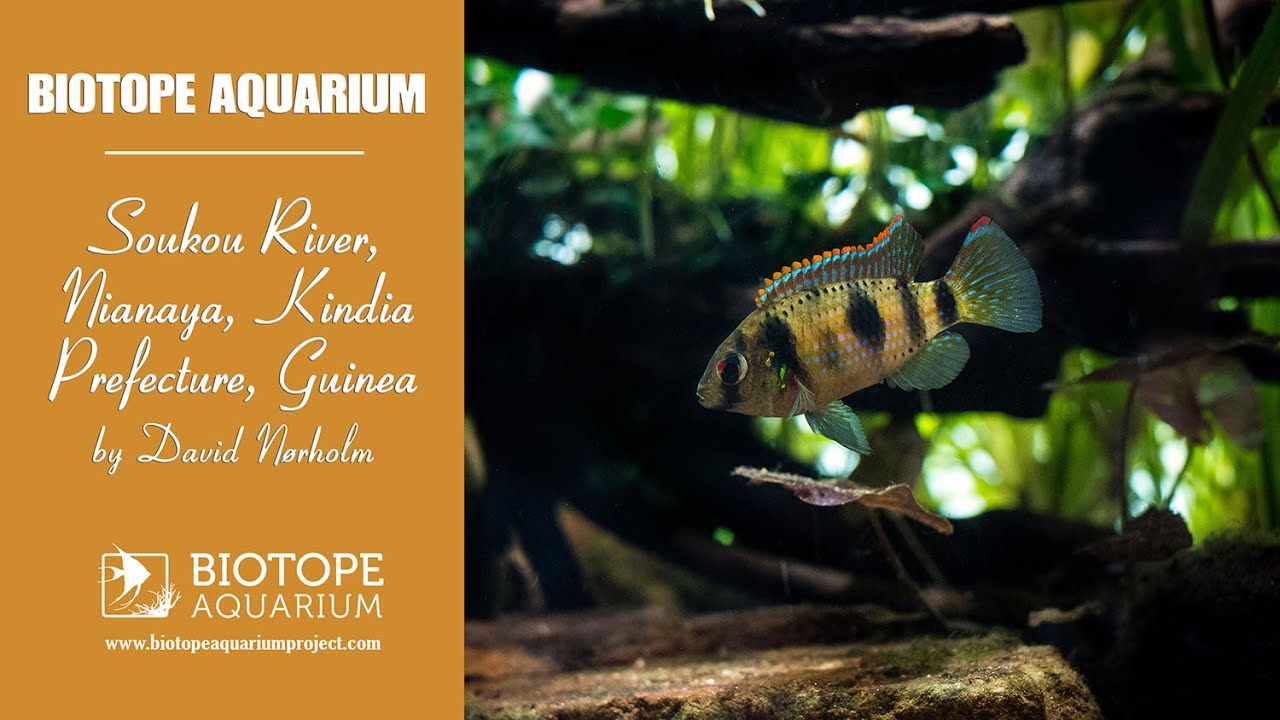
I have chosen to focus on recreating the transition zone of this biotope because it provides the most interesting habitat for my fish. Both Anomalochromis thomasi and Epiplatys sp. inhabit this area. At the same time, this area creates plenty of hiding spots for the aquarium fish, which is necessary as both Anomalochromis thomasi and Epiplatys dageti regularly breed in the aquarium. Several surviving Epiplatys dageti live in the aquarium.
I have deliberately chosen to use Epiplatys dageti, even though this fish, as far as is known, does NOT live in Guinea but in the surrounding countries. This decision was made because the species of Epiplatys that otherwise live in Guinea have not been obtainable. Additionally, the fish from the original biotope is described as Epiplatys sp., thus closely resembling Epiplatys dageti in both appearance and behavior.
E. dageti thrives among the many plants, actively swimming among both Anubias and Vallisneria. Nymphaea lotus is often used as a hiding place and a refuge from conspecifics. At the same time, they willingly swim among the many roots and seek shelter if there is too much aggression, especially from males.
Anomalochromis thomasi occupies the bottom of the aquarium and readily uses both stones and leaves from Nymphaea lotus as breeding grounds. Additionally, both the roots and the dense forest of Vallisneria serve as hiding places in case the males become too aggressive.
Fishes:
- Anomalochromis thomasi (Cichlidae)
- Epiplatys dageti (Nothobranchiidae)
- Plant care
The idea behind this aquarium is to recreate the transition zone of this area, as it is often where many of the smaller species found in the aquarium trade live. At the same time, it is possible to create a unique transition from underwater plants to emergent plants. Here, I have chosen to focus on the unique Anubias plant, which often grows above water in nature and is only periodically submerged. In my biotope, I have planted Anubias in the transition zone so that it grows both underwater and above water, running down my largest roots.
Additionally, I have chosen to use a larger fern that grows on a dense network of tree roots. I have done this to illustrate the overhanging vegetation that is often found in these areas. Furthermore I have used Vallisneria, as seen in the video of this biotope.
Finally I have chosen to use the Nymphaea lotus, which are native to Guinea and this area, and perfect for Epiplatys dageti to find shelter on. It’s a lovely plant, showcasing beautiful red colors in my tank.
- Water care
I add water from the decoction of alder cones to slightly tint the water and to keep the pH lower than my natural tap water.
The color of the water in the biotope is not classic blackwater, but it still has a slight tint, which I try to replicate with my lightly tinted water.
25% waterchange are done weekly as well.