bam Demanding level

Upper Sungai Ciliwung, West Java, Indonesia

Sponsored by

Indonesia, West Java, Bogor

This biotope aquarium is inspired by a shallow, fast-flowing section of the upper Ciliwung River, which originates on the forested slopes of Mount Gede-Pangrango in West Java, Indonesia. The stream winds its way through a mosaic of dense secondary montane forest and agricultural landscapes, where a thick canopy provides continuous shade and contributes seasonal deposits of leaf litter.

The substrate consists of fine volcanic sand, small round pebbles, fine gravel, and occasional roots or fallen branches, mimicking the natural riverbed structure. Light penetration is soft and filtered, with dappled sunlight reaching the water surface through the overhanging riparian vegetation. The water is clear and well-oxygenated, with visible microcurrents and a moderate to strong flow.

The environmental parameters in this setup reflect natural conditions: water temperature ranges between 22 and 24°C, pH stays within 6.8 to 7.4, and total dissolved solids (TDS) remain between 30 and 70 ppm. The water is soft, with a general hardness (GH) of 35.6 to 71.2, and maintains excellent clarity with minimal suspended particles. The flow remains consistently moderate to high, simulating the energy of the upland stream.

Submitted by
Noer Sarifah Ainy
Approved by
Heiko Blessin, Heok Hee Ng & Greg Martin
GPS
-6.6568532, 106.8100662
Geographical region
Southeastern Asia
Drainage Basin
Java Sea, via Jakarta Bay
River catchment
Cisadane–Ciliwung Basin
Water body type
River
Water body name
Ciliwung Hulu
Water body part
Rapids
Water body course
Headwaters
Water body: tributary of
Tributary name

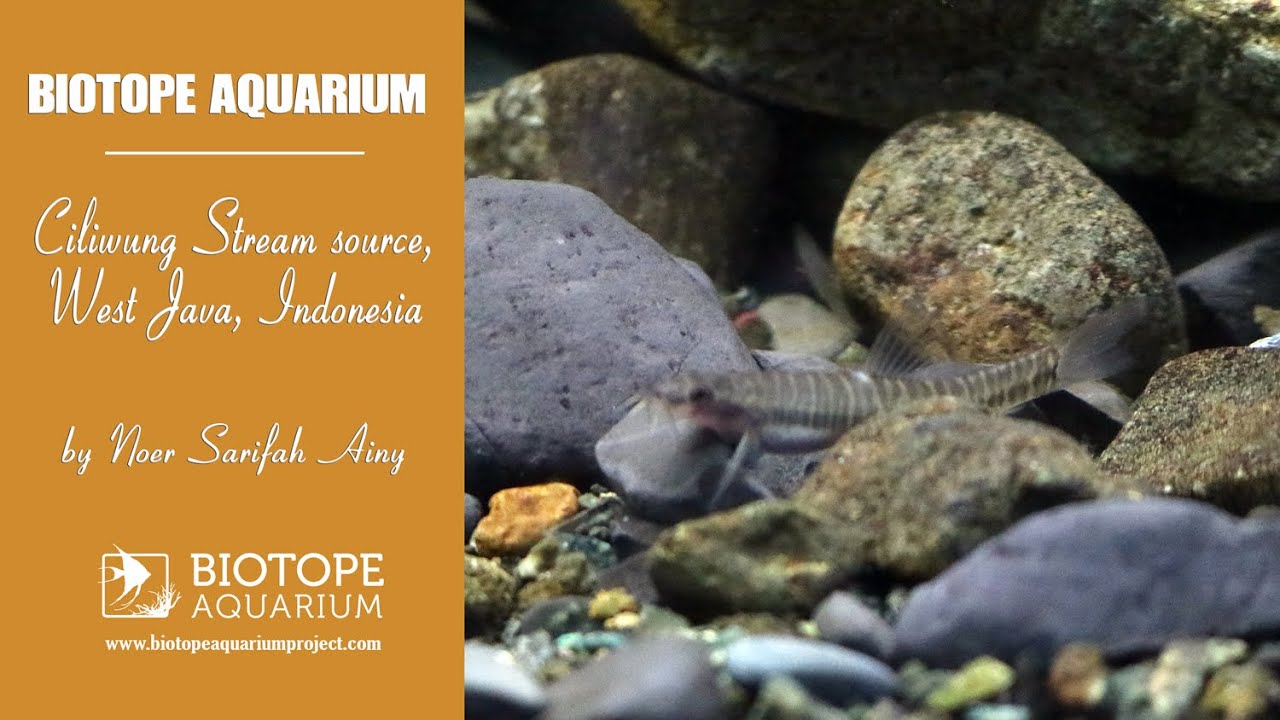
Videos above and below water

Warning: Undefined variable $fish_parent in /home/biotopea/public_html/wp-content/themes/bap/content-bam.php on line 85

Warning: Undefined array key "additional_species" in /home/biotopea/public_html/wp-content/themes/bap/functions/bap-fields.php on line 349

Water Chemistry

Water information

Water type
fresh-water
Water color
Clear water
Water transparency
Medium
Concentration of sediments
Low
Water temperature
26 – 28.2 °C
Water flow/curent
Strong

Chemical parameters

pH
7.0
Conductivity
0
GH
53.4 mg/l
dGH
KH
2 mg/l
dKH
Dissolved Oxygen
5 %

Aquarium information

Aquarium description

Set-up date
June, 2025
Aquarium decoration

Biotope consists of specimens and ornaments taken directly from the upstream habitat of the Ciliwung River. rocks, gravel and sand and wood of various sizes are adjusted to the appearance, size of the aquarium and the actual conditions in the field.

Aquarium equipment
  • Resun LG Filter – 1600 L/h flow rate
  • Resun Wave Maker – 1000 L/h flow rate
  • 40W fluorescent tube (90 cm)
  • 25W spotlight
  • Filter box with filter media
  • Filter fiber (mechanical filtration)
Fish care

Fish are kept in conditions similar to their natural habitat, both in terms of structure and environmental parameters. Food is given every day according to the type of food in nature, namely small crustaceans, worms and Chironomus sp. During the day, the lighting is on at maximum while at night the lighting is slightly dim following its biological cycle in nature.

Fish list:

  • Neolissochilus soroides (Cyprinidae)
  • Rasbora aprotaenia (Cyprinidae)
  • Barbodes binotatus (Cyprinidae)
  • Nemacheilus fasciatus (Nemacheilidae)

Crustacean list:

  • Palaemon styliferus (Palaemonidae)
  • Parathelphusa convexa (Gecarcinucidae)
Plant care

The plants are removed in the afternoon, then soaked in water for 24 hours. Planting in the aquarium is done in the morning using a substrate in the form of rockwool that has been given nutrients. This type of plant is a plant whose habitat is in shady conditions with minimal lighting so that the light available in the aquarium is sufficient to support the plants to adapt.

Wetland plant list:

  • Zoysia matrella (Poaceae)
  • Vittarioideae Adiantum  (Preridaceae)
  • Cyperus papyrus (Cyperaceae)
  • Hypolepis muelleri (Dennstaedtiaceae)
Water care

The water quality parameters measured in the field are adjusted to the levels in the biotope aquarium. Every week, re-measurements are carried out and 10 percent of the water is replaced to maintain its quality.

Dimensions

Length
120 cm
Depth
20 cm
High
40 cm
Volume
96 L

Substrate in aquarium

Sand
None
Pebble/Gravel
Grey
Stone
Grey
Stone form
Irregular
Silt/Mud
None
Leaves
None
Driftwood
Few
Submerged terrestrial vegetation
Yes

Bibliography

Comment by the expert

Heok Hee Ng: Macrognathus circumcinctus is not found in this habitat, as it is an obligate peat swamp species restricted to Sundaic Southeast Asia (thus not found in Vietnam). The BIN video shows a swift-flowing stream, but the recreated habitat has little to no current.

Greg Martin: This layout nicely captures the elements of a fast-flowing river.