bin
Cabin John Creek, Potomac River, Maryland, USA
United States, Maryland, Montgomery County
Cabin John Creek is an approximately 11-mile (18 km) stream flowing through Montgomery County, Maryland, USA. It is a tributary of the Potomac River within the Piedmont Plateau.
Much of the riparian corridor is protected by state agencies and conservation organisations, including Friends of Cabin John Creek, helping to maintain relatively good ecological conditions despite the stream flowing through a highly developed suburban landscape.
The creek supports a diverse assemblage of native aquatic and riparian fauna, most of which are currently classified as Least Concern by the IUCN. Owing to the shallow, fast-flowing nature of the stream, submerged aquatic vegetation is sparse, with only a limited number of native plant species occurring within the channel.
- Submitted by
- Ryan Wright
- Approved by
- Lawrence Kent, Fritz Rohde & John T. Baxter
- GPS
- 39.0017586, -77.0951309
- Geographical region
- Northern America
- Drainage Basin
- Piedmont Plateau
- River catchment
- Potomac River
- Water body type
- Creek
- Water body name
- Cabin John
- Water body part
- Meander
- Water body course
- Middle course
- Water body: tributary of
- River
- Tributary name
- Potomac River
Videos above and below water
Warning: Undefined variable $fish_parent in /home/biotopea/public_html/wp-content/themes/bap/content-bin.php on line 55
Water Chemistry
Water information
- Water type
- Freshwater
- Water color
- Clear water
- Water transparency
- Medium
- Concentration of sediments
- Medium
- Water temperature
- 23.9 °C
- Water flow/curent
- Strong
Chemical parameters
- pH
- Conductivity
- 285
- GH
- 60 mg/l
- dGH
- KH
- 60 mg/l
- dKH
- Dissolved Oxygen
- 60 %
Substrate in nature
- Sand
- None
- Pebble/Gravel
- Mixed
- Stone
- Mixed
- Stone form
- Irregular
- Silt/Mud
- Grey
- Leaves
- Few
- Driftwood
- Few
- Submerged terrestrial vegetation
- None
Aquatic Biotope
- Date of collecting
- 7 July, 2026
- Collecting area
- River bank
- Water depth
- 0,2m
- Air temperature
- 28 °C
- Sunlight
- Filtered/dappled sun
Environment
- Environment
- Human settlements
- Human settlements
- Urban area
- Surrounding area
Cabin John Creek is a protected environment and tributary of the Potomac River in Montgomery County, Maryland. The riparian zone around the creek is largely protected, extending approximately 100 m from the stream in many areas. However, the creek is crossed multiple times by busy roads.
Away from the protected and heavily planted riparian zones, the surrounding landscape consists of suburban housing complexes and urban areas that developed from long-established farmland.
- Underwater landscape
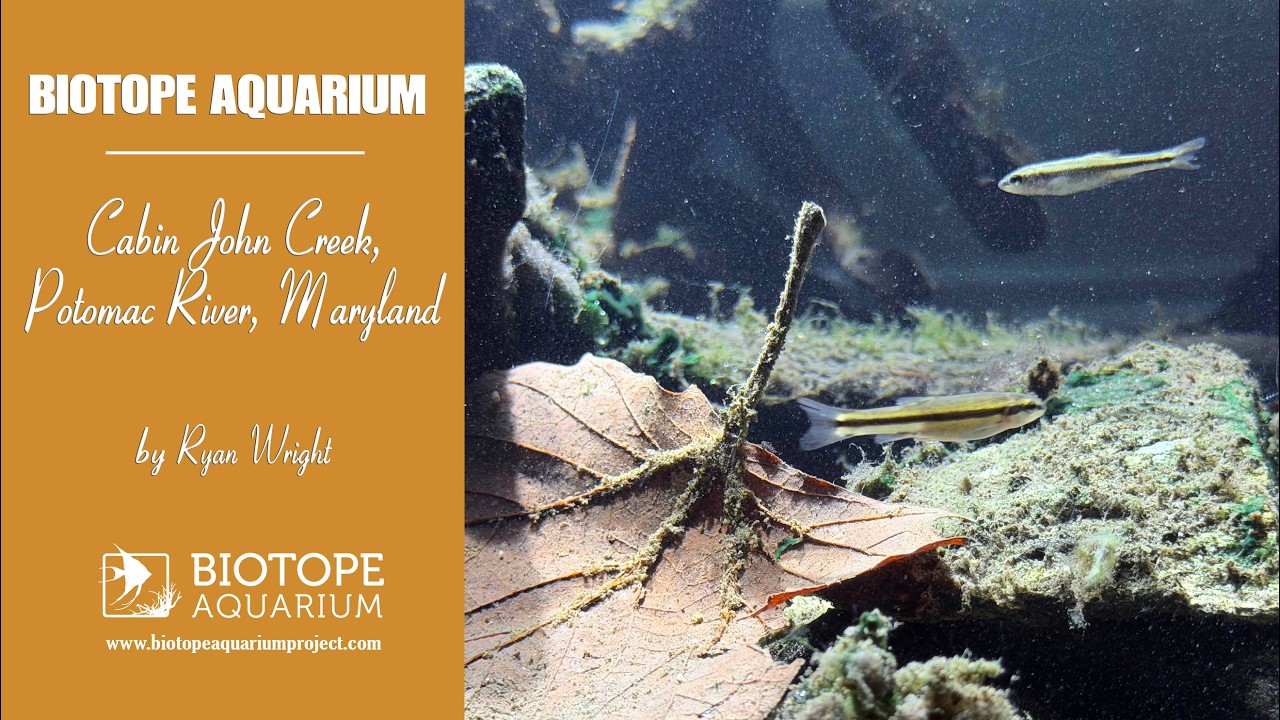
This creek is relatively shallow, with a combination of slow, meandering sections reaching up to a meter in depth and shallow, fast-moving currents only a few inches deep. Aquatic vegetation is limited, with most primary production occurring through algae, cyanobacteria, and non-photosynthetic bacterial mats.
In deeper, slower sections, sunfish and other larger fish can be observed occupying the open water column above beds of decomposing leaves and organic matter. Smaller shiners move among submerged roots near the muddy, elevated stream banks, while larger catfish occasionally rest among accumulations of dead leaves and woody debris.
Smaller organisms avoid larger predators by inhabiting the rocky, shallow riffles and rapids. During a collecting trip, after approximately one hour of snorkeling through a straight, shallow section between rapids, I observed a colony of around eight tessellated darters in approximately 40 cm of water, only a few feet from the bank. The fish occupied a small pocket surrounded by stones on three sides and a submerged flat stone on the fourth side, representing a typical microhabitat used by small benthic fishes.
Shiners and dace frequently approached and interacted with my equipment, while turning over rocks revealed crayfish, worms, and other invertebrates living among the pebbles and fine sediment of the stream bed. During mid-spring, breeding aggregations of chubs, shiners, and dace display their full colours, creating a remarkable natural spectacle. Exploring the shallow rapids and observing darters displaying courtship behaviour among the rocks further highlights the ecological richness of these habitats.
Fishes:
- Lampetra aepyptera (Petromyzontidae)
- Lampetra appendix (Petromyzontidae)
- Petromyzon marinus (Petromyzontidae)
- Anguilla rostrata (Anguillidae)
- Campostoma anomalum (Leuciscidae)
- Clinostomus funduloides (Leuciscidae)
- Carassius auratus (Cyprinidae)
- Cyprinella analostana (Leuciscidae)
- Cyprinella spiloptera (Leuciscidae)
- Cyprinus carpio (Cyprinidae)
- Ericymba buccata (Leuciscidae)
- Exoglossum maxillingua (Leuciscidae)
- Luxilus cornutus (Leuciscidae)
- Margariscus margarita (Leuciscidae)
- Nocomis micropogon (Leuciscidae)
- Notemigonus crysoleucas (Leuciscidae)
- Notropis amoenus (Leuciscidae)
- Notropis hudsonius (Leuciscidae)
- Notropis procne (Leuciscidae)
- Notropis rubellus (Leuciscidae)
- Pimephales notatus (Leuciscidae)
- Rhinichthys atratulus (Leuciscidae)
- Rhinichthys cataractae (Leuciscidae)
- Semotilus atromaculatus (Leuciscidae)
- Semotilus corporalis (Leuciscidae)
- Catostomus commersonii (Catostomidae)
- Hypentelium nigricans (Catostomidae)
- Moxostoma erythrurum (Catostomidae)
- Ameiurus natalis (Ictaluridae)
- Ictalurus punctatus (Ictaluridae)
- Percopsis omiscomaycus (Percopsidae)
- Gambusia holbrooki (Poeciliidae)
- Cottus caeruleomentum (Cottidae)
- Cottus girardi (Cottidae)
- Ambloplites rupestris (Centrarchidae)
- Lepomis auritus (Centrarchidae)
- Lepomis cyanellus (Centrarchidae)
- Lepomis gibbosus (Centrarchidae)
- Lepomis macrochirus (Centrarchidae)
- Lepomis megalotis (Centrarchidae)
- Micropterus dolomieu (Centrarchidae)
- Micropterus salmoides (Centrarchidae)
- Pomoxis nigromaculatus (Centrarchidae)
- Etheostoma blennioides (Percidae)
- Etheostoma flabellare (Percidae)
- Etheostoma olmstedi (Percidae)
Amphibian
- Eurycea bislineata (Plethodontidae)
Crustaceans
- Cambarus bartonii bartonii (Cambaridae)
- Crangonyx sp. (Crangonyctidae)
- Corydalus cornutus (Corydalidae)
- Aquarius remigis (Gerridae)
- Zygoptera
Molluscs
- Ferrissia rivularis (Planorbidae)
- Physella acuta (Physidae)
Aquatic vegetation
- Alisma subcordatum (Alismataceae)
- Callitriche stagnalis (Plantaginaceae)
- Potamogeton crispus (Potamogetonaceae)
- Threats to ecology
Runoff from impervious surfaces is currently the greatest threat to this ecosystem. Local government agencies and organisations such as Friends of Cabin John Creek conduct regular monitoring of water quality and biological conditions, with several stations performing monthly measurements of dissolved oxygen, pH, chloride, phosphate, nitrate, sedimentation, and temperature.
Despite these monitoring efforts, approximately 30% of the surrounding catchment area consists of impervious surfaces that limit natural filtration and allow pollutants, including road salt and urban contaminants, to enter the creek.
Riparian zone
- Trees near the aquatic habitat
-
Many -
Comment by the expert
Lawrence Kent:
Fritz Rohde: Excellent summary.
John T. Baxter: You clearly have a personal connection to this biotope. It is nice to see that reflected in the presentation. Very detailed presentation of conditions in Cabin John Creek. The effort to simulate these conditions in the aquarium biotope is evident.