bin
Danau Sentarum National Park, West Kalimantan, Indonesia
Indonesia, Borneo, West Kalimantan, Kapuas Hulu Regency
Lake Sentarum is a seasonal floodplain lake system and one of the most biologically diverse lake regions in the world. Located in the upper Kapuas River tectonic basin, about 700km upstream from the delta, the basin forms a vast floodplain composed of around 20 seasonal lakes, freshwater swamp forests, and peat swamp forests.
During the rainy season (October-May), the Kapuas River rises and backs up into the lake system, causing the lakes and marshes of Sentarum to expand considerably. In the dry season (June-September), the river level drops, and the water in Lake Sentarum recedes, exposing shallow areas and leaving behind smaller, often isolated lakes.
In summary, Lake Sentarum functions as a natural reservoir, helping to regulate the flow and flooding of the Kapuas River. At the same time, the Kapuas River serves as the lake’s primary water source. This dynamic system creates an ideal habitat for fish species that thrive in soft, acidic water, such as gouramis, rasboras, barbs, and loaches.
- Submitted by
- Duc Nguyen
- Approved by
- Heiko Blessin, Heok Hee Ng & Greg Martin
- GPS
- 0.6902226, 112.1531906
- Geographical region
- Southeastern Asia
- Drainage Basin
- South China Sea
- River catchment
- Kapuas
- Water body type
- Wetland
- Water body name
- Swamp
- Water body part
- Flood plain
- Water body course
- Middle course
- Water body: tributary of
- River
- Tributary name
- Kapuas river
Videos above and below water
Warning: Undefined variable $fish_parent in /home/biotopea/public_html/wp-content/themes/bap/content-bin.php on line 55
Water Chemistry
Water information
- Water type
- fresh-water
- Water color
- Black water
- Water transparency
- Medium
- Concentration of sediments
- Medium
- Water temperature
- 27-30 °C
- Water flow/curent
- Slow
Chemical parameters
- pH
- 6.0
- Conductivity
- 16
- GH
- 37 mg/l
- dGH
- KH
- 18 mg/l
- dKH
- Dissolved Oxygen
- 65 %
Substrate in nature
- Sand
- Grey
- Pebble/Gravel
- Mixed
- Stone
- Grey
- Stone form
- Irregular
- Silt/Mud
- Brown
- Leaves
- Many
- Driftwood
- Many
- Submerged terrestrial vegetation
- Yes
Aquatic Biotope
- Date of collecting
- 29/05/2025
- Collecting area
- Flood plain/Várzea
- Water depth
- 0,5m
- Air temperature
- 29 °C
- Sunlight
- Partial shade
Environment
- Environment
- Affected by human activity
- Affected by human activity
- Pollution
- Pollution
- Advanced
- Surrounding area
Lake Sentarum National Park (Taman Nasional Danau Sentarum) is a biodiversity treasure nestled in the heart of Borneo, Indonesia. Covering approximately 512 square miles (1,329 square kilometers), this extraordinary park is located within the Kapuas Hulu Regency of West Kalimantan. Renowned for its unique seasonal lake system, Lake Sentarum plays a vital role in the Kapuas River Basin—part of one of the longest river systems in the world.
The park features a dynamic and complex landscape, where the ebb and flow of water create a rich mosaic of ecosystems. Its terrain is dominated by a network of interconnected lakes, rivers, and peat swamp forests. During the rainy season, the lakes overflow, submerging the surrounding lowlands and transforming the area into an expansive aquatic world. In the dry season, the waters recede, revealing vast floodplains, grasslands, and isolated pools.
Vegetation across the park is equally diverse, encompassing peat swamp forests, freshwater swamp forests, and lowland dipterocarp forests. Towering trees such as Dyera costulata (jelutong) and Eusideroxylon zwageri (ironwood) provide essential habitat for a wide array of wildlife.
Lake Sentarum National Park is home to an astonishing variety of species. It serves as a sanctuary for more than 300 bird species, including the rare Storm’s stork and the iconic hornbills of Borneo. Mammals such as the proboscis monkey, agile gibbon, and the endangered Bornean orangutan can be spotted moving through the forest canopy.
- Underwater landscape
The waterways are teeming with life, harboring over 240 species of fish, including the rare and culturally significant Asian arowana (Scleropages formosus). Cryptocoryne and Eleocharis (hairgrass) grow abundantly among the rock crevices near the shore, where they are interwoven with mats of algae, moss, and fine organic detritus from decomposing fallen leaves. Dry branches are scattered across the rocky substrate and lakebed, creating an eerie, almost mystical atmosphere.
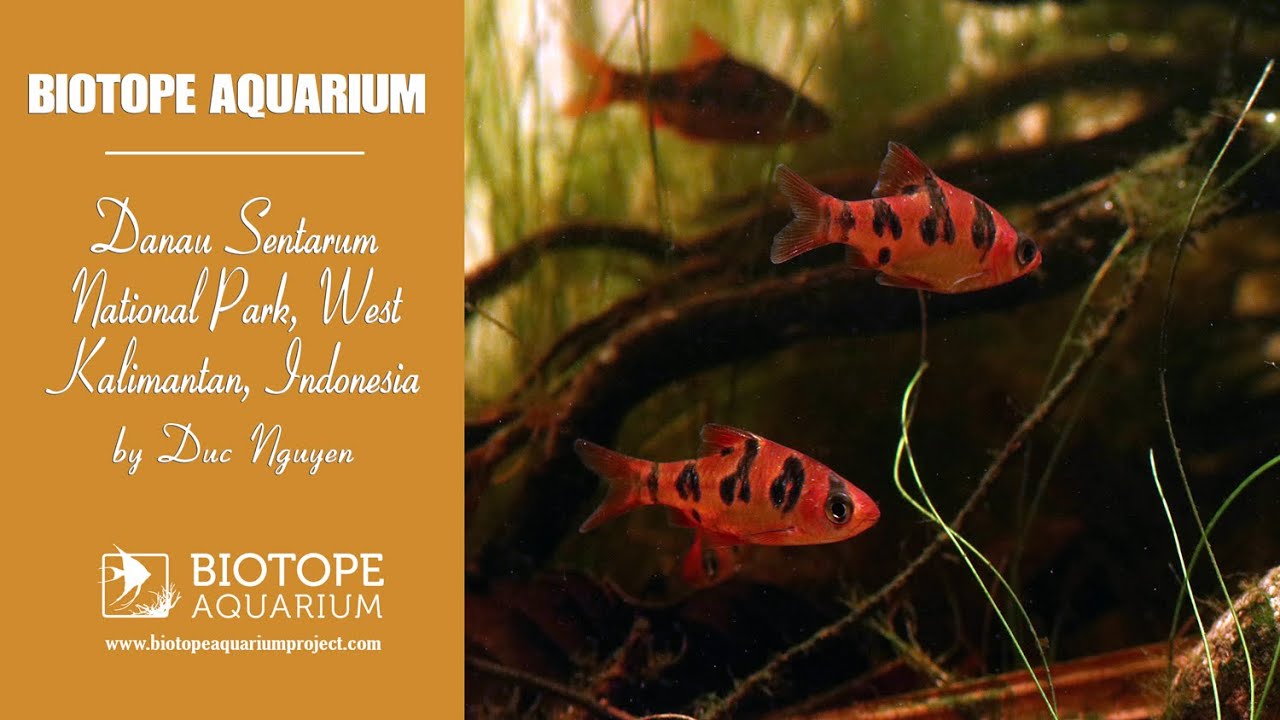
The water is tinted a pale amber, tea-like hue due to the presence of dissolved tannins. Schools of barbs (Desmopuntius rhomboocellatus), gouramis (Sphaerichthys osphromenoides), rasboras, and other small fish are among the most commonly observed aquatic fauna in this habitat.
Fish list:
- Sphaerichthys osphromenoides (Osphronemidae)
- Desmopuntius rhomboocellatus (Cyprinidae)
- Hemirhamphodon kuekenthali (Zenarchopteridae)
- Pangio shelfordii (Cobitidae)
- Parosphromenus bintan (Osphronemidae)
- Osphromenus deissneri (Osphronemidae)
- Desmopuntius pentazona (Cyprinidae)
- Sundadanio axelrodi (Sundadanionidae)
- Pangio kuhlii (Cobitidae)
Crustaceans:
- Anentome helena (Nassariidae)
Aquatic plants:
- Eleocharis sp. (Cyperaceae)
- Cryptocoryne cordata var. cordata ‘blassii’ (Araceae)
Wetland plants:
- Bucephalandra sp. (Dryopteridaceae)
- Bolbitis heteroclita (Araceae)
Terrestrial vegetation:
- Nepenthes ampullaria (Nepenthaceae)
- Threats to ecology
Conservation efforts at Lake Sentarum National Park face significant challenges, including illegal logging, land conversion, and the impacts of climate change.
Nevertheless, collaborative initiatives involving the Indonesian government, conservation organizations, and local communities have led to notable successes, such as habitat restoration projects and wildlife protection programs.
Ecotourism is playing an increasingly important role in sustaining these efforts, helping to strike a balance between environmental preservation and local livelihoods.
Riparian zone
- Trees near the aquatic habitat
-
Few -