bin
Lake of the Societies, Kolkata, India
India, West Bengal, Kolkata Municipal Corporation
The Lake of the Societies is a moderate sized lake situated at the borders of Kolkata, India. It is still a risky place to work on because of the presence of Russell’s Viper and Monocled Cobra.
This part of the slowly developing infrastructures were once part of agricultural lands, marshlands, wetlands and fallow lands. Slowly with the progress of time this area started to develop yet the lake provides the necessary elements to maintain a healthy habitat for both terrestrial and aquatic living creatures.
Aquatic sedges cover the surroundings of the lake making a suitable habitable place for lizards, reptiles, amphibians, birds and snakes. Even local human benefits from fishing during the monsoon when the flooded water of the lake cover the surroundings.
- Submitted by
- Debanjan Banerjee
- Approved by
- Hans-Georg Evers & Friedrich Bitter
- GPS
- 22.4533138, 88.3024902
- Geographical region
- Southern Asia
- Drainage Basin
- Southwest
- River catchment
- Hooghly River
- Water body type
- Lake
- Water body name
- Lake of the Societies
- Water body part
- Open water
- Water body course
- Source
- Water body: tributary of
- Tributary name
Videos above and below water
Warning: Undefined variable $fish_parent in /home/biotopea/public_html/wp-content/themes/bap/content-bin.php on line 55
Water Chemistry
Water information
- Water type
- fresh-water
- Water color
- Clear water
- Water transparency
- Low
- Concentration of sediments
- High
- Water temperature
- 30 °C
- Water flow/curent
- None
Chemical parameters
- pH
- 8.0
- Conductivity
- 131
- GH
- dGH
- KH
- 7.0 mg/l
- dKH
- Dissolved Oxygen
- 7 %
Substrate in nature
- Sand
- None
- Pebble/Gravel
- None
- Stone
- None
- Stone form
- Silt/Mud
- Beige
- Leaves
- Few
- Driftwood
- Few
- Submerged terrestrial vegetation
- Yes
Aquatic Biotope
- Date of collecting
- 28/2/2025
- Collecting area
- Edge of reservoir
- Water depth
- 2,0m
- Air temperature
- 32 °C
- Sunlight
- Full sun
Environment
- Environment
- Human settlements
- Human settlements
- Dispersed
- Surrounding area
The lake of the societies is a water body situated in the city outskirts of Kolkata city. Its based on a part of the town which is about to develop in the near future. Already people unaware of the importance of freshwater in this planet has slowly started littering.
The local god (idol) immersions also has a impact on the chemical parameters of the water. The depth on the shorelines of the waterbody is gradually declining because of that. As a enclosed water body type it is mostly being healed by the water hyacinths largely. This invasive water hyacinths clears the excess water nutrients. Yet hope remains as the few house owners around the block are very well aware of the protection of the waterbody and acts on it.
This water hyacinths gives refuge to several water birds, reptiles, amphibians, insects. The annual rainfall in this region is huge and that time the atmosphere mostly becomes humid and most fishes and birds breed but in the winter which is from November end to February beginning (below 15°C) it becomes a pleasant place to be with less humidity. In the summer which is from March to June, the temperature rises to 35-45°C.
- Underwater landscape
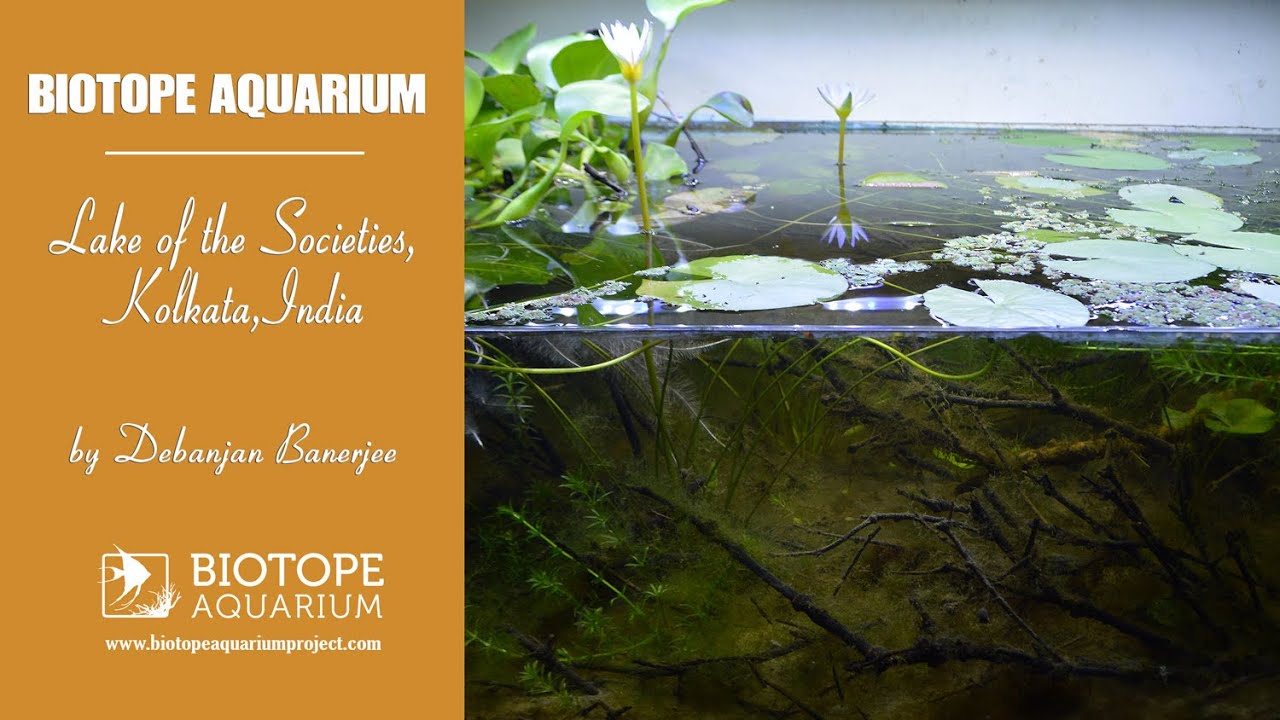
The underwater landscape in this area are mostly muddy. The shorelines of the waterbody is covered with Hydrilla as it cannot grow without depleting sunlight. Also there are few Nymphaea nouchali around the banks. The rest of the waterbody coastline is covered with water hyacinths making it impenetrable to visualize. Few branches and twigs and leaf litters from a tree are to be seen. Azolla/Mosquito fern can be seen scattered over the Hydrilla plants. As the water body is used for bathing, fishing and washing of clothes, due to that at day time visibility of the water body around the shore lines are very poor. At night the mud settles down and gives a moderate sight.
Fish list:
- Brachygobius nunus (Oxudercidae)
- Aplocheilus panchax (Aplocheilidae)
- Pethia aurea (Cyprinidae)
- Channa striata (Cyprinidae)
- Trichogaster fasciata (Osphronemidae)
Amphibian list:
- Duttaphrynus melanostictus (Bufonidae)
Mollusc list:
- Planorbarius corneus (Planorbidae)
Aquatic plant list:
- Nymphaea nouchali (Nymphaeaceae)
- Hydrilla verticillata (Hydrocharitaceae)
Wetland plant list:
- Cyperus rotundus (Cyperaceae)
- Threats to ecology
Constant global warming has a huge impact on the waterbodies of India which relies mostly on rainwater. The rising temperature of the water column has a huge impact on the overall growth and sustenance of all flora and fauna.
Riparian zone
- Trees near the aquatic habitat
-
Few -
Comment by the expert
Hans-Georg Evers: Excellent! Evaluated all components
Friedrich Bitter: The only thing is that the video could have been shorter and included fewer fixed shots.