bin
Rocky canals, Palude del Capitano, Puglia, Italy
Italy, Apulia, Nardò municipality, Province o Lecce
The “Palude del Capitano” is a small coastal cenote on the Ionian slope of Apulian Salento Peninsula in Italy. This coastal pool is of hyperkarstic origin and is characterised by inconstant hypothermal brackish water inflow. Its formation is due to the collapse of the roof that once covered a large underground cavity, leaving uncovered, in sunlight, a hitherto completely dark underground environment.
Gradually, this cenote illuminated by the sun was also colonised by photophilic species such as algae and aquatic plants. The chemical nature of this water is the results of freshwater mixed to the saltwater coming from the sea. The collapse of the vault of the ancient cavity also gave origin in some areas of the pool, to laminar walls (which was also replicated in the BAM), the result of the vertical collapse of entire portions of limestone.
The sea – at about 800m distance – is connected with the pool by submerged natural tunnels. The pool reaches a maximum depth of 3m.
- Submitted by
- Alessandro Crudo
- Approved by
- Francesco Denitto & Aleksey Malyshev
- GPS
- 40.2041855, 17.9258003
- Geographical region
- Southern Europe
- Drainage Basin
- Ionian coast of Puglia Region
- River catchment
- Water body type
- Pool
- Water body name
- Palude del Capitano
- Water body part
- Pool
- Water body course
- Water body: tributary of
- Channel
- Tributary name
Videos above and below water
Warning: Undefined variable $fish_parent in /home/biotopea/public_html/wp-content/themes/bap/content-bin.php on line 55
Water Chemistry
Water information
- Water type
- brackish-water
- Water color
- Clear water
- Water transparency
- High
- Concentration of sediments
- Medium
- Water temperature
- 18-23 °C
- Water flow/curent
- None
Chemical parameters
- pH
- 7.3
- Conductivity
- 12000
- GH
- 590 mg/l
- dGH
- KH
- 360 mg/l
- dKH
- Dissolved Oxygen
Substrate in nature
- Sand
- White
- Pebble/Gravel
- White
- Stone
- White
- Stone form
- Flat
- Silt/Mud
- Brown
- Leaves
- Few
- Driftwood
- Few
- Submerged terrestrial vegetation
- Yes
Aquatic Biotope
- Date of collecting
- 20/08/2024
- Collecting area
- Edge of reservoir
- Water depth
- over 2,0m
- Air temperature
- 28 °C
- Sunlight
- Full sun
Environment
- Environment
- Affected by human activity
- Affected by human activity
- Deforestation
- Deforestation
- Initial
- Surrounding area
The surrounding area, both emerged and semi-submerged, is mainly dominated by rocks, large expanses of Juncus, Samolus and Salicornia with splendid seasonal shades of green and red.
Seasonal rains, tides and irregular hypothermal springs periodically supply the external ecosystem with brackish water that, in periods of rain, floods the surrounding area, making it a muddy environment.
The main brackish basin is about two meters deep and is a collapsed sinkhole, completely exposed to the sun. External walls and karst channels of the lake, depending on the season, are surrounded by a few centimeters of water mixed with semi-submerged vegetation.
- Underwater landscape
The main basin and the canals were formed geologically by the natural limestone erosion that caused the collapse of the upper wall of what was an ancient submerged cave, provide an ideal environment for the life of some important euryhaline species i.e. Liza ramada, Anguilla anguilla, Atherina boyeri and Aphanius almiriensis.
Water is clear and the submerged environment is mainly made up of limestone rocks with signs of erosion of the brackish water and and not particularly affected by the development of algae.
Crustaceans and molluscs live on the rocky walls and continuously eat any algae that may form from strong exposure to the sun.
Water that in the marshy area outside the main lake does not exceed 10-15cm in height allows small euryhaline fish to hide from predators.
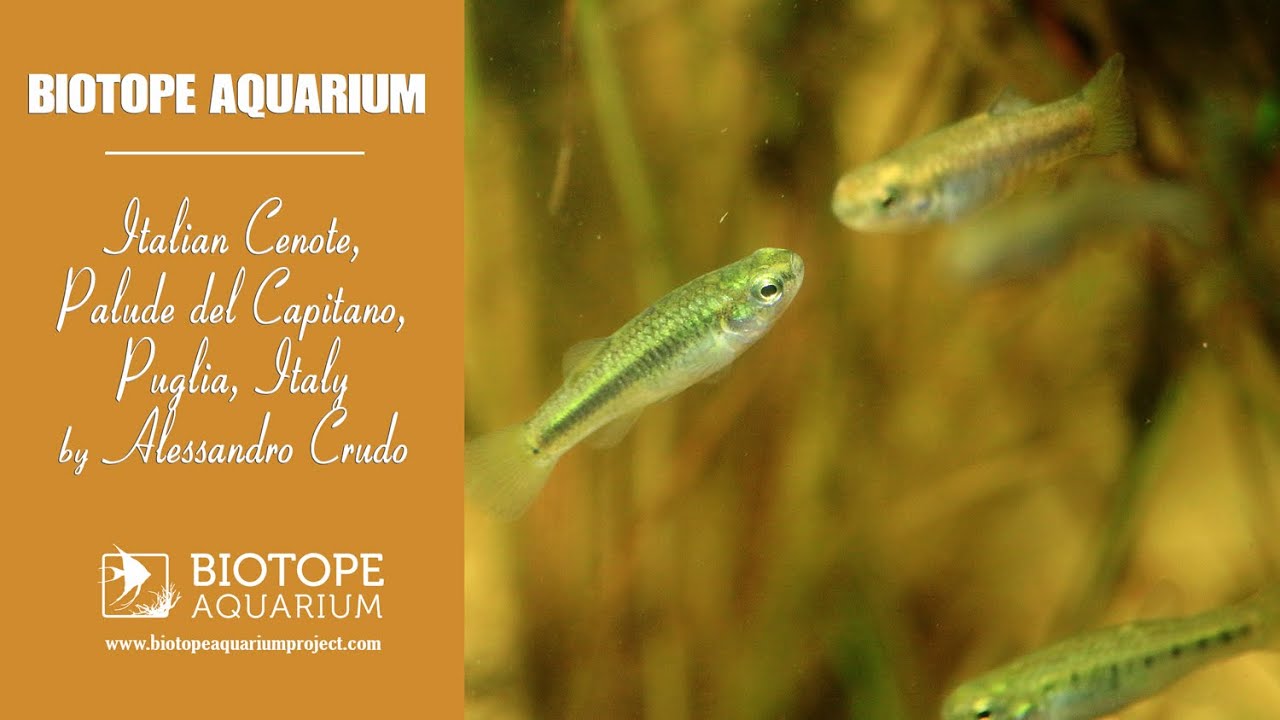
The cyprinodontid Aphanius almiriensis lives mainly in areas affected by the presence of fresh water, in channels adjacent to the pool and in shallow areas where the plants Ruppia maritima and Stuckenia pectinata (commonly known as Potamogeton pectinatus) thrive thanks to the presence of sediment deposited on the bottom and between the cracks of large rocks.
The water current in the basin is almost absent. However, freshwater flows into the pool from the emerged and submerged channels are intense at times, due to coastal sea tides and/or heavy seasonal rainfall.
Layers with different salinity and temperature make the environment particularly stable and cool even in periods of strong heat. The emerged channels are difficult to explore due to the presence of dense aquatic and terrestrial vegetation.
Fish list:
- Aphanius almiriensis (Aphaniidae)
- Atherina boyeri (Atherinidae)
- Liza ramada (Mugilidae)
Crustacean list:
- Gammarus aequicauda (Gammaridae)
- Palaemon adspersus (Palaemonidae)
Molusc list:
- Theodoxus fluviatilis (Neritidae)
- Cordylophora caspia (Cordylophoridae)
- Threats to ecology
The “Palude del Capitano” (Captain’s Swamp) is currently located in the strip of land facing zone A, an integral reserve of the “Porto Cesareo Protected Marine Area”. It is also protected by Community legislation as a Site of Community Interest (pSIC IT9150013). It has recently been included in the Porto Selvaggio Regional Park.
Palude del Capitano is home to numerous endemic species, both terrestrial and aquatic, that suffer from anthropic pressure – mainly agriculture and pastoralism, as well as tourism – and need to be protected.
Killifish of the genus Aphanius are small fishes inhabiting fresh to hypersaline waters around the Mediterranean, the Red Sea, the Persian Gulf and the coasts of the Indian Ocean eastwards to India and southwards to Somalia.
From Italy, only one species was known, Aphanius fasciatus, which is widespread along the coasts, mostly inhabiting estuaries and coastal lagoons. Aphanius living in this natural pool were believed to belong to the species Aphanius fasciatus. More recently, after molecular analysis, it was discovered that this population belongs to the species Aphanius almiriensis, of Aegean distribution.
This Italian population is the only one known outside its distribution range. The presence of this unique species in Italy was an inspiration for me to set up a biotope aquarium where this and some of the other aquatic species that represent the biodiversity of this magnificent natural place can live together.
Riparian zone
- Trees near the aquatic habitat
-
None -
Bibliography
-
Grotte Marine d’Italia. Memorie dell’Istituto Italiano di Speleologia, 6 Serie II (1994) - La Palude del Capitano: un ambiente salmastro costiero della penisola salentina di interesse idrobiologico e speleologico
by Bianchi C.N., Boero F., Forti S., C. Morri
-
→ Thalassia Salentina, 29, 99–116 (2006) - Novità speleologiche, idrologiche e naturalistiche della Palude del Capitano (pSIC IT9150013), Costa Neretina (Lecce)
by Denitto, F., Moscatello, S., Palmisano, P., Poto, M., R. Onorato
-
→ First record of Aphanius almiriensis from Italy and notes on the distribution of Aphanius fasciatus (Teleostei: Aphaniidae)
by Valdesalici S., A. Brahimi, J. Freyhof
Comment by the expert
Francesco Denitto: The participant’s field study was greatly appreciated. The video and photographic support he provided, in addition to the information he supplied, greatly aid in understanding the aquatic biotope under consideration.
Aleksey Malyshev: I liked the description of the natural biotope. It was brief and extremely clear.