bin
Travagliola Farm, Onsola Creek, Tuscany, Italy
Italy, Tuscany, Province of Siena
This micro-habitat represents a typical rheophilic watercourse of the Val d’Orcia, a UNESCO World Heritage site. The area has a strong historical connection with the traditional mezzadria farming system and the ancient Via Francigena route. For centuries, local agricultural activities have relied on these waters for irrigation and the operation of mills.
The stream has a torrential hydrological regime, with strong winter flows and pronounced summer low-water periods. Riparian vegetation, including willows, poplars, and reed beds, creates alternating zones of shade and cooler pools, helping to reduce thermal stress during the warmest months.
The highly oxygenated waters support native species such as the Italian bleak (Alburnus arborella), an active open-water swimmer, and the freshwater goby (Padogobius nigricans), a protected Tyrrhenian endemic species that inhabits the stream bottom among limestone pebbles and is currently threatened by introduced species.
Among the submerged rocks, filamentous algae and rheophilic mosses such as Fontinalis provide essential shelter and feeding surfaces for aquatic invertebrates, contributing to the ecological complexity of this freshwater habitat.
- Submitted by
- Pawel Lukasz Kocik
- Approved by
- Markku Varjo, Francesco Denitto & Alexey Malyshev
- GPS
- 42.9993057, 11.6328058
- Geographical region
- Southern Europe
- Drainage Basin
- Ombrone River Basin
- River catchment
- Orcia River
- Water body type
- Stream
- Water body name
- Onsola
- Water body part
- Water body course
- Water body: tributary of
- River
- Tributary name
- Ombrone
Videos above and below water
Warning: Undefined variable $fish_parent in /home/biotopea/public_html/wp-content/themes/bap/content-bin.php on line 55
Water Chemistry
Water information
- Water type
- Freshwater
- Water color
- Clear water
- Water transparency
- High
- Concentration of sediments
- Medium
- Water temperature
- 20-26 °C
- Water flow/curent
- Strong
Chemical parameters
- pH
- 7.5
- Conductivity
- GH
- dGH
- 15 °dGH
- KH
- dKH
- 10 °dKH
- Dissolved Oxygen
- 80 %
Substrate in nature
- Sand
- Grey
- Pebble/Gravel
- Grey
- Stone
- Grey
- Stone form
- Irregular
- Silt/Mud
- Black
- Leaves
- Few
- Driftwood
- Few
- Submerged terrestrial vegetation
- Yes
Aquatic Biotope
- Date of collecting
- 25 May, 2026
- Collecting area
- River bank
- Water depth
- 0,2m
- Air temperature
- 26 °C
- Sunlight
- Partial shade
Environment
- Environment
- Human settlements
- Human settlements
- Dispersed
- Surrounding area
The surroundings of the Onsola Torrent, near Podere Travagliola in the heart of the Val d’Orcia UNESCO World Heritage Site, represent a unique balance between natural ecosystems and the traditional Tuscan rural landscape.
The watercourse flows through the rolling hills of the Crete Senesi, a landscape shaped by Pliocene marine sediments, including clays and limestone marls that emerge in characteristic badlands and biancane formations. The erosion of these sedimentary rocks contributes to the formation of the stream’s light-coloured pebbles and influences the hard, alkaline water chemistry.
Along the banks, a dense riparian forest develops, dominated by white willow (Salix alba) and black poplar (Populus nigra). Their submerged root systems stabilise the banks, while brambles, elder shrubs, and common reed (Phragmites australis) form a complex understory habitat.
This ecological corridor supports a rich diversity of wildlife. Roe deer, porcupines, and wild boars regularly use the stream as a source of water, while kingfishers and grey herons are frequently observed along the watercourse. Grass snakes and freshwater crabs (Potamon fluviatile) inhabit the humid margins and rocky substrate.
The surrounding agricultural landscape, including durum wheat fields, olive groves, and pastures, forms a mosaic with the riparian ecosystem. The ancient gallery forest acts as an important ecological buffer, filtering runoff and helping preserve the water quality of the Onsola Torrent.
- Underwater landscape
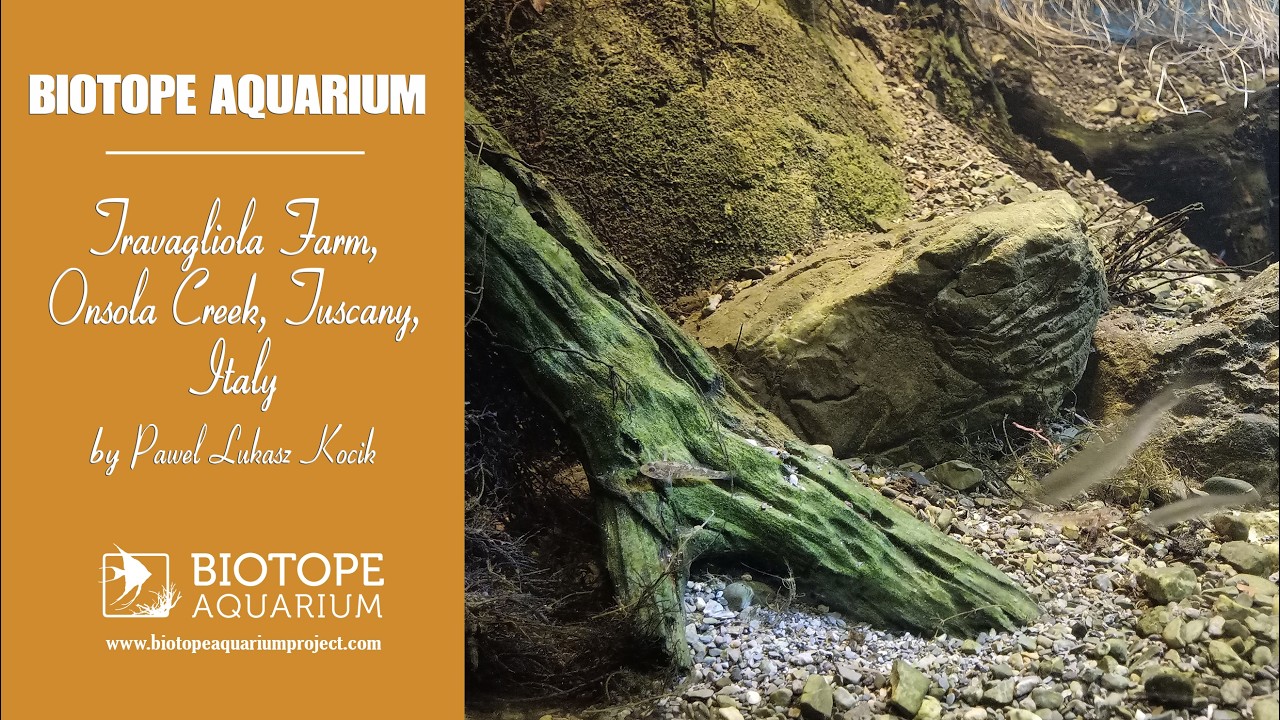
The underwater landscape of the Onsola Torrent, particularly in slack-water areas and calmer pools, represents a complex and highly structured freshwater microhabitat. It is characterised by strong contrasts between mineral substrates, light conditions, and biological components.
The streambed consists mainly of light-coloured limestone pebbles, ranging from white to grey, with smooth surfaces shaped by water movement. Fine silt and ochre-coloured sand accumulate in areas of reduced current, creating small depositional zones.
In the clear water, sunlight penetrates the shallow stream and produces dynamic patterns of light and shadow across the substrate. These areas alternate between illuminated sections and shaded zones created by riparian vegetation, contributing to the thermal stability and habitat complexity of the stream environment.
Fish:
- Alburnus arborella (Leuciscidae)
- Padogobius nigricans (Oxudercidae)
Crustacean:
- Potamon fluviatile (Potamidae)
Aquatic plants:
- Ceratophyllum demersum (Ceratophyllaceae)
- Potamogeton nodosus (Potamogetonaceae)
Aquatic moss:
- Fontinalis sp. (Fontinalaceae)
Wetland plants:
- Mentha aquatica (Lamiaceae)
- Phragmites australis (Poaceae)
Terrestrial vegetation:
- Salix alba (Salicaceae)
- Populus nigra (Salicaceae)
- Threats to ecology
The Onsola Torrent is a fragile freshwater ecosystem facing multiple environmental pressures. Climate change is increasing the frequency of prolonged drought periods, leading to the premature drying of summer pools and reducing dissolved oxygen levels, which can threaten aquatic organisms adapted to stable water conditions.
Agricultural activities in the Val d’Orcia may also affect the stream through water abstraction for irrigation and nutrient inputs, such as nitrates, from surface runoff. These changes can alter water quality and disrupt the ecological balance of the habitat.
Another significant threat is the spread of invasive alien species, particularly the red swamp crayfish (Procambarus clarkii). This species can damage aquatic vegetation, disturb riverbank structures, compete with native organisms, and act as a carrier of diseases that threaten native freshwater crayfish populations.
Riparian zone
- Trees near the aquatic habitat
-
Many -