bam Demanding level

#11222 Travagliola Farm, Onsola Creek, Tuscany, Italy

Sponsored by

Italy, Tuscany, Province of Siena

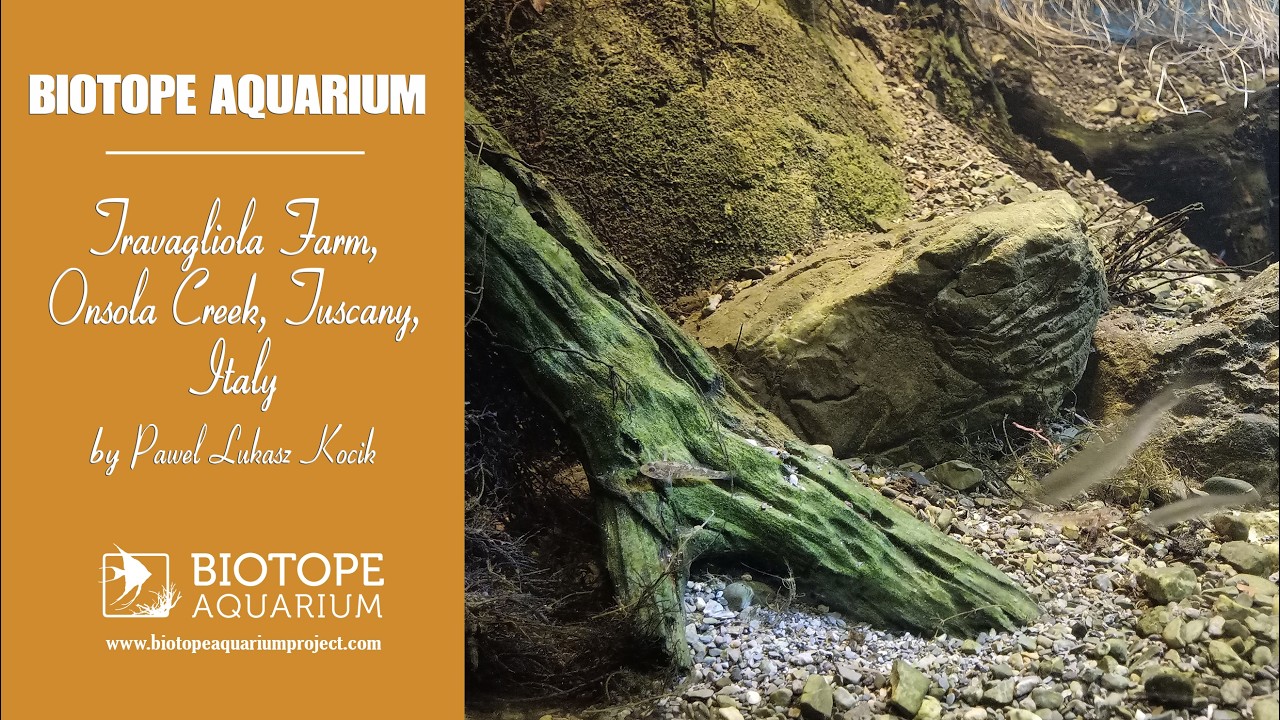
I present this biotope aquarium as a faithful recreation of a unique and fragile ecosystem: a summer pool of the Onsola Torrent, located in the Val d’Orcia, Tuscany, Italy.

The composition was designed according to precise ecological and aesthetic principles. The layout is based on a streambed of light-coloured limestone pebbles (white and grey) of different sizes, partially covered by ochre sand and fine silt, replicating the natural substrate observed in the habitat. Dark willow roots extend through the left side of the aquarium, creating structural complexity and natural shelter.

The main focus of the biotope is the interaction between vegetation and water movement. Native plants documented during field observations, including Potamogeton nodosus, Ceratophyllum demersum, and water mint, recreate the dense submerged vegetation characteristic of summer pools. Strong surface agitation generated by the DIY filter with two lateral outlets simulates the natural oxygenation of the torrent, supporting stable gas exchange and water quality.

Submitted by
Pawel Lukasz Kocik
GPS
42.9993057, 11.6328058
Geographical region
Southern Europe
Drainage Basin
Ombrone River Basin
River catchment
Orcia River
Water body type
Stream
Water body name
Onsola
Water body part
Water body course
Water body: tributary of
River
Tributary name
Ombrone

Videos above and below water


Warning: Undefined variable $fish_parent in /home/biotopea/public_html/wp-content/themes/bap/content-bam.php on line 85

Water Chemistry

Water information

Water type
Freshwater
Water color
Clear water
Water transparency
High
Concentration of sediments
Low
Water temperature
22-26 °C
Water flow/curent
Strong

Chemical parameters

pH
8.0
Conductivity
GH
dGH
15 °dGH
KH
dKH
8 °dKH
Dissolved Oxygen

Aquarium information

Aquarium description

Set-up date
20 January, 2026
Aquarium decoration

To transform a simple aquarium into an authentic representation of a wild section of the Onsola Stream, the design approach was based on abandoning the geometric principles of traditional aquascaping and instead recreating the “ordered chaos” characteristic of natural ecosystems.

The hardscape faithfully reproduces the geomorphology of the Onsola Torrent. The riverbed is composed of a realistic combination of limestone pebbles, gravel, and sand with different grain sizes, arranged according to natural hydrodynamic processes: larger stones structure the streambed, gravel accumulates in intermediate spaces, and fine sediments settle in lower-flow areas.

The two sides of the aquarium represent a cross-section of the watercourse. The left side recreates the erosional riparian bank, with a network of dark willow roots extending into the water and forming shaded zones where organic debris and fine sediments naturally accumulate. The right side represents the more open and illuminated section of the streambed, where slower currents allow sediment deposition. This area contains fewer woody structures and is dominated by smooth grey pebbles shaped by water movement.

The intentional asymmetry between the complex shaded bank and the open gravel bed reflects the natural habitat structure of the Onsola Torrent, where erosion, current dynamics, and sediment deposition continuously shape the aquatic landscape.

Aquarium equipment

Filtration: DIY 20 L filter with a 10,000 L/h pump and aquaponic filtration system.

Fish care

(Low-Tech Management)
Oxygenation and water movement: Strong surface agitation is maintained through the filter system. Oxygen-rich water is essential, especially when temperatures rise above 25°C, as dissolved oxygen levels tend to decrease. In addition, the current encourages active swimming behaviour, helping fish maintain good muscle tone.

Fish:

  • Padogobius nigricans (Oxudercidae) – 5
  • Alburnus arborella (Leuciscidae) – 25

Mollusc:

  • Physa fontinalis (Physidae) – 10
Plant care

Aquaponics: Root pruning is carried out when necessary to control plant growth and maintain system balance.

Aquatic plants:

  • Ceratophyllum demersum (Ceratophyllaceae) – 15
  • Potamogeton nodosus (Potamogetonaceae) – 15

Wetland plants:

  • Mentha aquatica (Lamiaceae) – 30
  • Phragmites australis (Poaceae) – 10
Water care

Easy.

Dimensions

Length
140 cm
Depth
60 cm
High
50 cm
Volume
420 L

Substrate in aquarium

Sand
Grey
Pebble/Gravel
Grey
Stone
Grey
Stone form
Irregular
Silt/Mud
None
Leaves
Few
Driftwood
Few
Submerged terrestrial vegetation
Yes