- Environment
- Affected by human activity
- Affected by human activity
- Pollution
- Pollution
- Little
- Surrounding area
Wugoushui Spring-fed Stream is located in Wanluan Township, Pingtung County, Taiwan, and belongs to the Jiaping River tributary system within the Donggang River basin. The spring water is supplied by underground aquifers originating from the Beidawu Mountain area, creating a unique spring-fed environment near an important hydrological confluence.
Unlike many lowland streams that experience reduced flow during the dry season, Wugoushui maintains continuous water discharge, stable flow conditions, and relatively clear water throughout the year. This hydrological stability provides a critical refuge for aquatic organisms, particularly during periods of drought and extreme weather.
Although air temperatures in Pingtung fluctuate considerably between winter and summer (approximately 14-34 °C), the spring water remains relatively stable in temperature throughout the year. This constant thermal environment supports a diverse freshwater community and contributes to the ecological resilience of the habitat.
The surrounding riparian landscape is characterised by rich vegetation, shallow gravel substrates, and gentle to moderate currents. These conditions provide suitable habitats for aquatic plants, fish, benthic organisms, and aquatic insects. The wetland margins and riparian vegetation offer feeding, shelter, and breeding areas for a wide range of organisms, including fishes, amphibians, reptiles, and birds.
The interaction between spring-fed waters, aquatic vegetation, wetland habitats, riparian plants, prey organisms, and predators forms a complex and highly diverse freshwater ecosystem. Wugoushui represents a rare and valuable spring-fed landscape in southern Taiwan, highlighting the ecological importance of conserving lowland freshwater habitats.
Fish:
- Barbodes semifasciolatus (Cyprinidae) – 50
- Candidia pingtungensis (Xenocyprididae) – 200
- Opsariichthys kaopingensis (Xenocyprididae) – 150
- Acrossocheilus paradoxus (Cyprinidae) – 100
- Spinibarbus hollandi (Cyprinidae) – 20
- Rhinogobius macromaculatus (Oxudercidae) – 200
- Rhinogobius similis (Oxudercidae) – 20
- Cobitis sinensis (Cobitidae) – 200
- Oreochromis sp. (Cichlidae) – 100
- Systomus rubripinnis (Cyprinidae) – 30
- Trichopodus trichopterus (Osphronemidae) – 3
- Channa striata (Channidae) – 6
- Dermogenys siamensis (Zenarchopteridae) – 200
- Poecilia sp. (Poeciliidae) – 500
Crustaceans:
- Macrobrachium nipponense (Palaemonidae) – 50
- Macrobrachium asperulum (Palaemonidae) – 50
- Neocaridina denticulata (Atyidae) – 2000
Wetland plant:
- Alocasia odora (Araceae) – 5
Aquatic plants:
- Ceratopteris thalictroides (Pteridaceae) – 30
- Vallisneria natans (Hydrocharitaceae) – 1000
- Limnophila pingtungensis (Plantaginaceae) – 1
- Myriophyllum aquaticum (Haloragaceae) – 5000
- Hydrocotyle leucocephala (Araliaceae) – 500
Terrestrial vegetation:
- Cyperus mindorensis (Cyperaceae) – 100
- Ludwigia octovalvis (Onagraceae) – 100
- Cyperus exaltatus (Cyperaceae) – 50
- Lindernia procumbens (Linderniaceae) – 100
- Persicaria barbata (Polygonaceae) – 30
- Urochloa mutica (Poaceae) – 5000
- Mimosa pigra (Fabaceae) – 20
- Underwater landscape
The underwater landscape of Wugoushui is primarily composed of clear spring-fed water, shallow gravel beds, natural stones, aquatic vegetation, and the root systems of riparian plants. Along the stream margins and waterline, a variety of semi-aquatic and aquatic plants occur, including Alocasia odora, Ceratopteris thalictroides, Vallisneria natans, and Pingtung Limnophila (Limnophila pingtungensis nom. nud.).
Among these species, Pingtung Limnophila represents a conservation-interest plant taxon that has not yet been formally described. During this field survey, only a single wild individual was recorded. In contrast, the native Vallisneria natans forms relatively stable submerged plant communities, increasing underwater coverage, attachment surfaces, and habitat complexity.
Aquatic plants, submerged leaves, and riparian root systems provide essential shelter, feeding areas, and breeding habitats for fish, shrimp, and aquatic insects. The vegetation structure supports fish species such as Barbodes semifasciolatus, Candidia pingtungensis, Opsariichthys kaopingensis, Acrossocheilus paradoxus, and Spinibarbus hollandi. Freshwater shrimps, including Macrobrachium nipponense, Macrobrachium asperulum, and Neocaridina denticulata, also utilise aquatic vegetation, stone crevices, and the substrate for shelter and foraging.
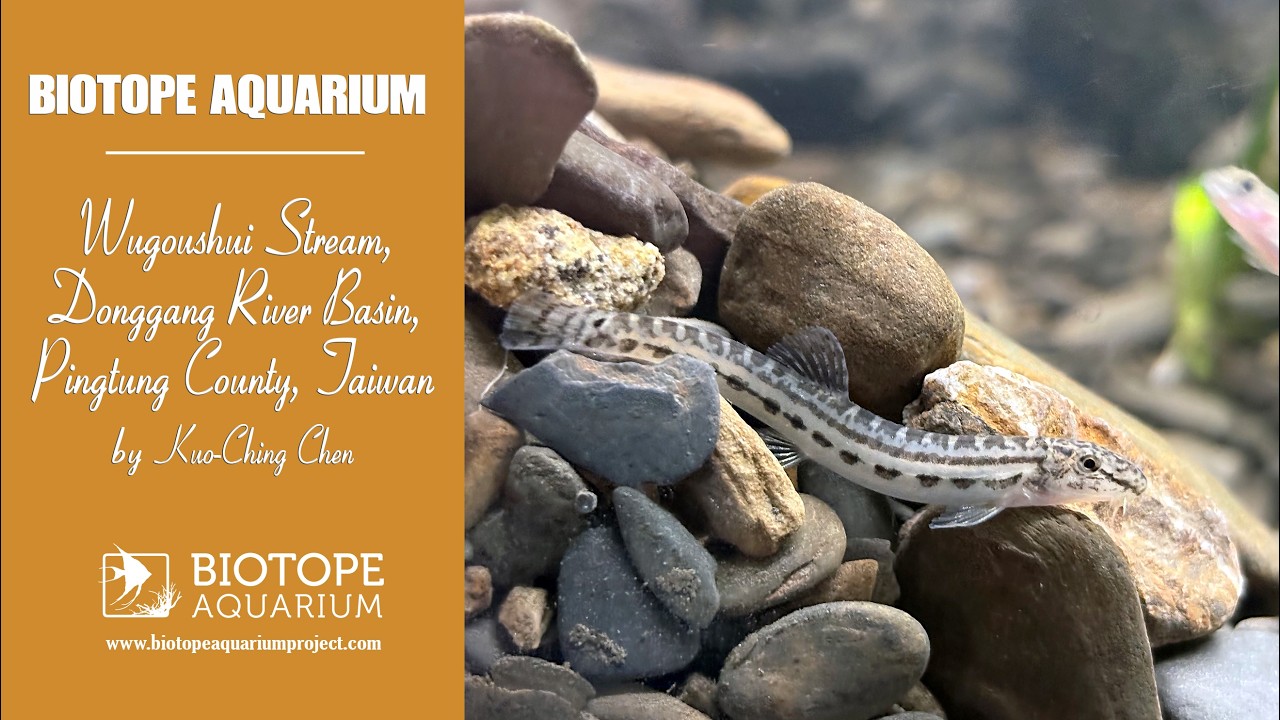
The streambed consists of fine river sand, mixed-sized gravel, and scattered natural stones, creating numerous microhabitats for feeding, refuge, and resting. These structures are particularly important for benthic species such as Rhinogobius macromaculatus, Rhinogobius similis, and Cobitis sinensis.
Therefore, the underwater landscape of Wugoushui is not only visually clear and natural but also ecologically functional, providing a complex and dynamic freshwater habitat that supports a diverse aquatic community.
- Threats to ecology
During the preparation of this biotope and field survey, I visited Wugoushui three times and directly observed how the stream habitat changed under the pressures of engineering work, seasonal rainfall, and invasive species. On the first visit, I found only one wild individual of Pingtung Limnophila (Limnophila pingtungensis nom. nud.), which made me realize that its condition in the original habitat was more fragile than expected.
On the second visit, dredging work was taking place, and parts of the stream bed and aquatic plant habitat were clearly disturbed. Although the stream was not fully converted into a concrete channel at that time, part of the native habitat was still preserved, creating the clear contrast of “half-dredged, half-preserved” shown in my photographs. However, because such dredging operations may be repeated every year, these remaining native habitats are still in a highly uncertain condition, leaving vulnerable aquatic plants such as Pingtung Limnophila at constant risk of disappearing from the wild.
On the third visit, the dredging work had been completed, but the stream bed was still loose and unstable. The spring-fed stream should have been clear, but the plum rain season brought heavy rainfall, washing large amounts of sediment into the water and greatly increasing turbidity. These three observations showed me that although Wugoushui is a stable and valuable spring-fed stream, it is highly vulnerable to the combined impacts of engineering disturbance, invasive species, and seasonal sediment runoff.
The invasion of alien species can be divided into large predatory invaders and small exotic competitors. As a small native fish occupying the mid-to-upper water column, the Chinese barb (Barbodes semifasciolatus) faces severe survival pressure. On one hand, it is directly threatened by large predatory alien fishes such as Channa striata, Systomus rubripinnis, and Oreochromis sp., which may prey upon it and reduce its available habitat. On the other hand, it must also compete for food and living space in the same water layer with highly adaptable small alien species, including Dermogenys siamensis and Trichopodus trichopterus.
Aquatic plants are mainly threatened by the aggressive spread of invasive species, especially Myriophyllum aquaticum and Hydrocotyle leucocephala. These fast-growing alien aquatic plants can form dense mats on the water surface and quickly occupy available space. As a result, they block sunlight and compress the growing space required by native aquatic plants. Under this competitive pressure, rare and narrowly distributed native plants such as Pingtung Limnophila (Limnophila pingtungensis nom. nud.) face the risk of being displaced from their wild habitat.
Therefore, this biotope aquarium was originally intended to recreate the natural landscape of Wugoushui. However, after these three field visits, I realized that the wild population of Pingtung Limnophila was far more fragile than expected. As a result, this work shifted from a simple representation of a natural biotope into a small demonstration base for the conservation and restoration of Pingtung Limnophila.